
Public works pilots a model that flags potholes from street-camera stills. Which AI type is the program manager primarily demonstrating?
Select an answer to reveal the explanation.
Short Explanation
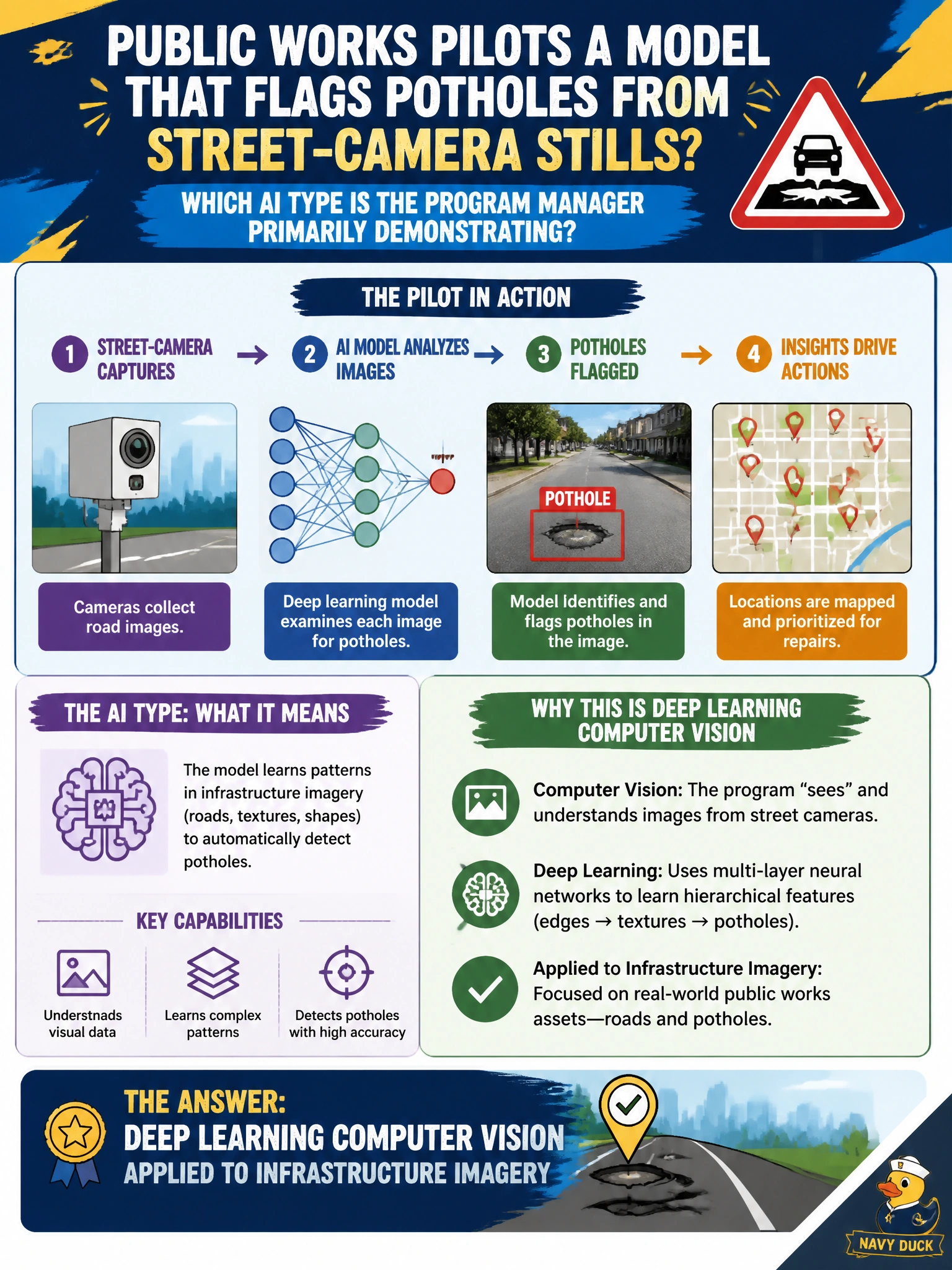
Cameras plus a model that spots cracked pavement is computer vision—deep learning looking at pictures the way a sharp-eyed inspector would. Budget spreadsheets and ZIP rules are different tools for different jobs.
Full Explanation
Detecting pavement distress from roadway imagery is deep learning computer vision applied to infrastructure imagery: models learn visual features of cracks, potholes, or surface failure from images, supporting pavement management prioritization for public works. That is a different tool class from budgets, ZIP rules, or tank alarms. Framing the project correctly sets expectations for labeled imagery, model evaluation, and field validation rides. Descriptive analytics of last year’s asphalt budget only explains spending history; it does not inspect pavement condition from cameras. Rule-based ZIP routing with no image input assigns work geographically without seeing surface distress. A threshold tank-level SCADA alarm is water-utility process monitoring unrelated to vision-based pavement assessment. Exam caveat: match modality—images imply computer vision, not BI or SCADA. Operational check: calibrate model findings against inspector ground truth, version datasets by season and lighting, avoid over-reliance on confidence alone for safety-critical road closures, and integrate detections into the work-order system so findings become maintained civic assets rather than orphaned model demos.