
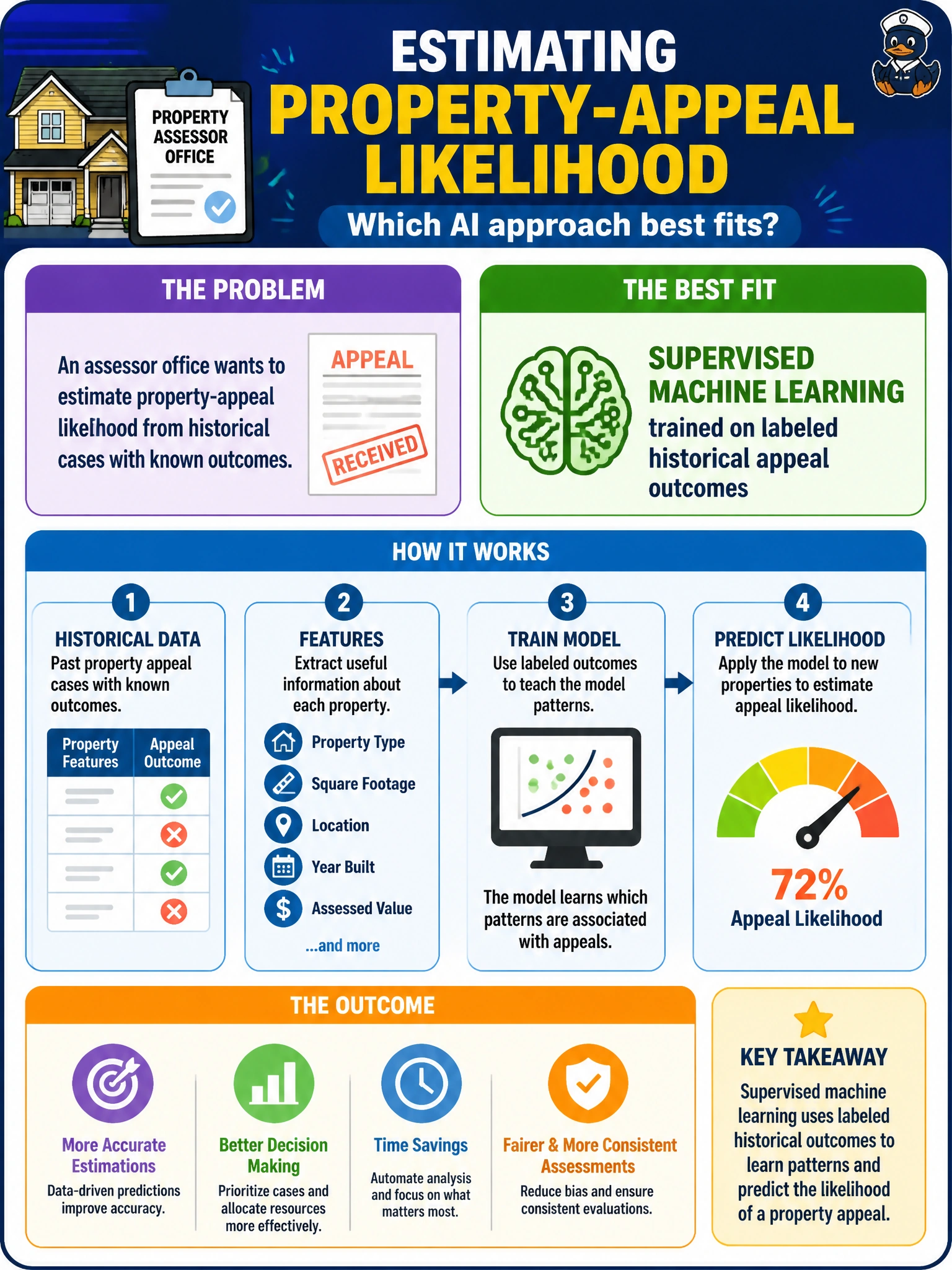
An assessor office wants to estimate property-appeal likelihood from historical cases with known outcomes. Which AI approach best fits?
Select an answer to reveal the explanation.
Short Explanation
When you have a stack of old appeals stamped won or lost, you can teach a model the patterns—that is supervised learning with labels as the teacher. Skipping the labels and hoping a storyteller guesses is the wrong class of AI.
Full Explanation
Predicting likelihood of success on housing-authority appeals from historical outcomes is a supervised machine-learning pattern: labeled past appeals (granted/denied or similar outcomes) teach the model decision-relevant patterns for triage or decision support. Labels are the teacher; without them the learning problem is different. Civic program managers should ensure labels are defined carefully, bias-checked across protected classes and neighborhoods, and that outputs support human adjudicators rather than silently deciding rights. A generative storyteller with no labeled appeal outcomes may draft narratives but does not learn calibrated success likelihood from adjudicated history. Rule-only routing that ignores historical win/loss labels forgoes empirical learning the stem asks for. Unsupervised topic modeling of brochure PDFs alone finds themes in documents; it neither uses appeal outcome labels nor produces supervised risk or success scores for case triage. Exam caveat: match learning paradigm to available supervision—labels point to supervised ML. Operational check: define outcome labels with legal/housing SMEs, separate train/serve data by time to avoid leakage, monitor disparate impact, and present scores as decision support with appeal officers retaining authority over final determinations.