
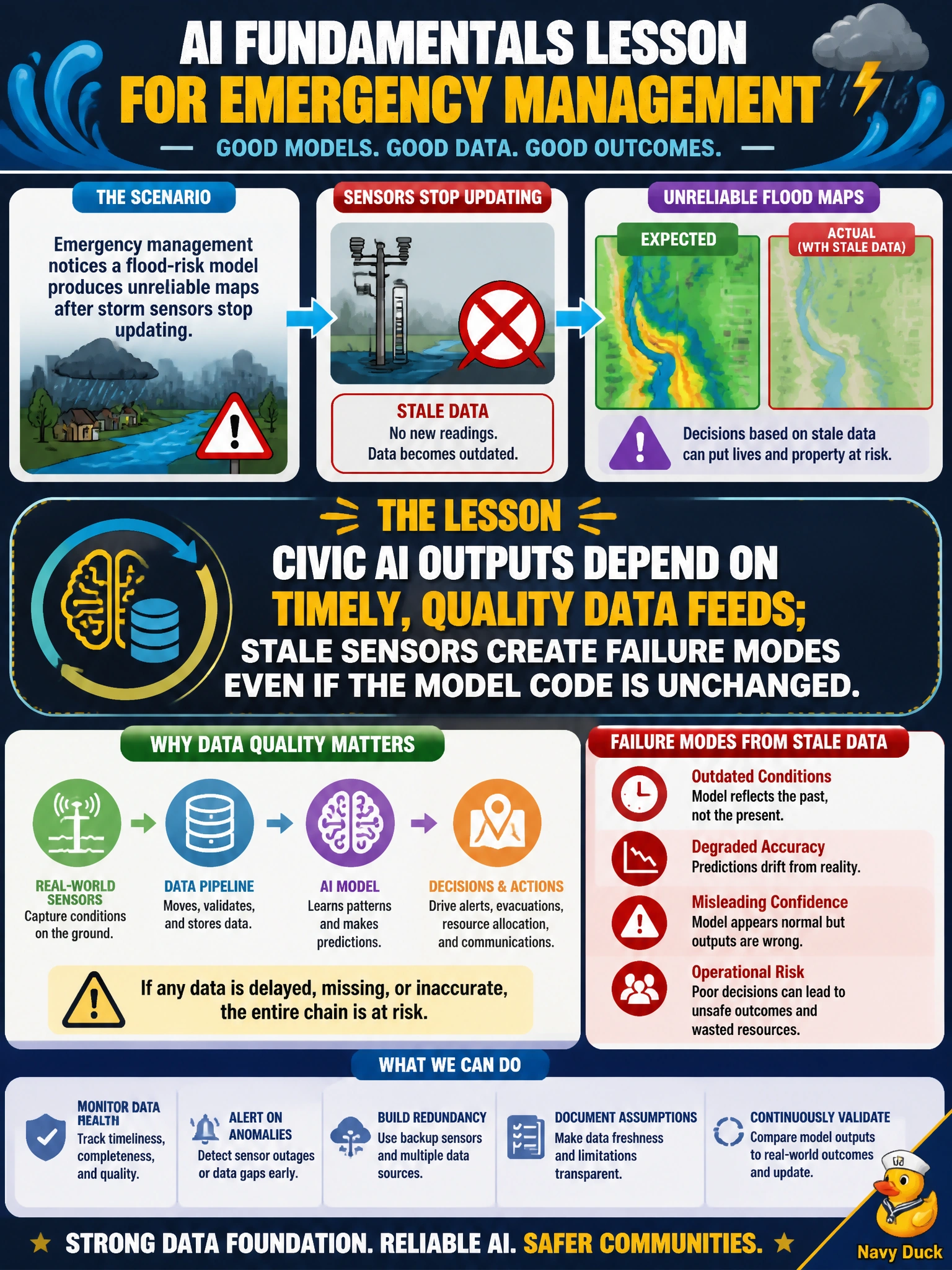
Emergency management notices a flood-risk model produces unreliable maps after storm sensors stop updating. What AI fundamentals lesson should the program manager highlight?
Select an answer to reveal the explanation.
Short Explanation
Even a sharp weather brain goes foggy if the rain gauges freeze. AI rides on fresh data the way a GPS rides on satellites—cut the feed and the pretty map turns into a guessing game. Keep sensors alive or expect bad guidance.
Full Explanation
Emergency management’s flood-risk model producing unreliable maps after storm sensors stop updating illustrates a core AI fundamental: civic AI outputs depend on timely, quality data feeds. Stale or missing inputs create failure modes even when model code and council-approved algorithms are unchanged. Program managers must treat data pipelines as part of the AI service, with monitoring and fallbacks, not as an afterthought behind the model artifact. Claiming accuracy is independent of input data once council approves the algorithm is false; approval does not immunize models against garbage-in or silent feed death. Saying sensor outages only affect dashboards, never predictive flood models, invents a false firewall—predictive products consume the same feeds. Asserting floods models fail only when staff manually recolor maps mistakes presentation edits for the primary failure mode of data starvation. Exam caveat: "model approved" does not mean "data forever healthy"; silent degradation is a classic trap. Operational check: alert on sensor heartbeat and latency SLAs, degrade maps to "data unavailable" messaging instead of confident wrong risk, assign DataOps owners for storm-sensor feeds during activations, and exercise failover drills so emergency managers do not trust stale flood polygons in a real event.