
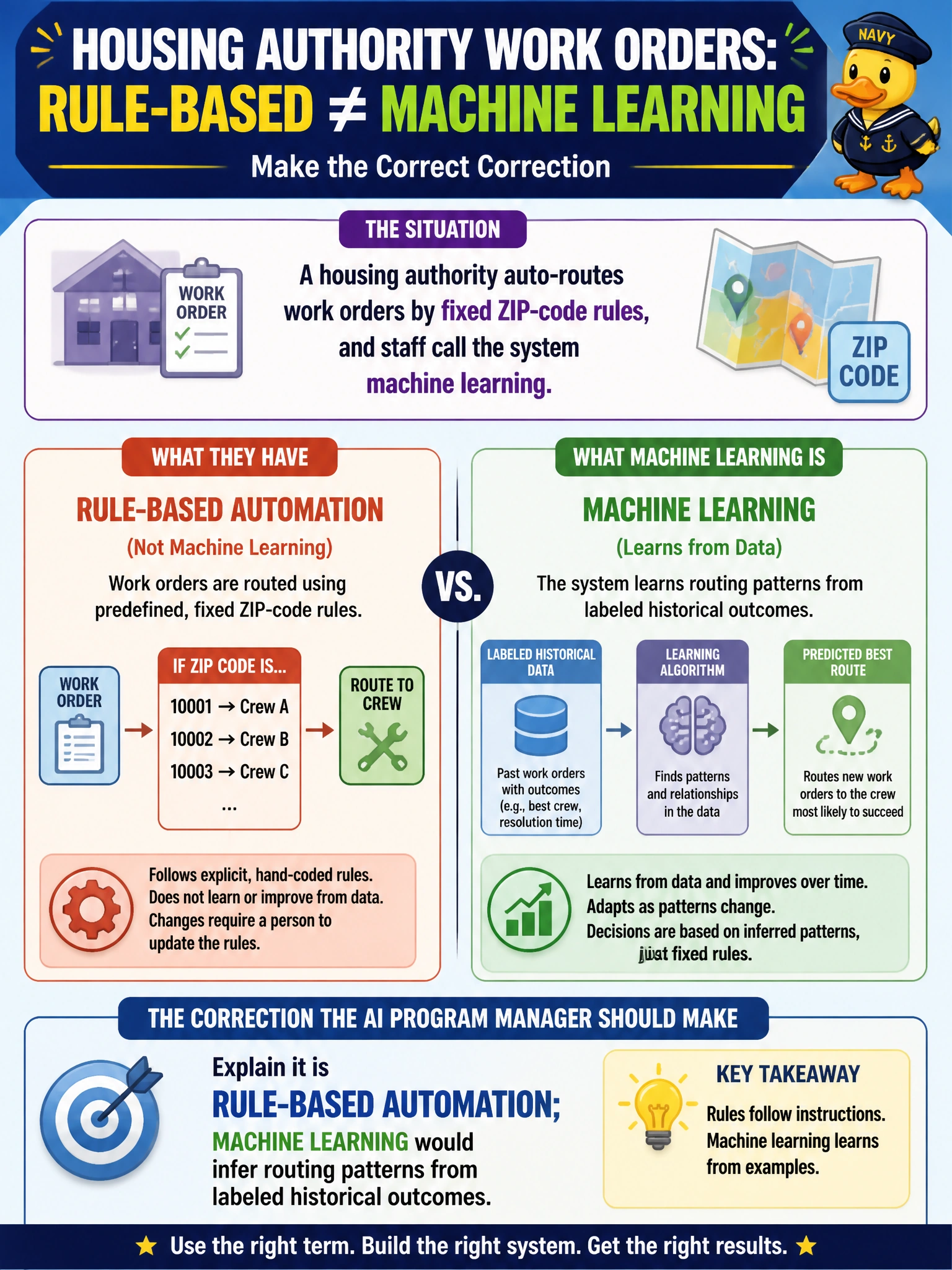
A housing authority auto-routes work orders by fixed ZIP-code rules, and staff call the system machine learning. What correction should the AI program manager make?
Select an answer to reveal the explanation.
Short Explanation
If the map says “this ZIP always goes to Team Blue,” that is a hardwired rule, not a model that got smarter from last year’s tickets. Machine learning would study past outcomes and adjust; this system just follows the ZIP cheat sheet.
Full Explanation
A housing authority that auto-routes work orders by fixed ZIP-code rules is running rule-based automation. Explicit, authored conditions map geography to teams. Machine learning would instead infer routing patterns from labeled historical outcomes (who resolved what successfully, delays, specialties) and could update as neighborhoods and staffing change. The AI program manager must correct the "machine learning" label so vendor RFPs, risk registers, and staff skills match the actual system. Confirming it is ML because ZIP codes are numeric features confuses feature-shaped data with learning; rules can use numbers without training. Calling it deep learning because routing spans departments confuses organizational complexity with neural depth. Treating it as generative AI because work-order text is copied into tickets confuses text transport with text generation. Exam caveat: authored rules ≠ learned decision boundaries; multi-department scope ≠ deep learning. Operational check: version-control the ZIP routing table as policy, measure misroutes and reopen rates, and only introduce ML routing when labeled outcomes, fairness review across neighborhoods, and rollback to rules are in place so residents’ maintenance requests are not stranded by an opaque model.