
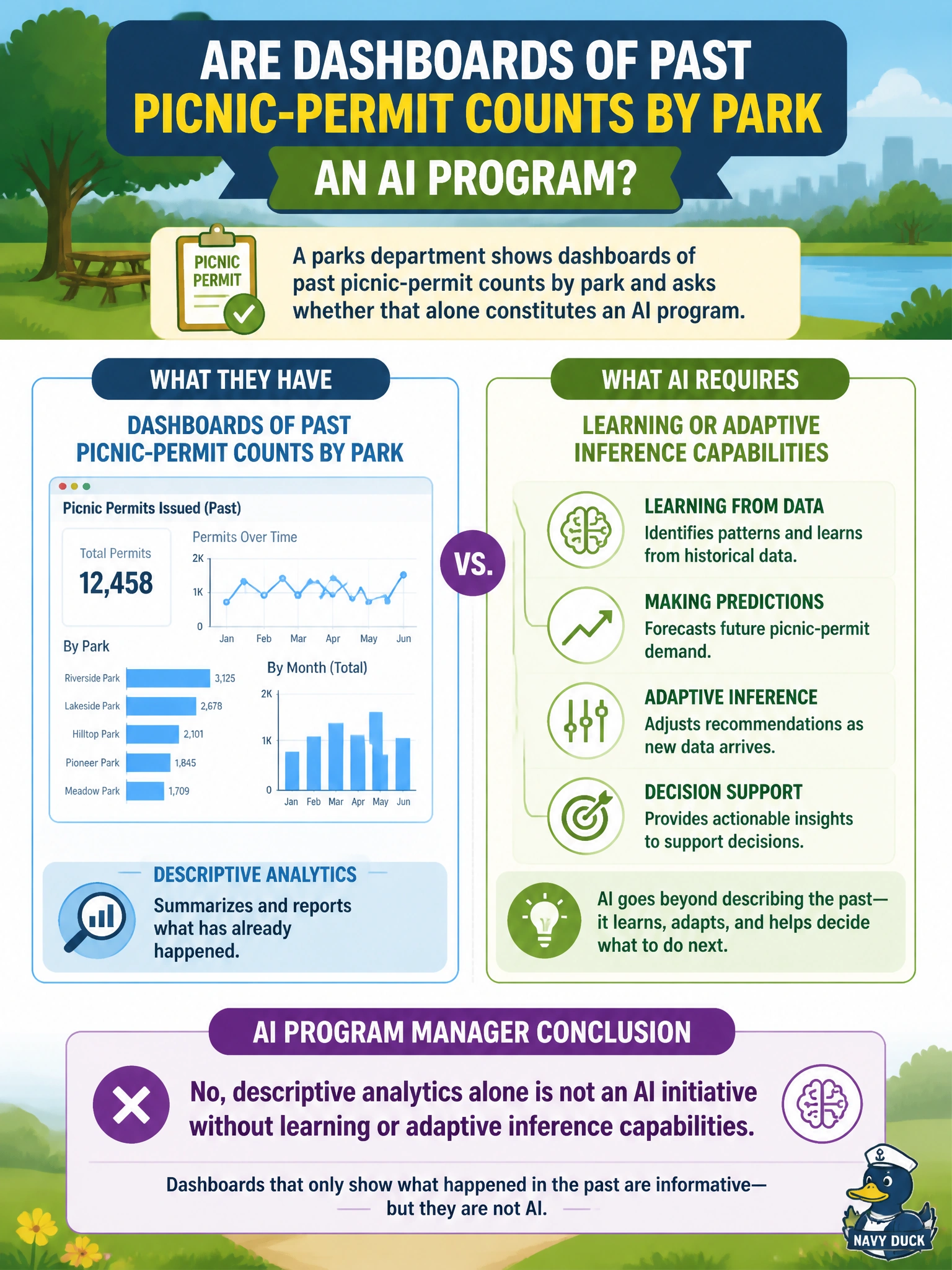
A parks department shows dashboards of past picnic-permit counts by park and asks whether that alone constitutes an AI program. What should the AI program manager conclude?
Select an answer to reveal the explanation.
Short Explanation
Counting last summer’s picnic permits is like flipping through a photo album—useful, not magical. An AI program needs systems that learn, predict, generate, or act adaptively. A dashboard of yesterday’s totals is analytics, not an AI portfolio.
Full Explanation
Dashboards of past picnic-permit counts by park are descriptive analytics: they summarize historical measures for awareness and planning. Alone, they do not constitute an AI program because there is no learning from data to generalize, no predictive inference, no generative composition, and no agentic action. The AI program manager should conclude that analytics can be a valuable precursor and KPI layer, but labeling charts as an AI initiative misstates maturity and misguides budget and governance expectations for the parks department. Claiming any municipal chart is generative AI fails: generation produces new content from models, not bar charts of stored counts. Asserting historical counts automatically train a deep neural network is false—training requires intentional ML pipelines, labels or objectives, and model management, none of which a BI dashboard implies. Saying parks data can never support analytics of any kind is wrong and unnecessarily blocks useful reporting; the issue is category (descriptive vs AI), not data legitimacy. Exam caveat: descriptive BI ≠ AI initiative; do not equate "uses data" with "is AI." Operational check: keep permit dashboards for seasonal planning, and if parks later pursue AI (for example demand forecasting or generative public FAQ drafts), stand up explicit learning/generation use cases with data quality, privacy, and ownership—not a rebrand of existing Tableau or Power BI views.