
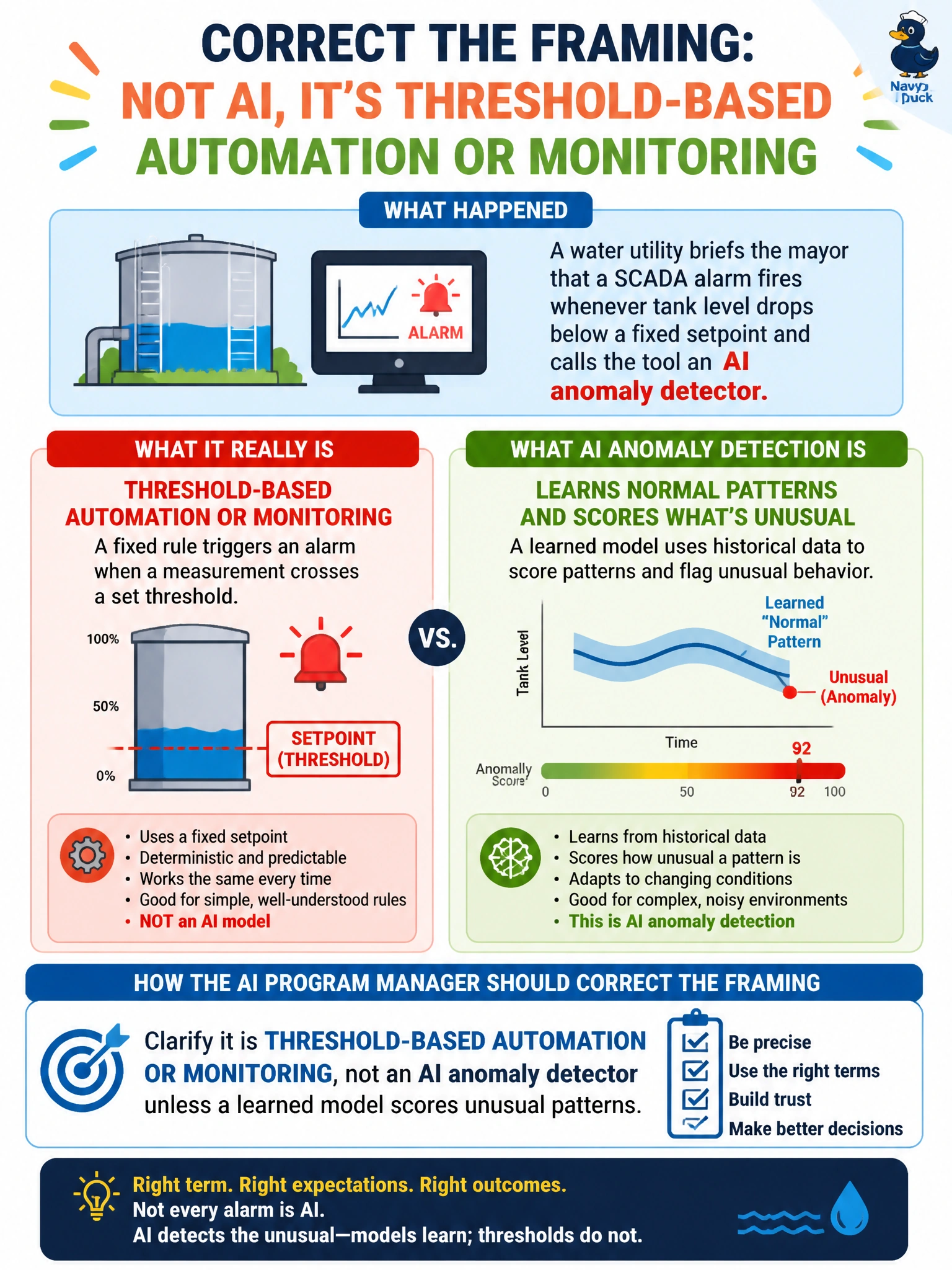
A water utility briefs the mayor that a SCADA alarm fires whenever tank level drops below a fixed setpoint and calls the tool an AI anomaly detector. How should the AI program manager correct the framing?
Select an answer to reveal the explanation.
Short Explanation
A tank-level tripwire is more like a smoke alarm than a detective. It yells when a number crosses a line you already picked—no learning, no pattern hunting. Save the “AI anomaly detector” badge for models that actually learn what weird looks like.
Full Explanation
A water utility SCADA alarm that fires when tank level drops below a fixed setpoint is threshold-based automation or traditional monitoring. Predetermined limits encode engineering judgment; the system does not learn normal operating envelopes from data or score unusual multivariate patterns. The AI program manager should correct "AI anomaly detector" labeling so the mayor’s office does not assume model risk management, training pipelines, or adaptive detection that do not exist. Agreeing that any operational alert is machine learning fails conceptually: alerts can be pure rules. Relabeling it generative AI because alarm text is English confuses natural-language display with generative models. Calling it an autonomous agent that invents new tank setpoints overnight invents both agency and unauthorized control changes—setpoints are engineered and governed, not improvised by software overnight. Exam caveat: fixed thresholds ≠ learned anomaly detection; English status text ≠ generative AI. Operational check: keep setpoint changes under change control, monitor alarm floods and sensor faults separately from any future ML anomaly pilots, and only claim AI anomaly detection when a model scores deviations from learned norms with documented training data, drift monitoring, and operator playbooks.