
A public-health department maps where AI could triage after-hours clinic messages. What framing best aligns with responsible civic AI program practice?
Select an answer to reveal the explanation.
Short Explanation
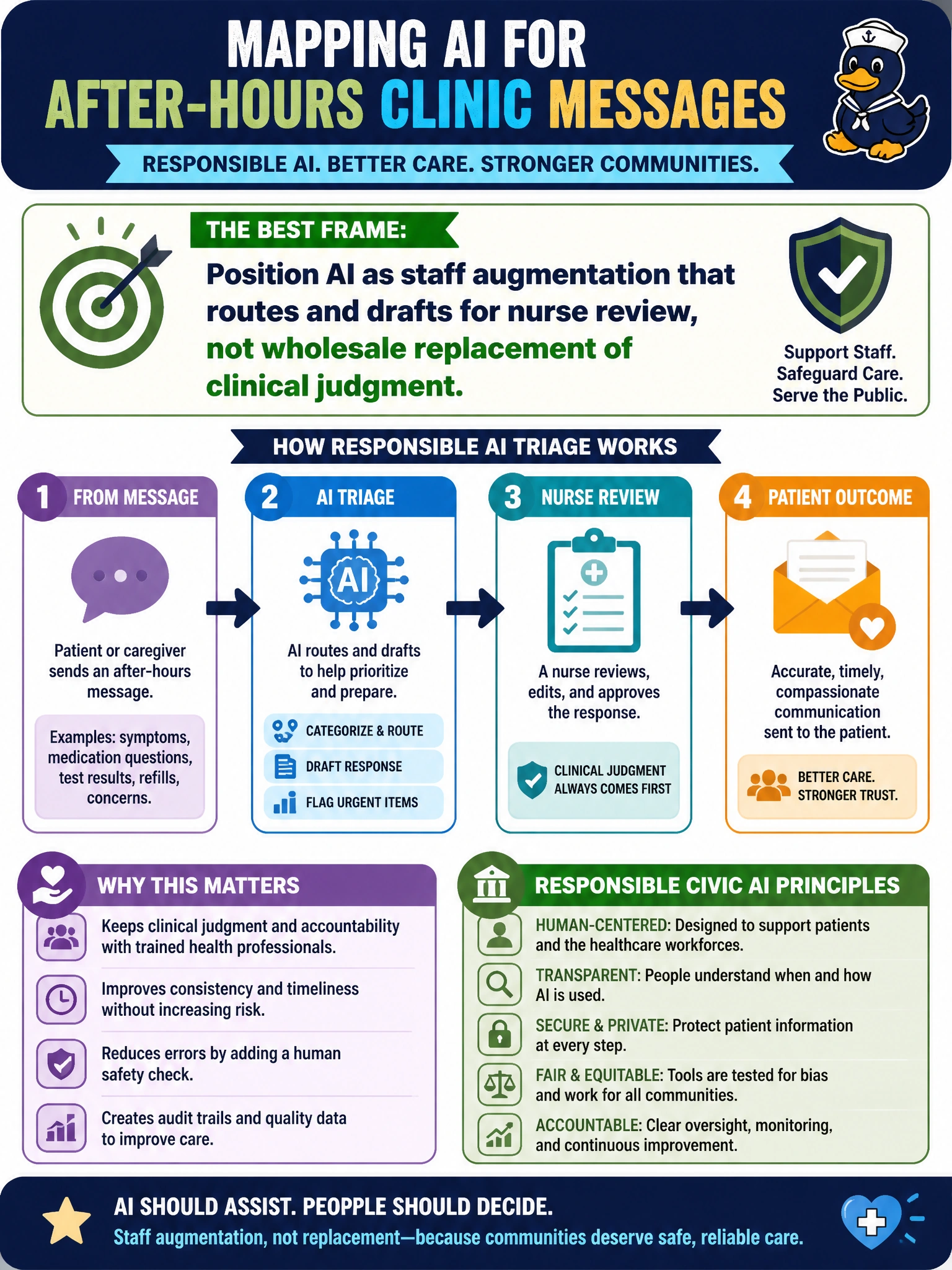
Think of the triage bot as a night clerk who sorts the inbox and sticky-notes the urgent ones for the nurse—not as the nurse. Civic AI shines when it clears busywork and surfaces risk, while licensed judgment stays with people.
Full Explanation
When a public-health department maps AI for after-hours clinic message triage, responsible civic practice frames AI as staff augmentation: prioritize, route, and draft for licensed nurse review rather than replacing clinical judgment. That framing preserves professional accountability, aligns with duty-of-care expectations, and still captures value by clearing inbox busywork and surfacing urgency signals overnight. Program managers should scope the use case around human-in-the-loop decision rights from day one. Replacing all overnight nurses with an unsupervised chatbot that never escalates fails clinically and ethically: it removes escalation paths and clinical accountability when symptoms may be time-critical. Treating triage as a pure analytics dashboard with no message handling misses the operational work—messages still need sorting and response pathways. Deploying an agent that issues prescriptions without clinician oversight overreaches legal and medical authority; prescribing is a regulated act, not a chatbot convenience feature. Exam caveat: civic AI questions often test augmentation versus replacement and whether oversight remains with licensed staff. Operational check: define severity tiers, mandatory escalation for red-flag symptoms, audit logs of AI suggestions versus nurse decisions, PHI-minimizing prompts, and after-hours coverage SLAs so the tool supports nurses instead of silently owning clinical outcomes.