
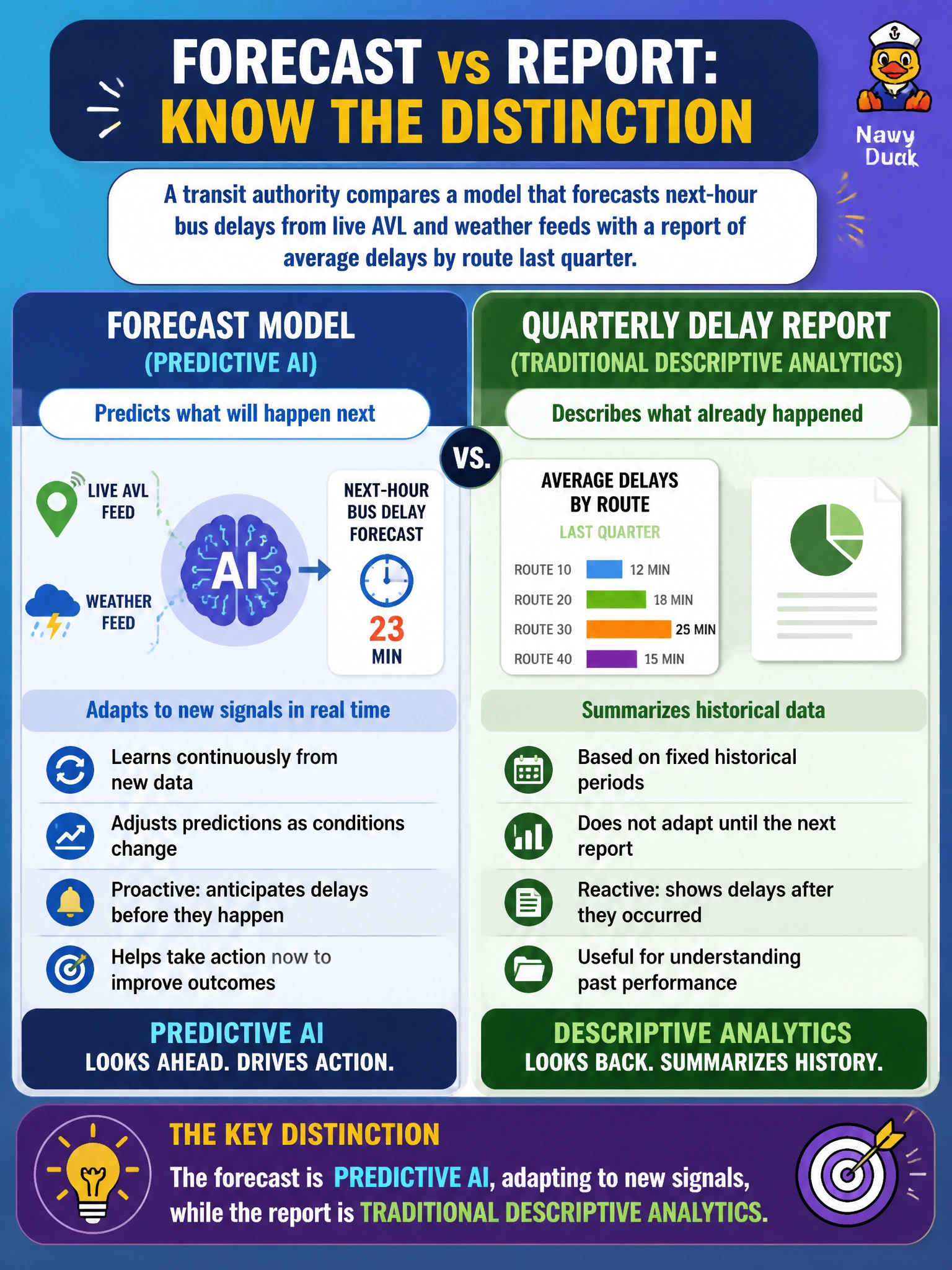
A transit authority compares a model that forecasts next-hour bus delays from live AVL and weather feeds with a report of average delays by route last quarter. What distinction should the AI program manager emphasize?
Select an answer to reveal the explanation.
Short Explanation
Last quarter’s delay chart is a rear-view mirror; the next-hour forecast is more like a weather radar for the bus. One describes what already happened; the other predicts what is about to hit the schedule. Riders care about the radar.
Full Explanation
A transit authority comparing next-hour bus-delay forecasts from live AVL and weather against a quarterly average-delay report must emphasize predictive versus descriptive analytics. Predictive AI estimates future outcomes from current and historical features and can refresh as new signals arrive—supporting proactive rider alerts and dispatch decisions. The quarterly report summarizes what already happened; it informs planning and accountability but does not adapt to this hour’s rain or vehicle positions. Framing investment, pipelines, and SLAs correctly starts with that distinction. Claiming both approaches are identical because each touches historical ridership conflates shared data lineage with identical capability; history can feed either descriptive summaries or predictive features without making them the same product. Saying the quarterly report is generative AI while the forecast is pure automation reverses both labels: averages are not generative, and forecasts from live feeds are predictive inference, not fixed-threshold automation. Asserting only the quarterly report can support rider alerts because forecasts "invent data" misunderstands prediction: forecasts estimate under uncertainty and need calibration and monitoring, but they are designed for forward-looking alerts when quality gates pass. Exam caveat: watch for swapped labels (generative vs predictive vs descriptive). Operational check: publish forecast confidence and data-freshness indicators to operations, keep the quarterly report for governance dashboards, and gate rider-facing alerts on AVL/weather feed health so stale inputs do not trigger misleading next-hour guidance.