
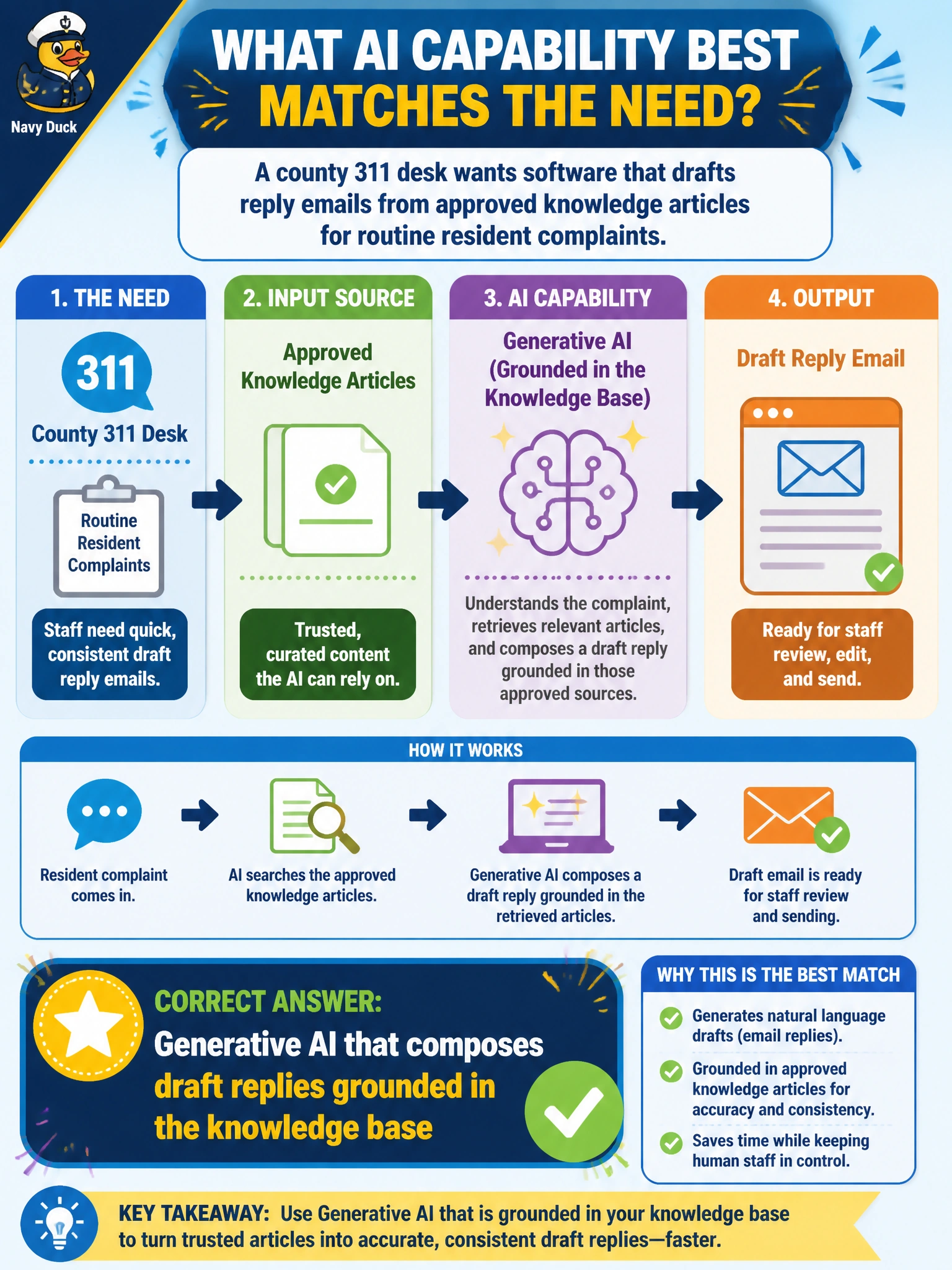
A county 311 desk wants software that drafts reply emails from approved knowledge articles for routine resident complaints. Which AI capability best matches that need?
Select an answer to reveal the explanation.
Short Explanation
Picture a clerk with a binder of approved answers and a helpful intern who turns those pages into a first-draft email. That drafting step is generative AI, not a chart or a cluster map. Keep a human reviewing before send, and you are in good shape.
Full Explanation
A county 311 desk that needs draft reply emails grounded in approved knowledge articles is asking for generative AI: models that compose natural-language text conditioned on a prompt and retrieved civic content. The capability match is drafting assistance that stays tethered to sanctioned articles so tone and facts align with municipal service standards while a human clerk reviews before send. That pattern reduces repetitive writing load without replacing accountability for the official response to residents. Unsupervised clustering of past tickets fails the need because clustering discovers groupings in historical data; it does not produce a draft email a clerk can edit. A SCADA-style threshold alarm that pages on call-volume spikes is monitoring/automation for operations surge—useful for staffing, irrelevant to composing replies. A static dashboard of last month’s complaint counts by ZIP is descriptive analytics; it informs trends but writes nothing a resident can receive. Exam caveat: do not confuse analytics, alerting, or clustering with generative composition; the stem’s verb "drafts" points to generation. Operational check: retrieve only approved articles, watermark drafts as AI-assisted, require clerk approval before outbound email, log knowledge-base versions used, and measure escalation rates when the knowledge base lacks an answer so the 311 desk fails safely rather than inventing policy.