
A city permitting director prepares a council briefing about a rules-based script that auto-approves simple fence permits when every checklist box is checked. How should the AI program manager frame the tool?
Select an answer to reveal the explanation.
Short Explanation
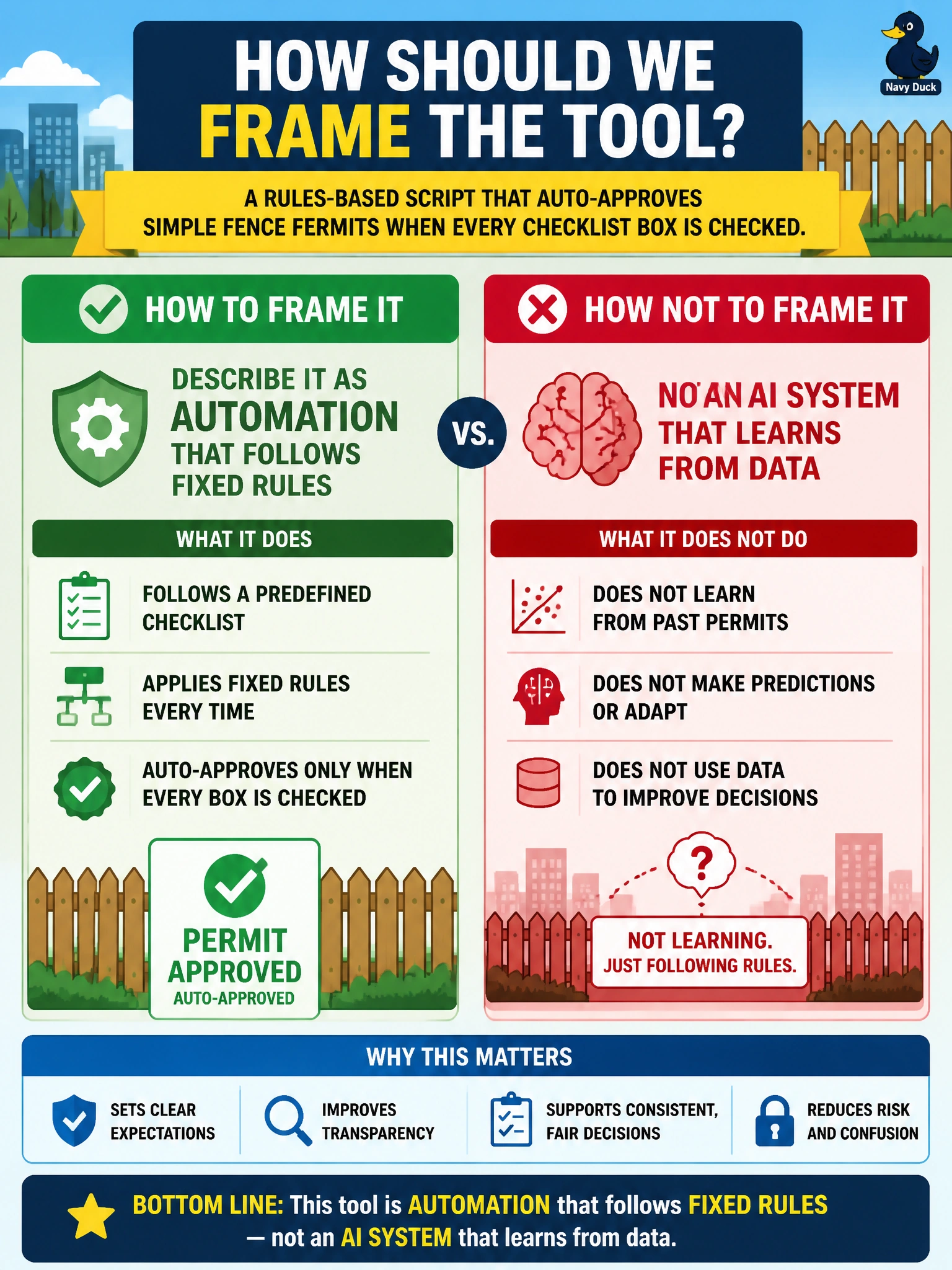
Think of that fence-permit script like a vending machine: same buttons, same snack every time. It is not guessing or learning; it just fires when every checkbox is green. Call it automation so council does not think you shipped a brain.
Full Explanation
In municipal permitting, a script that auto-approves fence permits only when every checklist condition is satisfied is classic rules-based automation: authored if-then logic, deterministic outcomes, and no model that learns from historical permit data. The AI program manager should frame it that way for council so sponsors understand capability boundaries, auditability, and failure modes. Fixed checklists are transparent and easy to change by ordinance or policy update; they do not invent zoning exceptions or adapt to new patterns without a human rewriting the rules. That honesty protects trust when residents or auditors ask how an approval was produced. Generative AI is the wrong label because producing an approval-notice PDF from a template is document generation or mail-merge style output, not a model composing novel language from learned distributions. Deep learning is wrong because a large number of checklist fields does not create neural representation learning; field count is a configuration detail, not architecture. Calling the script an autonomous agent that invents new zoning exceptions fails on two concepts: agents typically plan and act across tools with adaptive goals, and inventing exceptions would violate statutory authority—civic systems must not create law by inference. Exam caveat: exam items often bait candidates to call any software that "produces text" or has "many inputs" AI. Distinguish learning/adaptive inference from predetermined rules. Operational check: document the rule set as policy-controlled automation, log which checklist conditions fired, keep a human override path for edge parcels, and reserve AI terminology for systems that actually train, predict, generate with models, or act agentically under governance.