
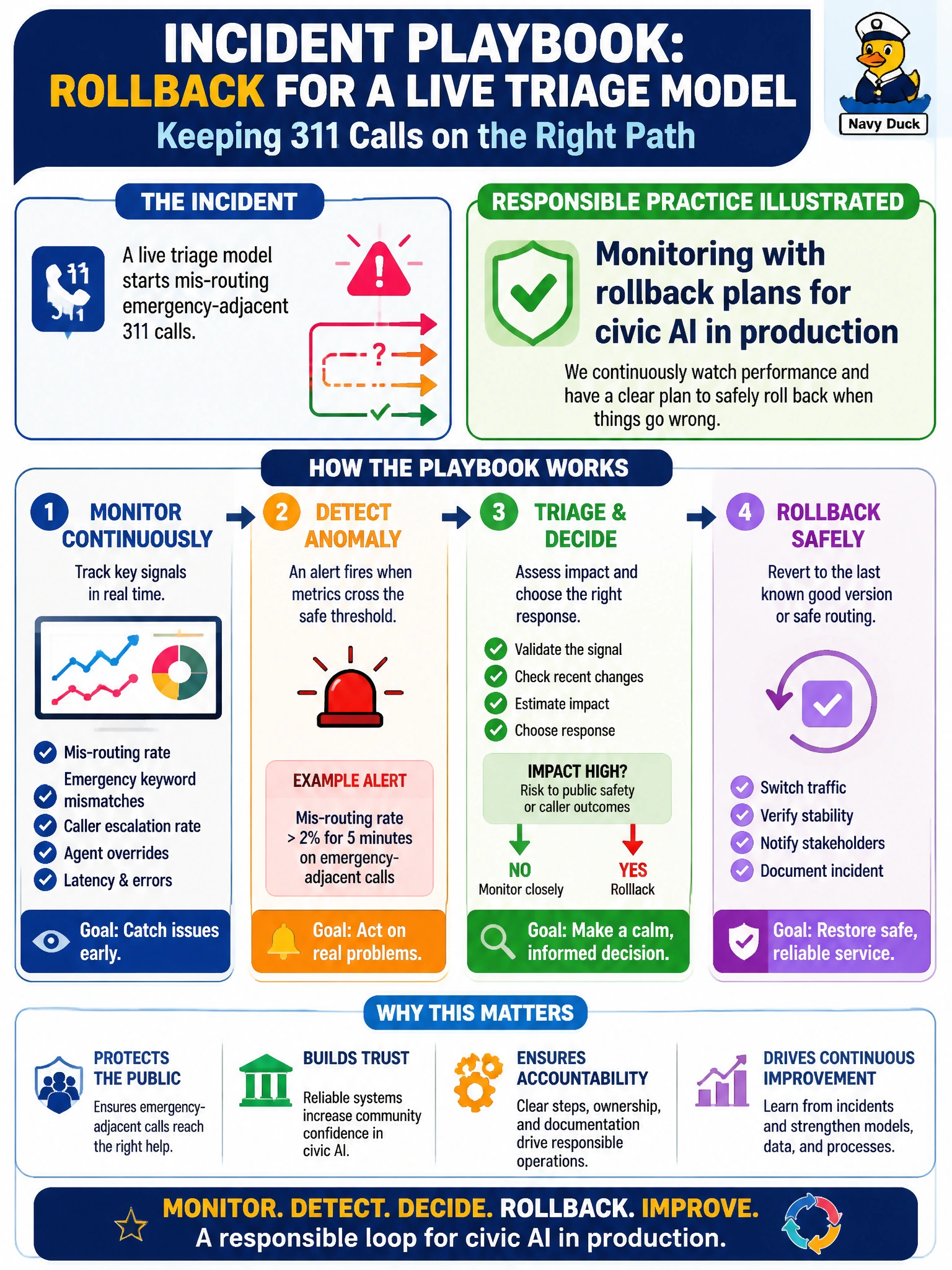
An incident playbook covers rollback when a live triage model starts mis-routing emergency-adjacent 311 calls. What responsible practice is illustrated?
Select an answer to reveal the explanation.
Short Explanation
When a triage model starts sending calls the wrong way, you need a playbook to roll it back fast. Monitoring without a kill switch is incomplete. Production civic AI needs an exit ramp.
Full Explanation
An incident playbook covering rollback when a live triage model starts mis-routing emergency-adjacent 311 calls illustrates monitoring with rollback plans for civic AI in production. The correct answer is monitoring with rollback plans for civic AI in production. Triage models that route urgent or safety-adjacent requests can silently degrade after data drift, upstream outages, or bad retrains. Detection without a rehearsed rollback leaves residents stuck in wrong queues; a playbook that restores prior routing rules or human triage is operational resilience, not optional polish.
Publishing rollback performance summaries for civic AI in production fails because summarizing rollback performance is retrospective reporting and too slow to stop live mis-routes affecting safety-adjacent services; it documents a rollback, not monitoring with a rollback plan to execute during the incident. Retraining triage models on rollback data for production monitoring fails because retraining is a slow, offline model update and does nothing to stop active mis-routing during an incident; it is a refresh strategy using incident data, not production monitoring with a tested rollback path. Logging operator overrides during rollback events for civic audit fails because recording overrides for audit does not restore correct routing or stop live mis-routes as they occur; it creates accountability, not an incident rollback.
Exam caveat: rollback is not the same as never improving models. The tested practice is production monitoring plus a tested reversion path; canary releases and shadow mode are complements, not substitutes for knowing how to turn a bad model off quickly.
Operational check: define mis-route SLOs and dashboards, write a step-by-step rollback to last-known-good rules, assign on-call authority to execute it, run tabletop drills quarterly, and require post-incident review before the model returns to full traffic.
Prefer to study offline? Printable PDF study book + test engine ($7.50, unofficial). These questions stay free here.