
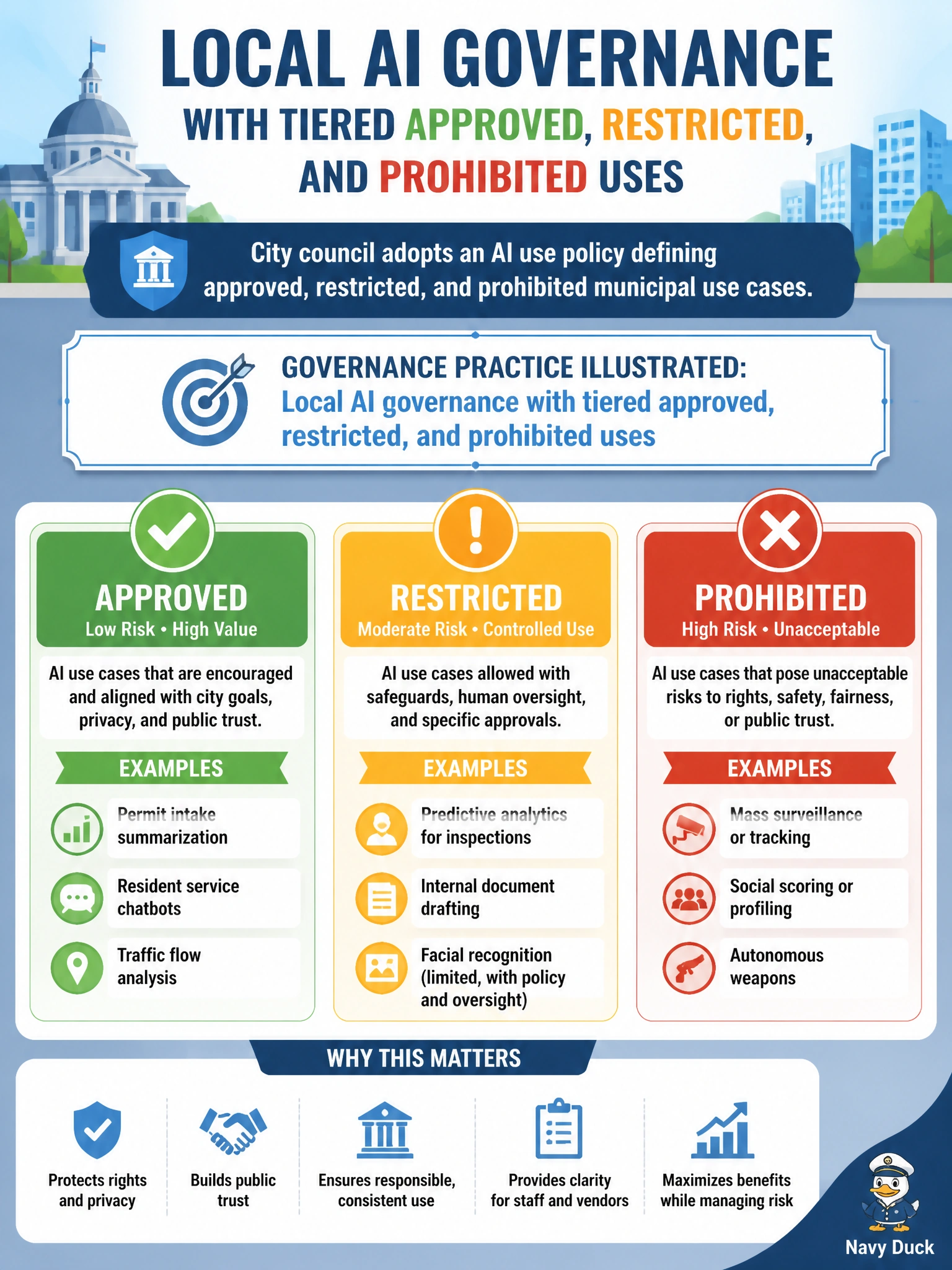
City council adopts an AI use policy defining approved, restricted, and prohibited municipal use cases. What governance practice is illustrated?
Select an answer to reveal the explanation.
Short Explanation
A clear policy saying what's okay, limited, or banned gives you citywide boundaries you'll actually use, and it's governance setting the tiers up front. Vetted vendors for the tiers only tell you who you're allowed to buy from, so you won't get the tier definitions themselves from that vetting. Audited use logs and scored use cases only track what's happened or rank single uses, so you'll still need the approved, restricted, and banned tiers set up front.
Full Explanation
City council adopting an AI use policy that defines approved, restricted, and prohibited municipal use cases illustrates local AI governance with tiered uses. The correct answer is local AI governance with tiered approved, restricted, and prohibited uses. Not all AI risk is equal: chatbot FAQs differ from biometric surveillance or automated benefit denial. A tiered policy gives departments clear boundaries, concentrates review resources on higher tiers, and creates a shared vocabulary for procurement and oversight, not just Local AI governance with vetted approved, restricted, and prohibited use vendors, which vets which vendors are allowed for each tier rather than establishing citywide governance up front. Local AI governance with vetted approved, restricted, and prohibited use vendors describes vetting of vendors within the tiers; it focuses on which vendors are cleared for approved, restricted, and prohibited uses rather than the enterprise-wide governance practice of establishing the approved, restricted, and prohibited tiers by council policy. Local AI governance with audited approved, restricted, and prohibited use logs describes after-the-fact review of logs for compliance and performance; it checks whether uses follow the tiers through audited logs rather than classifying all municipal uses into approved, restricted, and prohibited tiers as the council policy does. Local AI governance with scored approved, restricted, and prohibited use cases narrows the practice to scoring individual use cases; it assigns scores to specific cases within the tiers rather than the upfront enterprise-wide classification into approved, restricted, and prohibited tiers. Exam caveat: a tiered policy is only as strong as its update and enforcement mechanisms. The tested concept is classifying uses into approved/restricted/prohibited tiers; lists must evolve as tools and laws change, and exceptions need documented approval paths. Operational check: publish the tiered use table, map existing tools into tiers, require pre-approval for restricted uses, hard-block prohibited uses in procurement, train department leads on examples at each tier, and review the policy annually with council or an AI governance body.
Prefer to study offline? Printable PDF study book + test engine ($7.50, unofficial). These questions stay free here.