
An open-data AI release accidentally enables re-identification of sparse rural clinic visits. What privacy risk is illustrated?
Select an answer to reveal the explanation.
Short Explanation
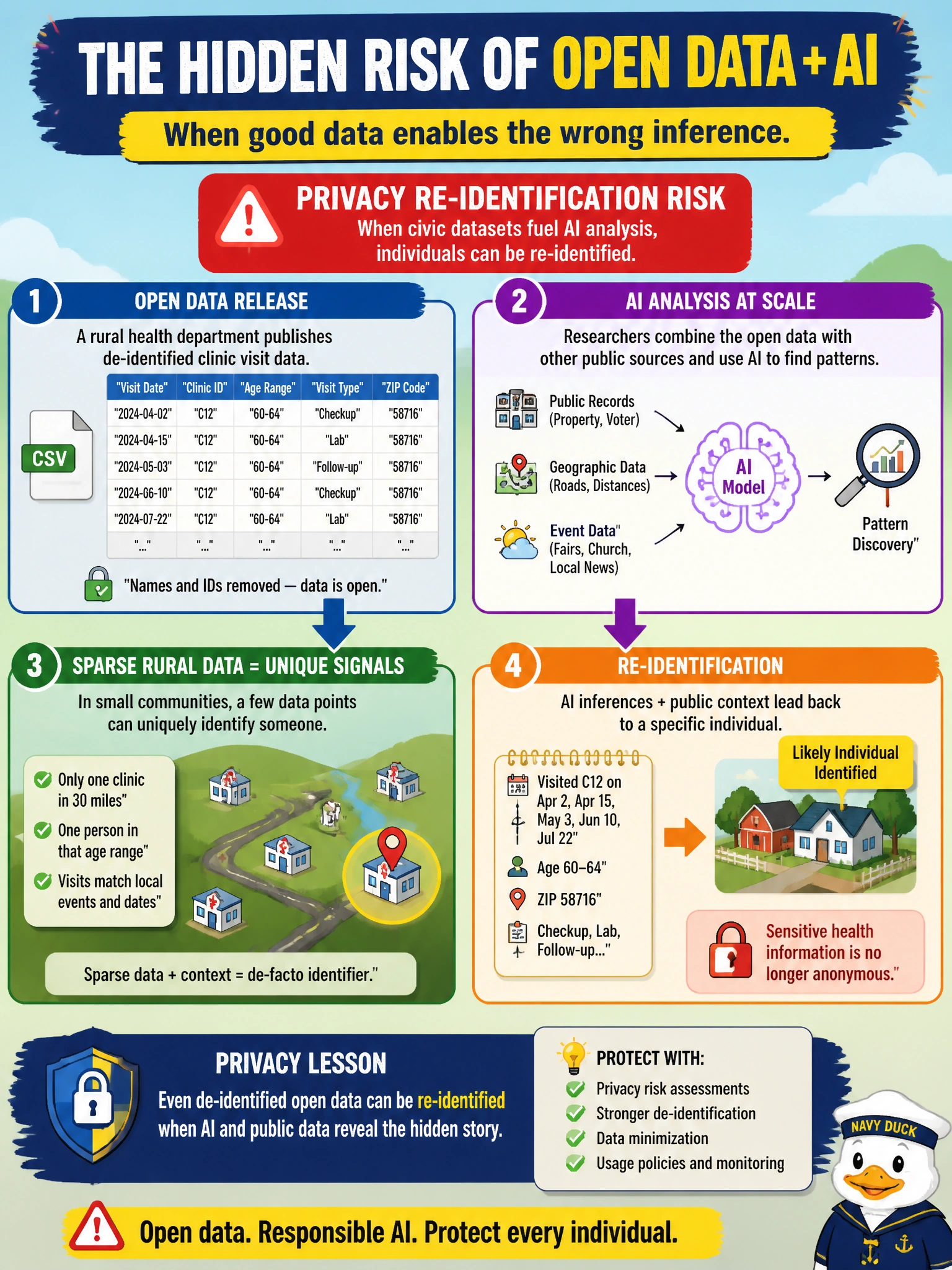
Sparse rural visits can be a fingerprint even without names. Open data plus AI can re-identify people if you are not careful. You're tying a visit to a specific person, not just confirming someone's included, so it's re-identification you'll need to guard against.
Full Explanation
When an open-data AI release enables re-identification of sparse rural clinic visits, the illustrated risk is privacy re-identification: rare combinations of place, time, and service can fingerprint individuals even without names. The correct answer is privacy re-identification risk when civic datasets fuel AI analysis. Sparse rural populations have low k-anonymity; linking quasi-identifiers across open civic tables or with external data can reveal who visited which clinic. Publishing 'de-identified' extracts without assessing uniqueness under AI-assisted linkage leaves residents—and the municipality—exposed to confidentiality breaches and eroded trust in open-data programs.
Privacy re-identification risk when civic AI confirms inclusion fails because the scenario is about linking sparse quasi-identifiers in an open release to re-identify who visited which clinic, not about merely confirming inclusion in a dataset.
Privacy re-identification risk when civic AI leaks memorized visits fails because the breach comes from AI-assisted linkage of de-identified civic tables revealing identities, not from a model having memorized and leaked verbatim visit rows in its outputs.
Privacy re-identification risk when civic AI infers undisclosed diagnoses fails because the illustrated harm is identity disclosure from unique place-time-service patterns, not inference of an unknown diagnosis from partial attributes.
Exam caveat: do not confuse open-data transparency with a duty to release the most granular health-adjacent tables. Transparency can be satisfied with aggregate statistics, delayed release, or secure research enclaves; the tested concept is re-identification risk under AI analysis of sparse civic data.
Operational check: run a re-identification risk assessment on rural clinic extracts before open release, enforce minimum cell sizes and geographic coarsening, prohibit joining keys that recreate unique visit patterns, log downstream AI uses, and require privacy office sign-off when sparsity makes individuals reconstructible.
Prefer to study offline? Printable PDF study book + test engine ($7.50, unofficial). These questions stay free here.