
Youth counselors worry that always-on AI companions in a city teen program could deepen mental-health isolation. What societal concern is illustrated?
Select an answer to reveal the explanation.
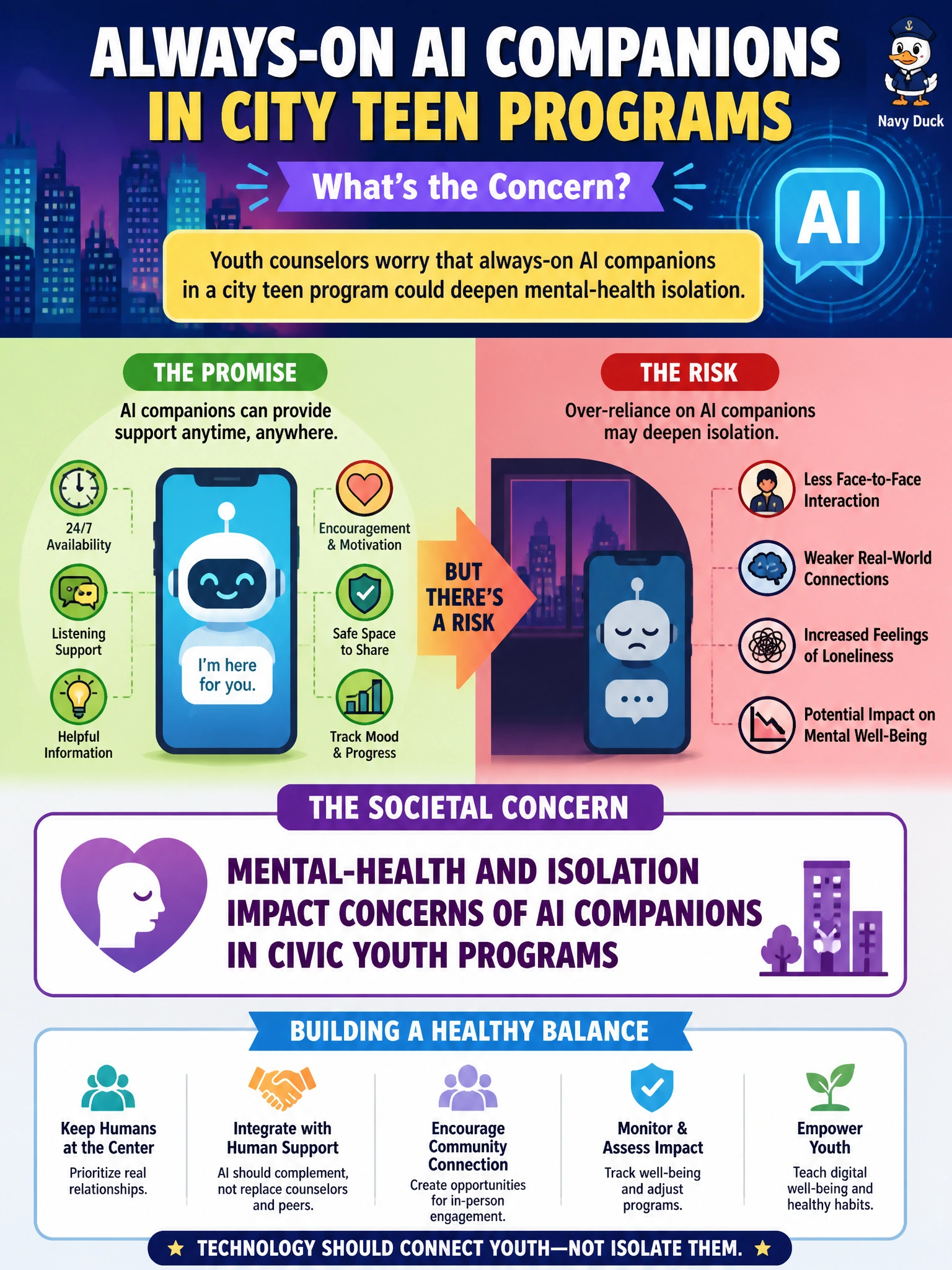
Short Explanation
Always-on AI buddies for teens can leave kids more alone, not less. Counselors are right to worry about isolation. Tools that replace human connection need careful limits.
Full Explanation
In a municipal teen program, counselors' concern that always-on AI companions could deepen mental-health isolation illustrates a societal impact risk: companion systems can displace human connection rather than merely supplement it. The correct answer is mental-health and isolation impact concerns of AI companions in civic youth programs. Always-available chat interfaces may reduce help-seeking from counselors, peers, and families; teens can form parasocial bonds with systems that lack duty of care, crisis escalation judgment, or continuity of relationship. Cities that fund youth services remain accountable for wellbeing outcomes, so isolation and dependency effects belong in the risk analysis before scale-up—not as an afterthought once engagement metrics look strong.
Mental-health and isolation data-privacy risks of AI companions in civic youth programs is a different concern, not the one illustrated here; the counselors worry that always-on companions deepen mental-health isolation by displacing human connection, not that teen data is collected or used without proper consent. Mental-health and isolation algorithmic-bias risks of AI companions in civic youth programs is the wrong risk type; the counselors’ specific worry is that the companion itself may deepen isolation and reduce human help-seeking, not that the system treats groups unfairly. Mental-health and isolation misinformation risks of AI companions in civic youth programs does not match the scenario, which describes a city-wide teen program where the issue is whether always-on companions deepen isolation for the youth who use them, not whether companions manipulate opinions or spread false information.
Exam caveat: do not equate 'AI companionship raises isolation risk' with 'all youth AI is unethical.' The tested concept is recognizing wellbeing and isolation as societal concerns that must be weighed; age-appropriate, human-supervised tools with clear escalation paths may still be justifiable under tight controls.
Operational check: before expanding a city teen companion pilot, require a wellbeing impact review with youth counselors, define usage caps and quiet hours, mandate crisis-keyword escalation to humans, disclose AI nature to teens and guardians per policy, and measure isolation proxies (counselor utilization, peer-group participation) rather than chat volume alone.
Prefer to study offline? Printable PDF study book + test engine ($7.50, unofficial). These questions stay free here.