
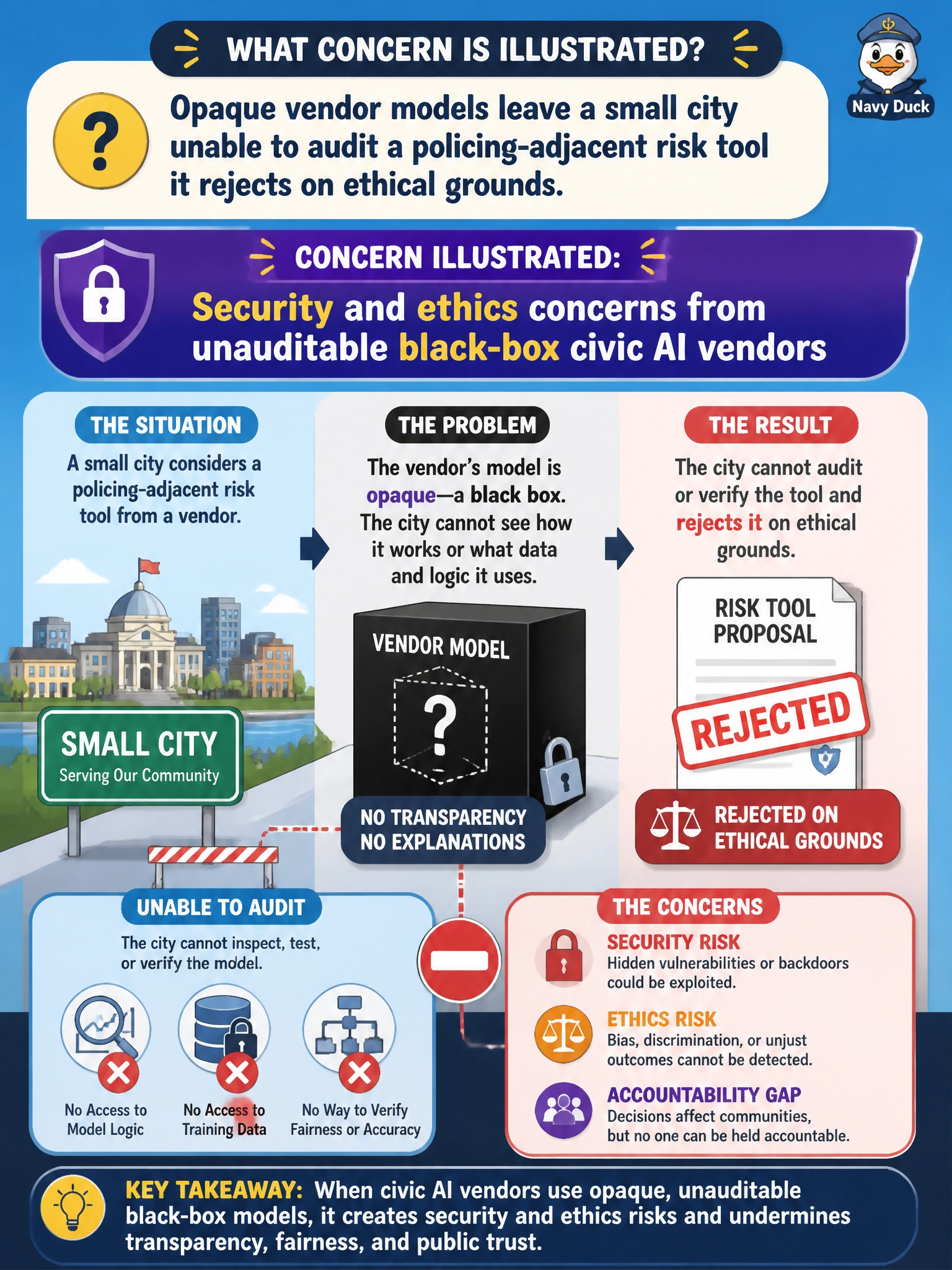
Opaque vendor models leave a small city unable to audit a policing-adjacent risk tool it rejects on ethical grounds. What concern is illustrated?
Select an answer to reveal the explanation.
Short Explanation
If the city can't peek inside the model, it can't defend residents or itself—and you'll see it's not a privacy and consent issue, not a safety and robustness issue, or an accuracy and reliability issue. Black-box lock-in is a security and ethics problem on its own. Saying no to an unauditable risk tool is responsible.
Full Explanation
When opaque vendor models leave a small city unable to audit a policing-adjacent risk tool it rejects on ethical grounds, the concern illustrated is security and ethics from unauditable black-box civic AI. Policing-adjacent systems affect liberty, safety, and equal protection; without model documentation, feature insight, testing access, or audit rights, the city cannot verify bias, failure modes, data leakage, or adversarial robustness. Rejecting such a tool can be a responsible act when contractual opacity blocks accountability the municipality owes residents. Privacy and consent concerns from unauditable black-box civic AI vendors fails to match the scenario: while the domain is civic AI, the illustrated worry is security and ethics from inability to audit for bias, failure modes, data leakage, and adversarial robustness plus accountability for liberty and equal protection, not primarily privacy collection or consent, and the tool was rejected on ethical grounds for unauditability. Safety and robustness concerns from unauditable black-box civic AI vendors fails because the scenario describes ethical rejection due to unauditability and lack of accountability for bias, security, and equal protection, not primarily operational safety or robustness performance; robustness testing is part of the audit need, but the illustrated concern is security and ethics oversight. Accuracy and reliability concerns from unauditable black-box civic AI vendors fails because the scenario centers on inability to meet security and ethics accountability that justifies ethical rejection, not merely whether predictions are accurate or reliable; auditability for bias, data leakage, and adversarial robustness is the ethical blocker. Exam caveat: 'black box' does not mean every proprietary model is forbidden, and it should not be confused with a same-domain different-worry concern like privacy and consent concerns from unauditable black-box civic AI vendors, with safety and robustness concerns from unauditable black-box civic AI vendors, or with accuracy and reliability concerns from unauditable black-box civic AI vendors. The tested idea is that high-stakes civic uses require meaningful auditability; cities may accept constrained opacity only with compensating controls, independent testing, and clear human accountability—especially outside low-risk administrative tools. Operational check: for policing-adjacent procurements, require audit rights, documentation of training data and known limits, bias and security test evidence, a right to discontinue without penalty when opacity blocks oversight, and a written ethics rejection memo when those conditions cannot be met.
Prefer to study offline? Printable PDF study book + test engine ($7.50, unofficial). These questions stay free here.