
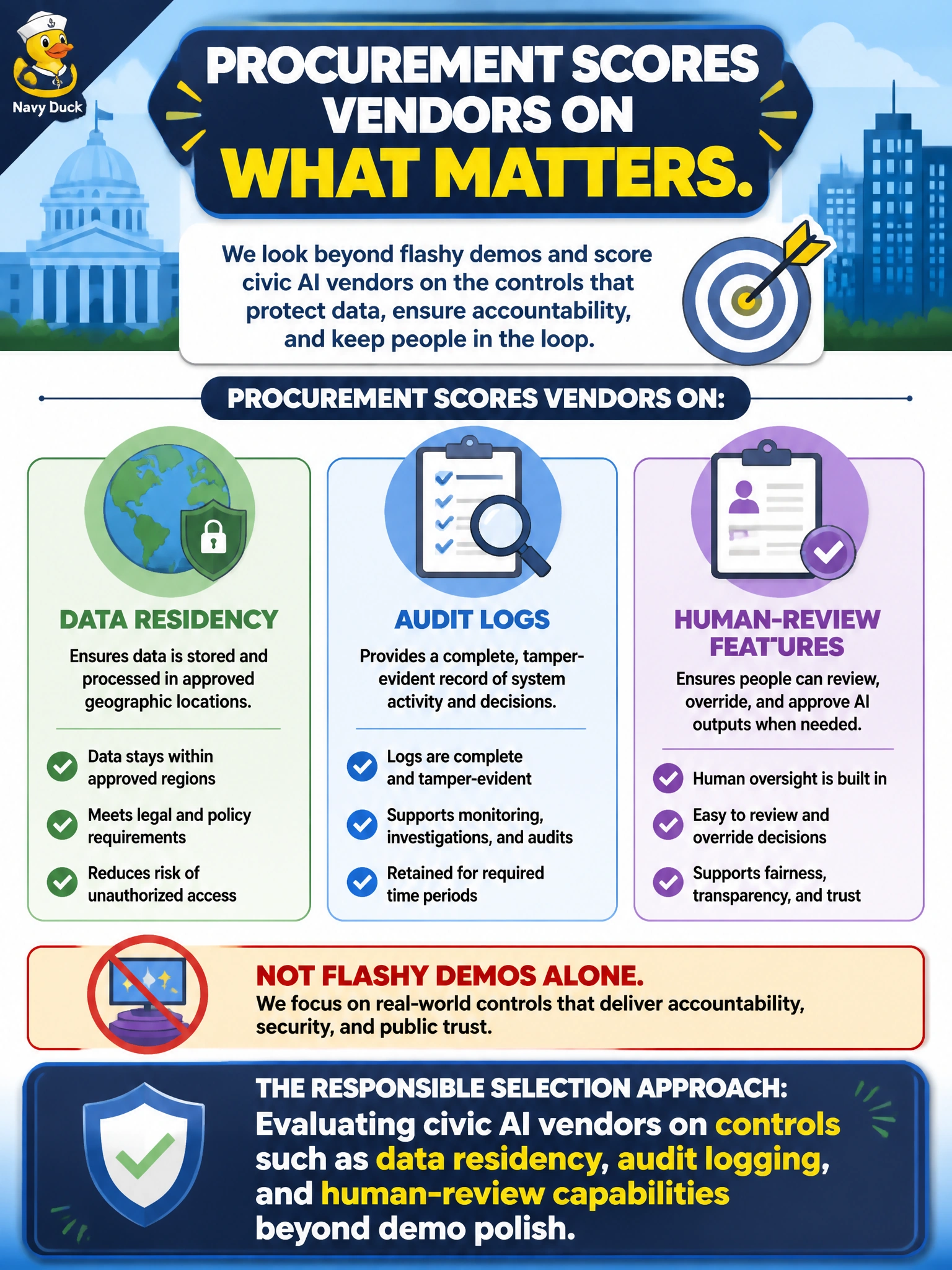
Procurement scores vendors on data residency, audit logs, and human-review features—not flashy demos alone. What responsible selection approach is shown?
Select an answer to reveal the explanation.
Short Explanation
Narratives in vendor self-assessments and future-release roadmaps won't cut it; you'll protect the city when you verify data residency, audit logs, and human-review switches. Procurement that scores those specific controls is doing responsible selection. Accuracy, latency, and feature breadth with questionnaires won't prove what's actually enforced right now.
Full Explanation
Responsible municipal AI procurement evaluates vendors on substantive controls—data residency, audit logging, and human-review capabilities—rather than demo polish alone. Scoring those controls protects resident data, supports investigations and public-records obligations, and preserves human authority over consequential decisions. Flashy demos can mask weak tenancy isolation, opaque subprocessors, or missing override switches.
Evaluating civic AI vendors on data residency, audit logging, and human-review narratives in vendor self-assessments beyond demo polish fails: narratives in self-assessments are still unverified vendor assertions, not proof of where data will actually live, whether logs are complete and exportable, or whether a human can override a live decision. Evaluating civic AI vendors on data residency, audit logging, and human-review roadmaps scheduled for future releases beyond demo polish fails because treating core controls as future roadmaps leaves them unimplemented at award, not ensuring residency is enforced, logs are complete and exportable, or human review can intervene. Evaluating civic AI vendors on model accuracy, inference latency, and feature breadth with security questionnaires beyond demo polish fails because accuracy, latency, and feature breadth measure performance and breadth, not present, testable controls for where data is stored, whether actions are auditable end to end, or whether a human can intervene now.
Exam caveat: checklist controls must be verified in the contract and technical configuration—narratives in vendor self-assessments, future-release roadmaps, and accuracy/latency/feature-breadth scoring are not substitutes for residency, audit-log, and human-review verification. Operational check: require written residency commitments, test log export and retention, confirm human-review workflows in UAT, involve security/privacy/legal in scoring, and reject demo-only evaluations as insufficient for award. Include exit and data-return clauses so the city can leave a vendor without losing logs or stranded resident data.
Prefer to study offline? Printable PDF study book + test engine ($7.50, unofficial). These questions stay free here.