
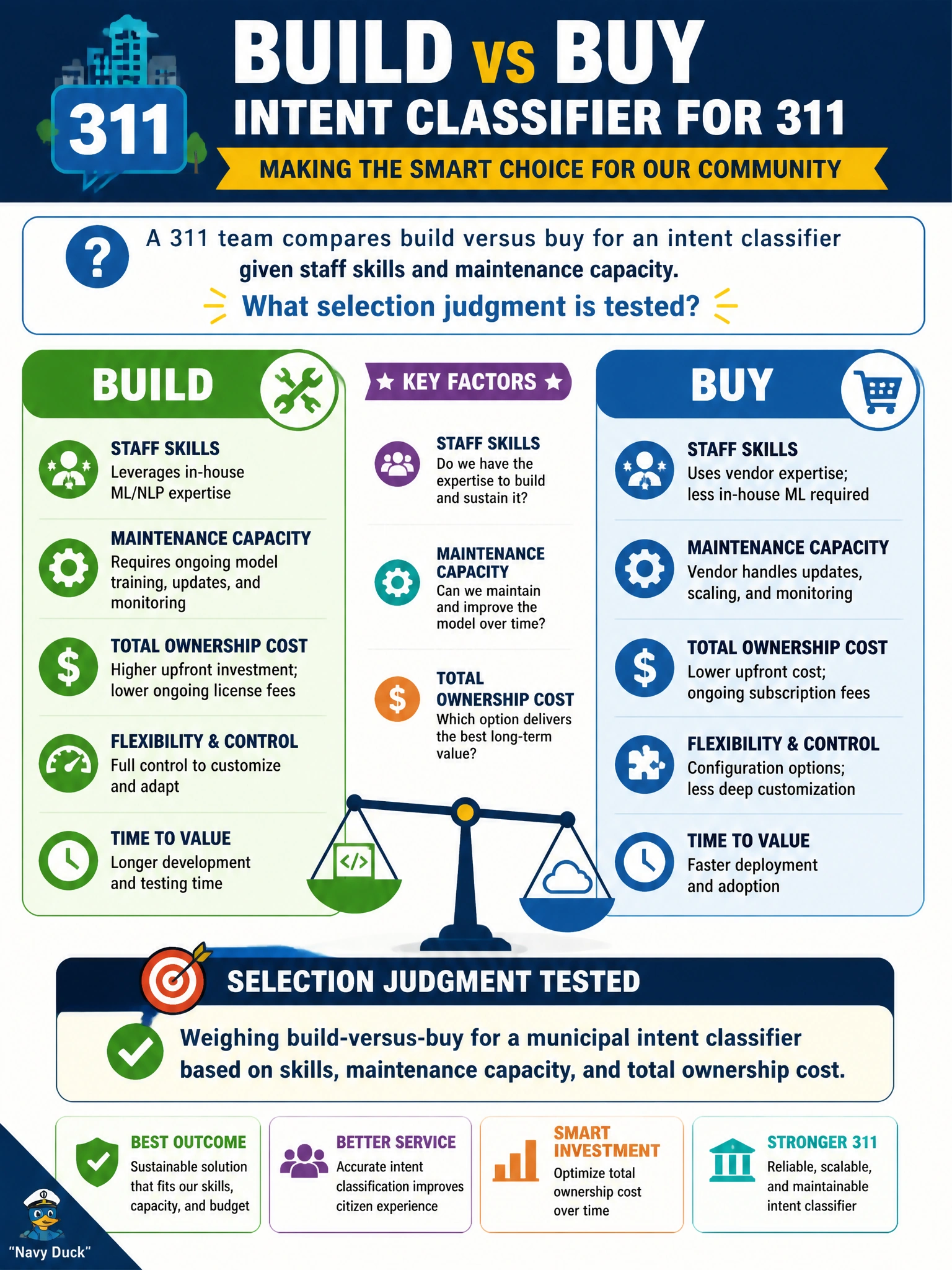
A 311 team compares build versus buy for an intent classifier given staff skills and maintenance capacity. What selection judgment is tested?
Select an answer to reveal the explanation.
Short Explanation
Can the team keep an intent classifier alive after launch—or is a vendor product wiser? Build-versus-buy is about skills and maintenance, not pride. You'll miss the real tradeoff if you note your skills and maintenance but judge total cost by prototype accuracy results, by vendor support service tiers, or by initial deployment outlay alone.
Full Explanation
Build-versus-buy judgment for a municipal 311 intent classifier weighs staff skills, maintenance capacity, and total cost of ownership—not institutional pride. An intent classifier only helps if someone can retrain it when new request types appear, monitor drift, fix integrations, and support on-call issues. Teams with limited ML operations capacity may rationally buy a supported product; teams with strong skills and unique taxonomy needs may build. The literacy is making that comparison explicitly. Weighing build-versus-buy for a municipal intent classifier based on skills, maintenance capacity, and prototype accuracy results keeps the staffing lens but swaps total ownership cost for prototype accuracy results, which don't tell you whether you can afford to sustain retraining, integration, and support over time. Weighing build-versus-buy for a municipal intent classifier based on skills, maintenance capacity, and vendor support service tiers keeps the staffing lens but swaps total ownership cost for vendor support service tiers, which don't substitute for comparing long-term build and buy ownership effort and expense. Weighing build-versus-buy for a municipal intent classifier based on skills, maintenance capacity, and initial deployment outlay keeps the staffing lens but narrows total ownership cost to initial deployment outlay alone, overlooking retraining labor, integration upkeep, monitoring, and support burden. Exam caveat: buy is not “no maintenance”—vendors still need contract management, data pipelines, and quality monitoring from the city. Operational check: inventory skills and hours available post-launch, estimate retraining and integration effort for build and buy, require a maintenance owner named in writing, and pilot with clear exit criteria before committing citywide.
Prefer to study offline? Printable PDF study book + test engine ($7.50, unofficial). These questions stay free here.