
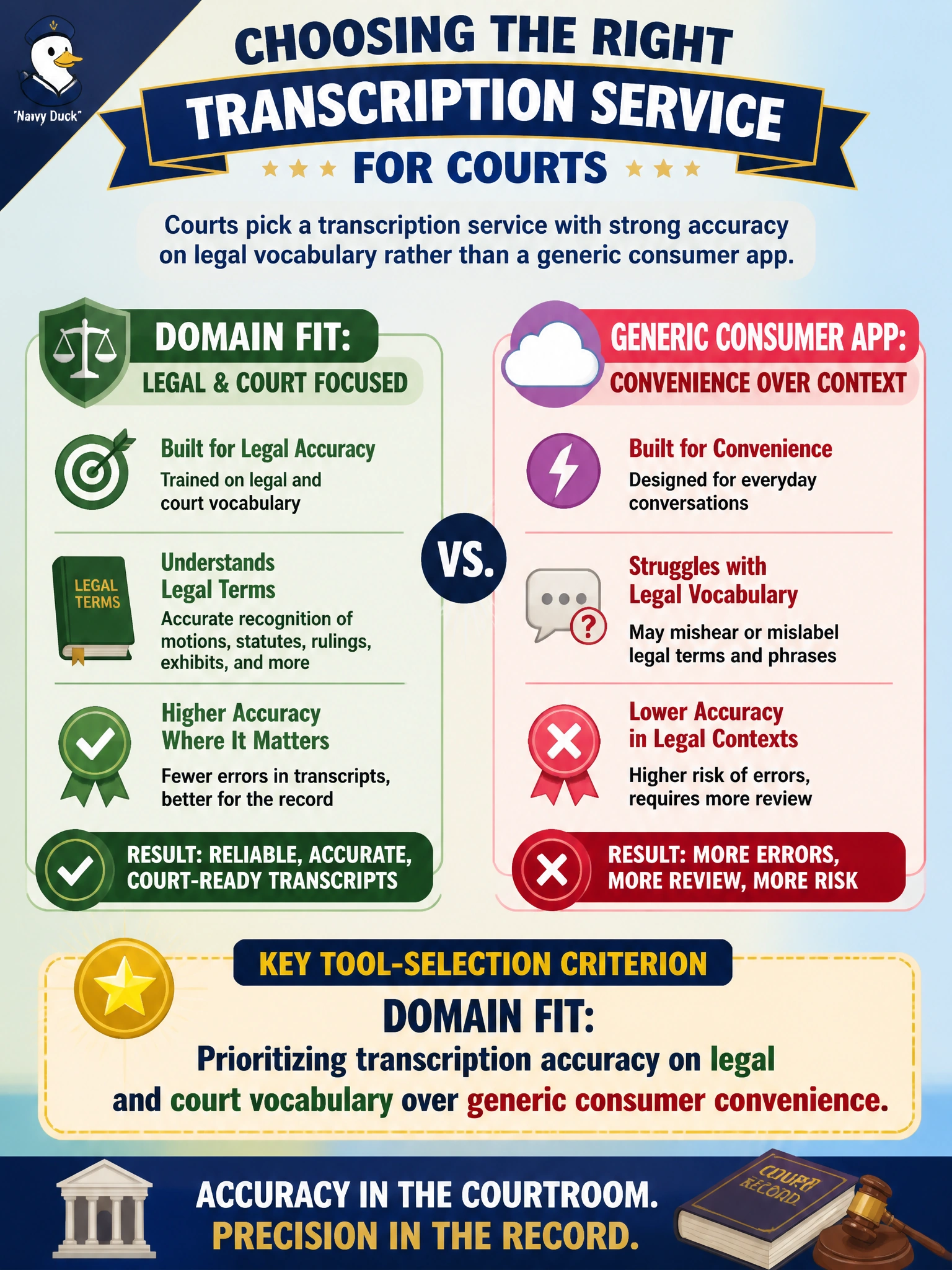
Courts pick a transcription service with strong accuracy on legal vocabulary rather than a generic consumer app. What tool-selection criterion is emphasized?
Select an answer to reveal the explanation.
Short Explanation
Court talk is full of statutes and case styles—generic phone apps stumble there. Domain fit means picking transcription that knows the lingo. You'll still get bad records if you pick for real-time processing, baseline adaptability, or training set traceability when it's legal accuracy that matters.
Full Explanation
Domain fit is a primary tool-selection criterion: courts should prefer transcription services with strong accuracy on legal vocabulary—statutes, case captions, procedural phrases—over generic consumer apps optimized for casual speech. Municipal court records demand reliable rendering of names, citations, and terms of art; prioritizing real-time processing of legal and court vocabulary over generic consumer convenience still creates downstream errors in dockets, appeals, and public access if legal terms are misrecognized. Prioritizing real-time processing of legal and court vocabulary over generic consumer convenience elevates speed over domain fit. Prioritizing baseline adaptability on legal and court vocabulary over generic consumer convenience elevates untested general capability over proven legal-vocabulary accuracy. Prioritizing training set traceability for legal and court vocabulary over generic consumer convenience elevates documentation of sources over proven domain accuracy. Exam caveat: domain-fit vendors still need BAAs/contracts, retention rules, speaker diarization quality checks, and human correction workflows for the record. Operational check: score vendors on legal-vocabulary test sets from real (appropriately governed) hearings, ban personal-device storage of court audio, and require editable transcripts with audit of corrections before official use. Ask vendors for word-error-rate reports on legal speech specifically, not only general conversational benchmarks, and confirm redaction tooling for sealed or sensitive portions before any citywide rollout.
Prefer to study offline? Printable PDF study book + test engine ($7.50, unofficial). These questions stay free here.