
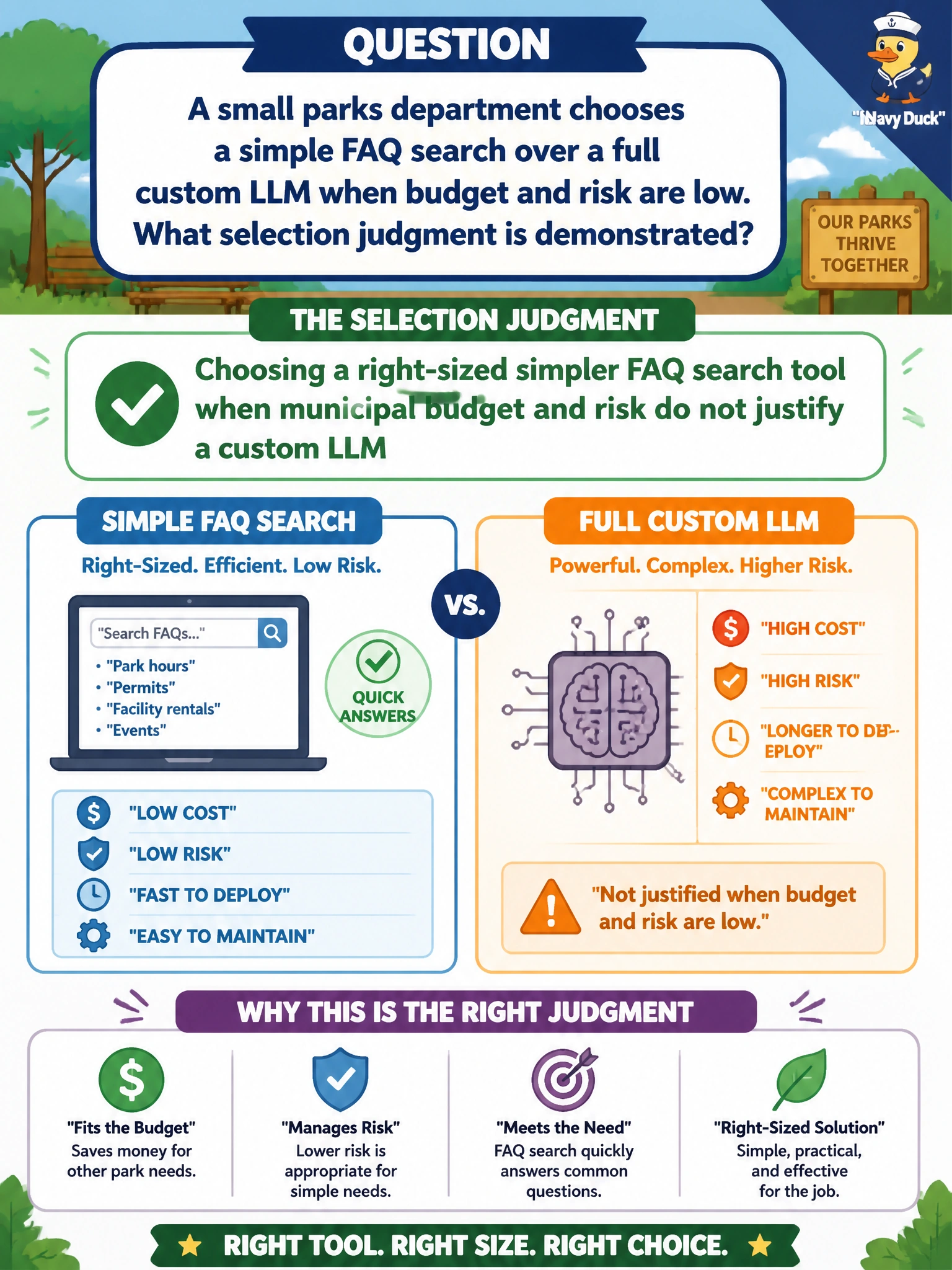
A small parks department chooses a simple FAQ search over a full custom LLM when budget and risk are low. What selection judgment is demonstrated?
Select an answer to reveal the explanation.
Short Explanation
You've got a tiny parks budget and low risk, so a plain FAQ search can beat a custom LLM science project. Right-sizing is grown-up tool selection. Sticking with plain FAQ when you need parameter fine-tuning undersizes your tool, you'll fall short when risks necessitate generative vector embeddings you can't get from plain matching, and you've got no right-sizing win when continuous custom prompting is dictated and funded to justify the LLM.
Full Explanation
Right-sizing is a core municipal AI tool-selection judgment: choose capability that matches budget, complexity, and risk. A small parks department selecting simple FAQ search instead of a full custom LLM when stakes and resources are low demonstrates proportionate selection. FAQ search can answer common park hours and reservation questions with lower cost, easier maintenance, and fewer hallucination pathways than a custom generative system. Choosing a right-sized simpler FAQ search tool when municipal budget and risk demand custom LLM parameter fine-tuning misapplies right-sizing; when budget supports it and risk demands tuned accuracy on parks rules or procedures, a plain FAQ search under-fits specialized language and edge cases, and the proportionate choice would point toward a fine-tuned model or richer retrieval, not the simpler tool. Choosing a right-sized simpler FAQ search tool when municipal budget and risk necessitate generative vector embeddings confuses right-sizing with undersizing; when budget supports it and varied visitor phrasing requires semantic matching, requests need embedding-based retrieval and relevance tuning, which a plain FAQ search without vector handling does not satisfy. Choosing a right-sized simpler FAQ search tool when municipal budget and risk dictate continuous custom LLM prompting misreads right-sizing; when budget sustains it and risk dictates ongoing prompt design and monitoring, selection points toward a justified custom LLM with prompting operations, not toward keeping the simpler tool despite the LLM workflow being affordable and warranted. Exam caveat: “simple” tools still need content ownership, accessibility, and update processes; right-sizing is not neglect. Operational check: write a one-page decision record comparing FAQ search versus LLM options on cost, staff skills, accuracy needs, and privacy; revisit if inquiry volume or complexity grows; measure deflection and escalation rates after launch. Also compare expected ticket volume and seasonal spikes: a parks FAQ that rarely changes is a poor candidate for custom model ops, whereas a fast-changing program catalog might justify richer retrieval later without starting at a full custom LLM.
Prefer to study offline? Printable PDF study book + test engine ($7.50, unofficial). These questions stay free here.