
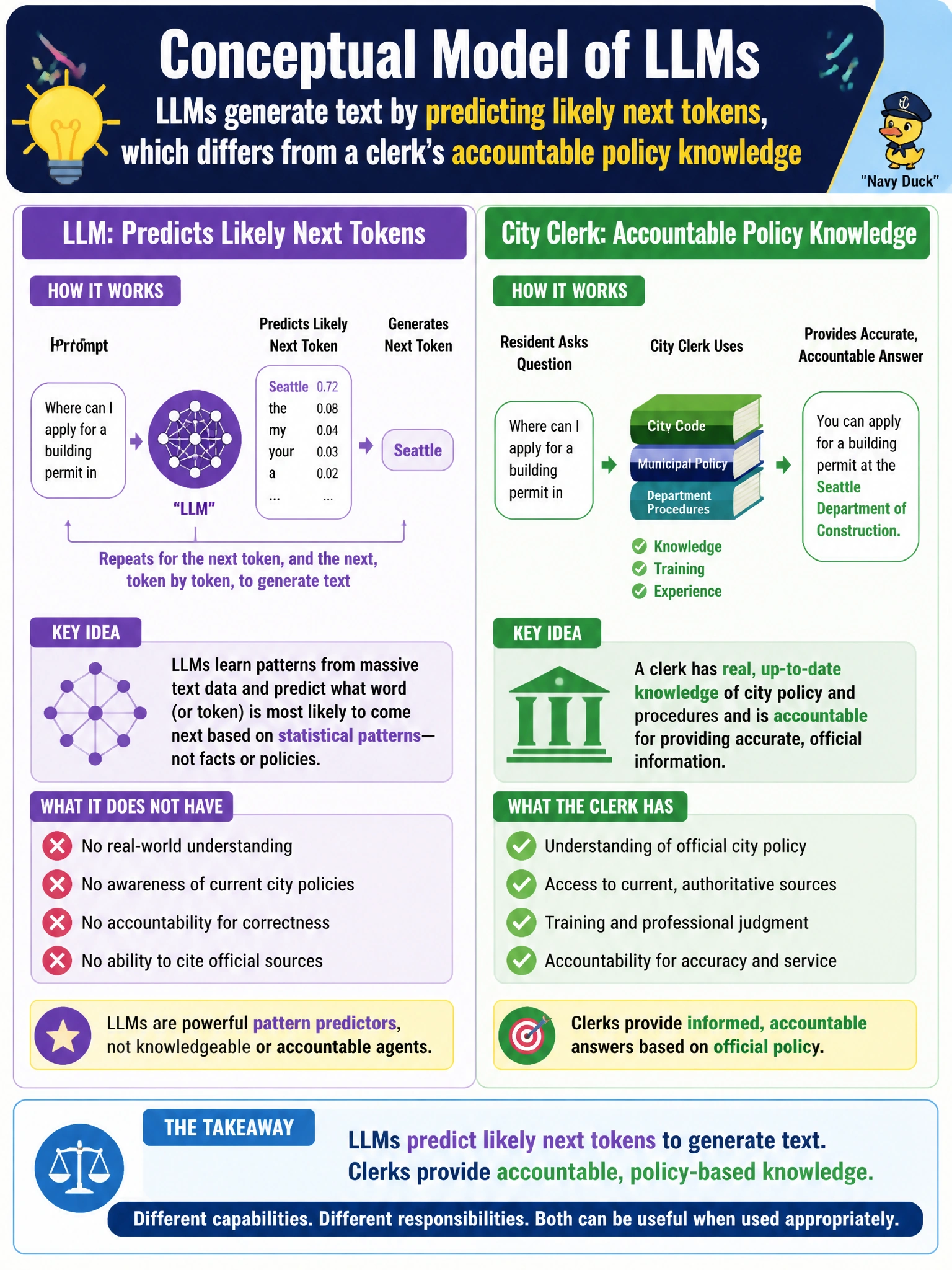
Open-data educators show that LLMs predict likely next words—they do not “know” city policy like a clerk does. What conceptual model of LLMs is taught?
Select an answer to reveal the explanation.
Short Explanation
The model is guessing fluent next words, not sitting at the clerk’s desk with accountable policy knowledge. Educators stress prediction versus knowing. You’re not getting a clerk’s know-how from vector lookup, clerk logic wired into attention layers, or real policy knowledge pulled from weights — it’s just predicting the next token.
Full Explanation
Open-data educators teach a core conceptual model: LLMs generate text by predicting likely next tokens from patterns in training data and prompts. That statistical generation differs from a municipal clerk’s accountable policy knowledge, where a person can cite the controlling rule, apply discretion under authority, and accept responsibility for the answer. Fluency from next-token prediction is not the same as certified knowledge of city policy, and treating it as such creates governance failures.
LLMs do not mimic a clerk’s policy knowledge via vector retrieval; vector similarity scores help predict likely next tokens from patterns, not replicate a clerk’s ability to cite controlling authority, exercise discretion, and accept responsibility. They do not map a clerk’s accountable logic to attention layers; attention layers are numerical weighting operations that guide next-token prediction, with no representation of legal authority, discretion, or responsibility for the answer. They do not extract accountable policy knowledge from semantic weights; weights encode statistical word-pattern associations from training, not certified city policy a clerk can cite and stand behind. Those distractors anthropomorphize or over-credential the model.
Exam caveat: retrieval grounding and tools can supply current policy text, but the generator can still mis-read or overgeneralize retrieved material. Operational check: require citations to the controlling policy for public answers, route high-stakes questions to clerks, and train staff to explain LLMs as probabilistic generators rather than unofficial deputy clerks.
Prefer to study offline? Printable PDF study book + test engine ($7.50, unofficial). These questions stay free here.