
IT explains tokens and context windows simply when a long ordinance paste gets truncated mid-answer. What LLM limit is being taught?
Select an answer to reveal the explanation.
Short Explanation
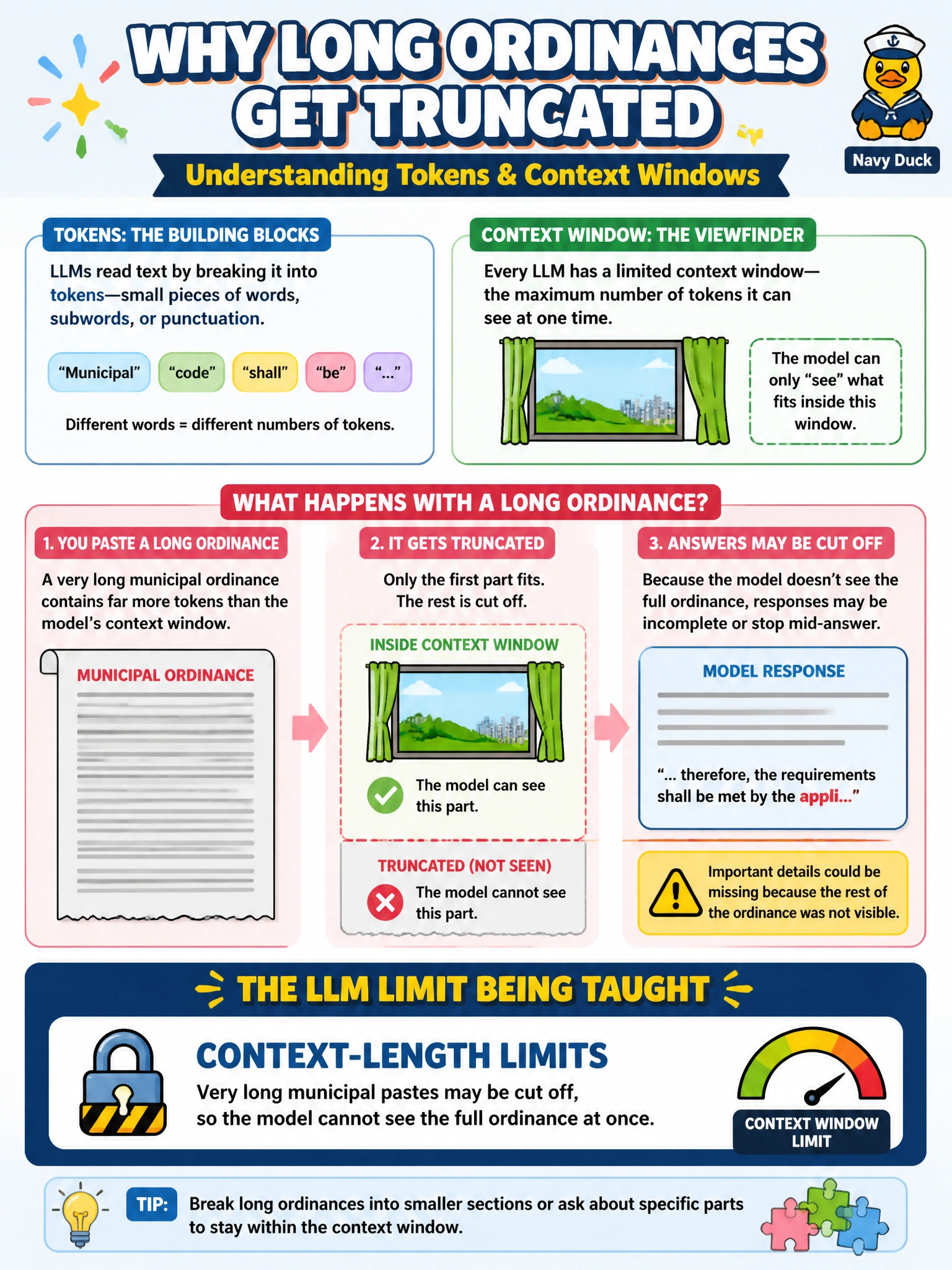
Stuff a giant ordinance into the chat and the model may only “see” part of it—that is the context window. API rate limits just throttle traffic, response-length limits just trim what you'll get back, and knowledge cutoffs are just about how old the training data is, so they don't cut off how much of the ordinance you can paste in. IT is teaching a real LLM limit.
Full Explanation
Large language models process text in tokens and can only attend to a limited context window at once. When IT shows that pasting a long ordinance causes mid-answer truncation, the literacy point is that the model may not “see” the full municipal text—earlier or later sections can fall outside the context limit—so answers can be incomplete or wrong even if the staff member pasted everything into the chat UI. Tokens are subword pieces of text; context length is an architectural limit on how much input fits at once, not a response-length limit, which only caps output length and does not cut off a very long municipal paste so the model cannot see the full ordinance at once. Labeling this as model knowledge cutoffs mistakes training-data freshness for input capacity; knowledge cutoffs limit how recent the model's learned information is, they do not cut off a very long municipal paste so the model cannot see the full ordinance at once. Labeling this as API rate limits confuses traffic throttling with model context limits; rate limits queue or delay requests during peak use, they do not cut off a very long municipal paste so the model cannot see the full ordinance at once. Labeling this as response length limits is a settings error; response length limits shorten output length for readability, but they do not cut off a very long municipal paste so the model cannot see the full ordinance at once. Exam caveat: vendors quote context sizes differently (tokens ≠ words), and long system prompts or chat history consume the same window as the ordinance paste. Operational check: chunk long ordinances by section, retrieve only relevant clauses, verify answers against the official code text, and teach staff that a confident partial answer can still miss a critical exception outside the window.
Prefer to study offline? Printable PDF study book + test engine ($7.50, unofficial). These questions stay free here.