
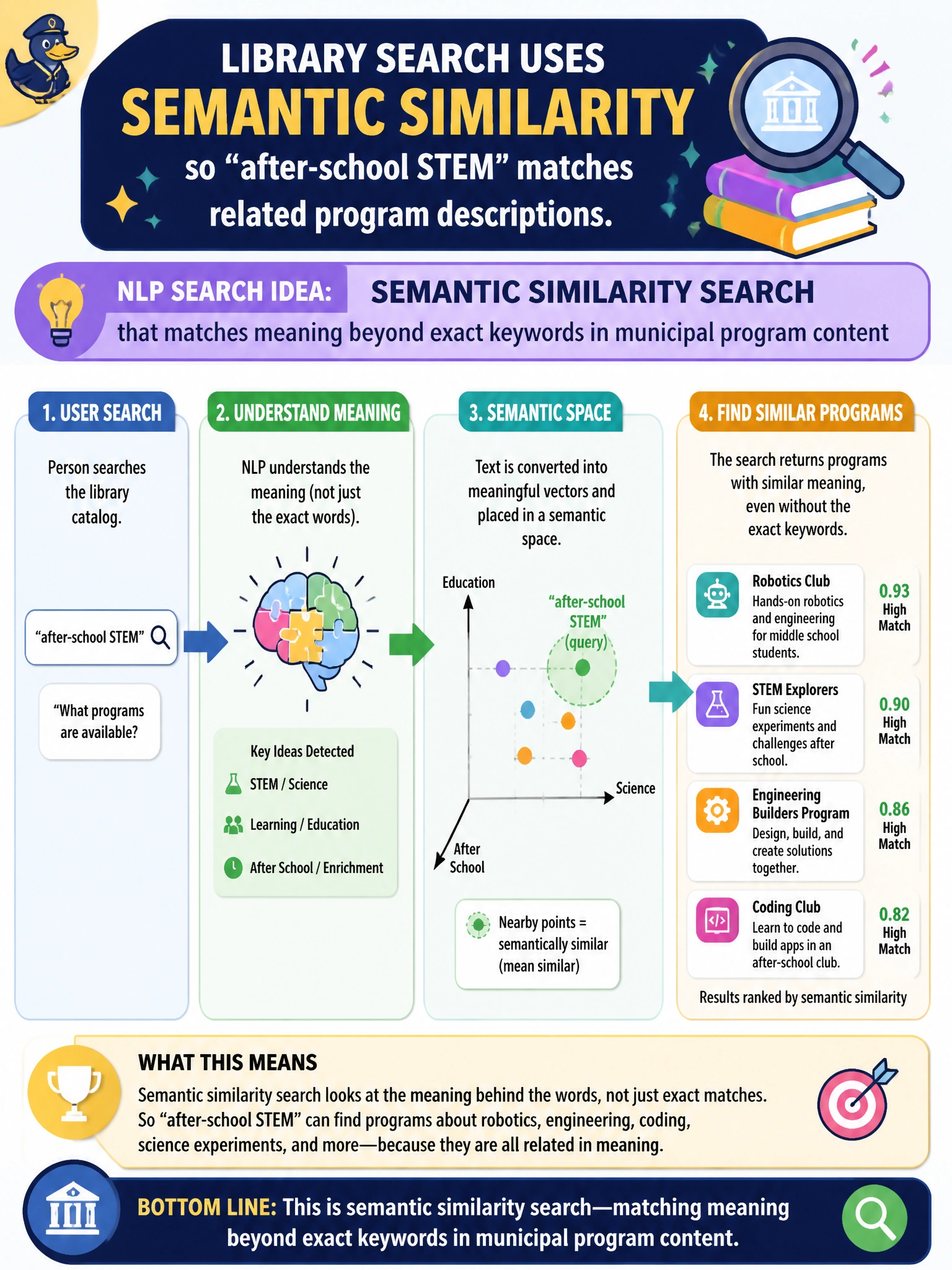
Library search uses semantic similarity so “after-school STEM” matches related program descriptions. What NLP search idea is demonstrated?
Select an answer to reveal the explanation.
Short Explanation
If a kid types “after-school STEM” and still finds the robotics club write-up, meaning-based search did the work. You'll know it's meaning matching because you're catching ideas beyond exact words, not just counting overlapping n-grams, scoring sparse tf-idf vectors, or looking up root tokens in inverted indices that still need keyword overlap. The catalog stays put.
Full Explanation
Semantic similarity search uses NLP embeddings or related meaning-based retrieval so that a query such as “after-school STEM” can match municipal program descriptions that use different words—robotics club, coding workshop, science enrichment—without requiring exact keyword overlap. Library and recreation catalogs benefit because patrons rarely phrase needs the same way staff wrote the program copy. The demonstrated idea is meaning-aware search over municipal content, not semantic similarity search that relies on overlapping n-grams to rank municipal program content. Semantic similarity search that relies on overlapping n-grams to rank municipal program content counts shared word sequences rather than matching query meaning to description meaning, so it cannot connect “after-school STEM” to a robotics club description that uses different wording. Semantic similarity search that computes sparse tf-idf vectors to rank municipal program content scores exact-term frequency and rarity rather than retrieving by meaning, so it would not help a plain-language query such as “after-school STEM” find a robotics club description that uses different wording. Semantic similarity search that queries inverted indices of root tokens in municipal program content looks up stemmed keywords in an inverted index, so it would miss robotics club, coding workshop, or science enrichment when the patron types “after-school STEM” — the opposite of meaning-first semantic ranking. Exam caveat: semantic search can over-associate loosely related programs; municipal deployments still need filters for age, location, eligibility, and date. Operational check: test a golden set of patron-style queries against known relevant programs, review near-miss results with librarians, and keep an exact-match or keyword fallback for catalog numbers and official program codes.
Prefer to study offline? Printable PDF study book + test engine ($7.50, unofficial). These questions stay free here.