
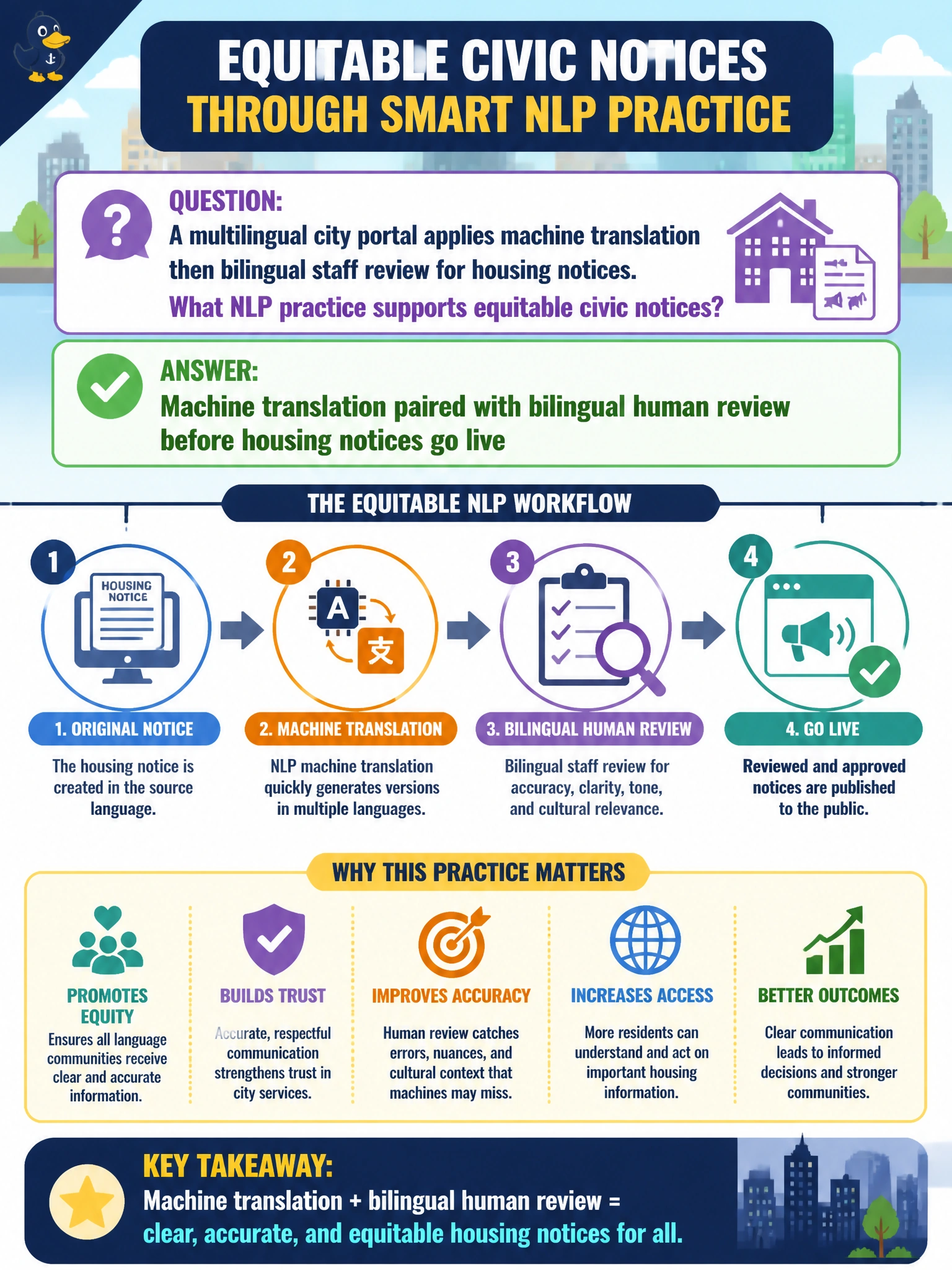
A multilingual city portal applies machine translation then bilingual staff review for housing notices. What NLP practice supports equitable civic notices?
Select an answer to reveal the explanation.
Short Explanation
Machine translation drafts fast; bilingual staff catch the oops moments before housing notices ship. You need bilingual review of each full notice before it goes live, so you'll still ship wrong dates and confusing wording if you're only using back-translation with dictionary checks or trusting zero-shot transfer scored by automated metrics. You'll still leave gaps if you're only relying on automated quality checks after neural machine translation because auto scores won't catch wrong dates or confusing tone like bilingual staff will.
Full Explanation
Equitable multilingual civic communication pairs machine translation speed with bilingual human review before housing notices go live. NLP translation models can draft notices quickly across languages, but housing content often carries legal deadlines, eligibility rules, and culturally sensitive phrasing. Bilingual staff catch mistranslations, missing particles that reverse meaning, and tone problems that would confuse or alarm residents. The municipal practice being tested is machine-assisted language access with accountability—not automated back-translation paired with dictionary validation before housing notices go live, which checks round-trip wording and word lists without bilingual judgment of legal deadlines or eligibility meaning. Pairing automated back-translation with dictionary validation before housing notices go live relies on machine round-trip and word lookup rather than human review, so errors in legal deadlines, eligibility rules, and tone can pass both automatic checks while still misleading residents. Pairing zero-shot cross-lingual transfer with automated metrics before housing notices go live applies models to unseen languages without bilingual review, so residents get output scored well by automatic metrics that still don't guarantee correct dates, eligibility conditions, and instructions in their language. Pairing neural machine translation with automated quality checks before housing notices go live drafts full translations but skips bilingual human review, so key dates, conditions, and tone problems can survive automatic scoring and still mislead residents even if the output reads cleanly. Exam caveat: “human in the loop” is not optional window dressing on high-stakes housing messaging; it is the control that makes MT operationally acceptable. Operational check: maintain a glossary of approved housing terms, require bilingual sign-off before publication, spot-audit live notices against source English (or source language), and provide a resident path to request clarification when wording is unclear.
Prefer to study offline? Printable PDF study book + test engine ($7.50, unofficial). These questions stay free here.