
A city data academy teaches features versus labels using parking-citation examples for a basic classifier. What ML vocabulary idea is being taught?
Select an answer to reveal the explanation.
Short Explanation
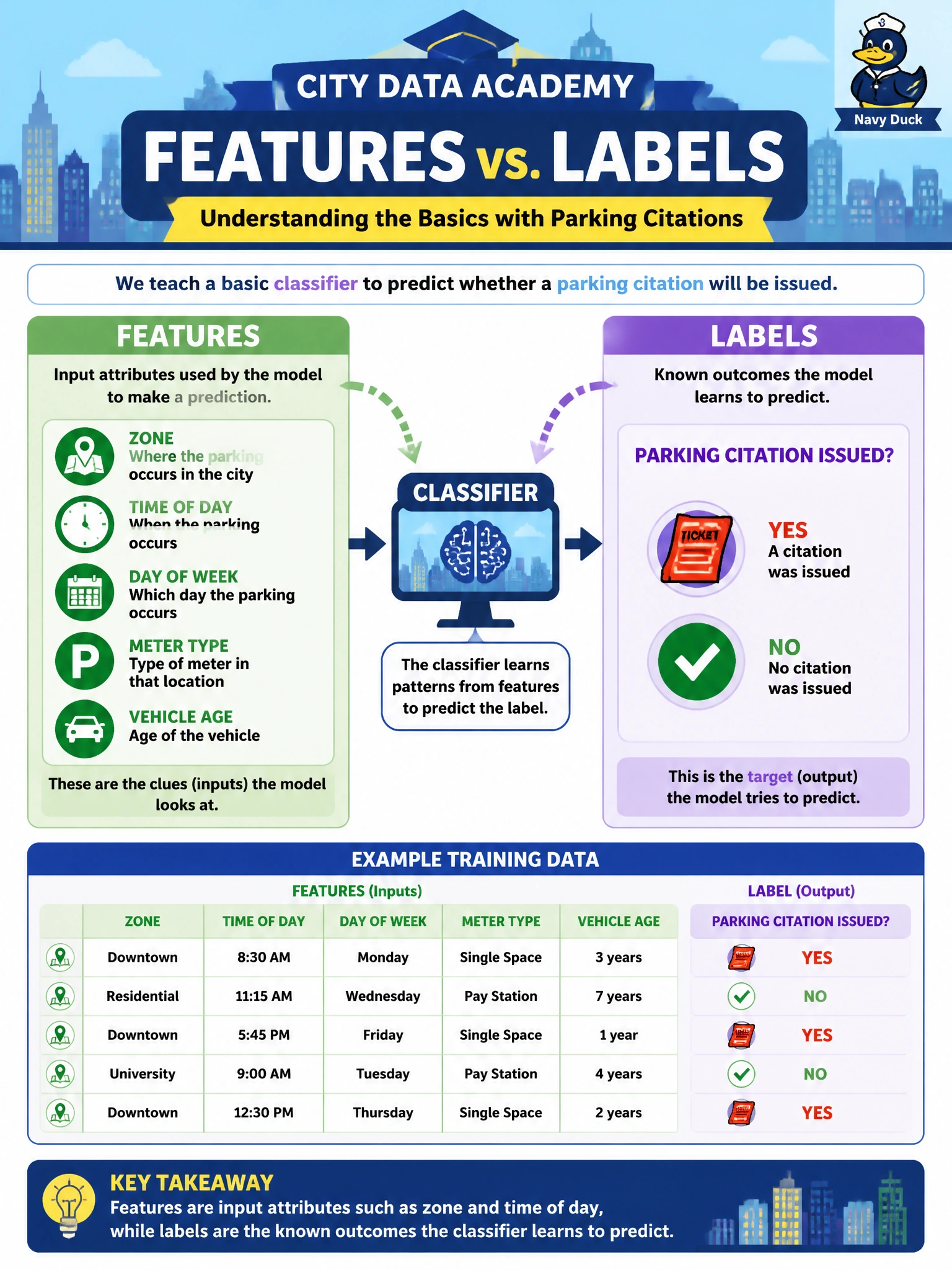
Think of features as the clues on the citation—zone, hour, plate type—and labels as the answer key for what happened. The academy is teaching that split so people stop mixing inputs with outcomes. An issuing-district tag or a similarity score isn't the label, and the label isn't the input either—it's the outcome you're trying to predict.
Full Explanation
In supervised machine learning for municipal operations, features are the measurable input attributes fed to a model, while labels are the known target outcomes the model is trained to predict. A city data academy that uses parking-citation examples is teaching exactly that vocabulary split: inputs such as zone, time of day, plate type, or prior history are features; the outcome being predicted—for example whether a citation falls into a particular class or outcome bucket—is the label. Getting this language right matters because staff who confuse inputs with outcomes will mis-specify training tables, misread model cards, and ask vendors the wrong questions when procuring classifiers for parking, permitting, or 311 triage. The distractors fail by concept rather than by trivia. Treating labels as metadata tags identifying the issuing district office, rather than the outcome being predicted, misses what makes a label a label: in supervised learning the label is the target the model learns to predict, not an administrative tag. Calling features the known violation outcomes to predict, while making labels input attributes such as zone and time of day, swaps the two terms: the outcome to predict is the label, while features are the input attributes—zone, time of day, plate type—the model uses to make that prediction. Treating labels as similarity scores used to rank related past citations for officer review confuses a derived ranking with the supervised target: the label is the known outcome recorded for each citation, not a score computed from the inputs. Exam caveat: exam items may tempt you to equate “label” with an administrative tag such as the issuing district office. In ML vocabulary, label means the supervised target, not merely a metadata field. Operational check: before approving a parking-classifier pilot, ask staff to point to the feature columns versus the label column in a sample training extract and confirm that production inference will supply the same feature fields without leaking the future label.
Prefer to study offline? Printable PDF study book + test engine ($7.50, unofficial). These questions stay free here.