
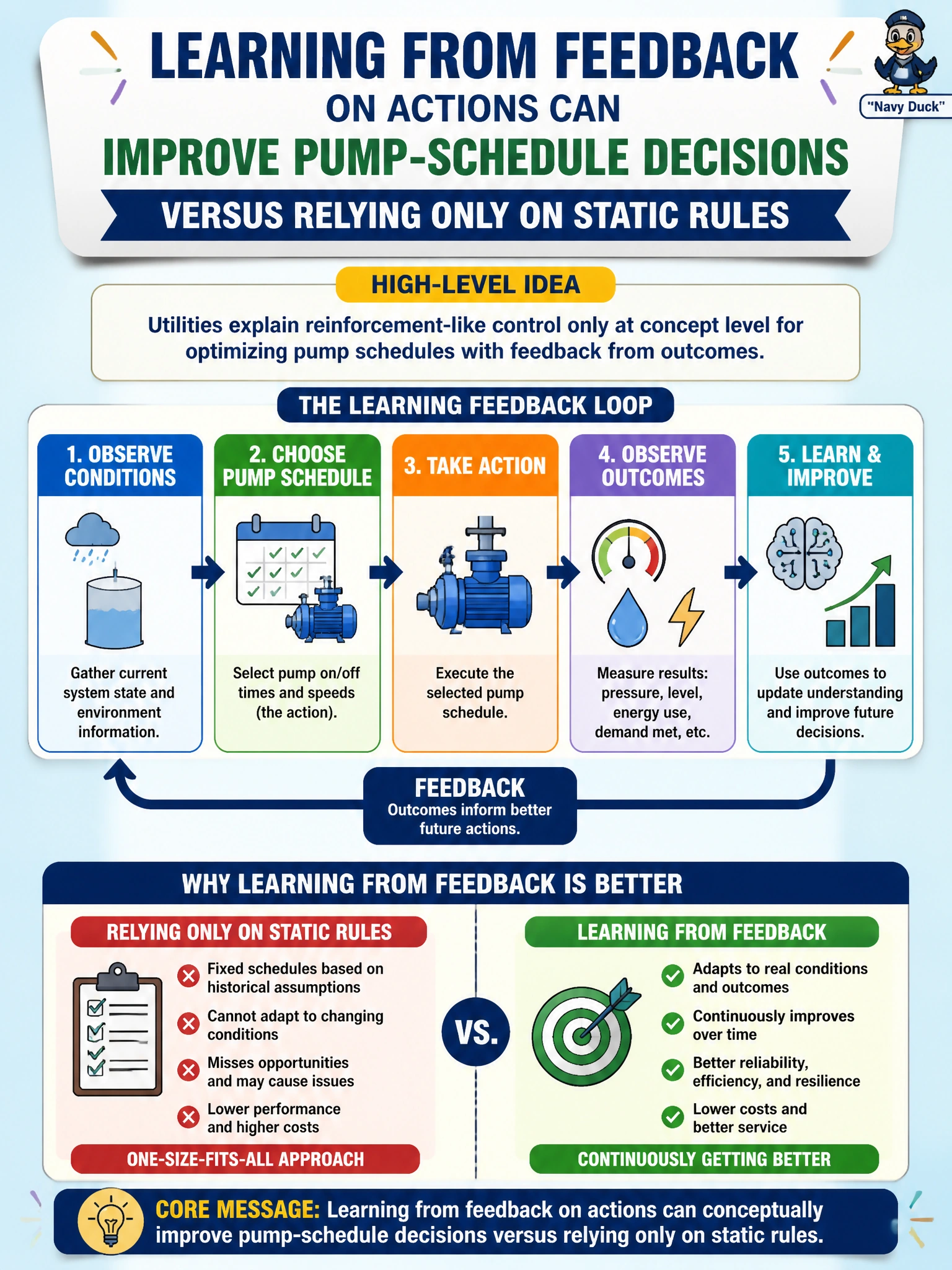
Utilities explain reinforcement-like control only at concept level for optimizing pump schedules with feedback from outcomes. What high-level idea fits?
Select an answer to reveal the explanation.
Short Explanation
If the pumps try a schedule and the tank levels teach a lesson, that feedback loop can beat a dusty static rulebook—at concept level. You’re looking at learning from what your schedules actually do, not learning demand patterns from labeled data or computing one optimal hydraulic schedule. Grouping operating modes from sensor logs isn’t that action-reward loop either — you’ll just get clusters, not lessons from what your schedules achieve.
Full Explanation
Utilities explaining reinforcement-like control only at concept level for optimizing pump schedules emphasize that learning from feedback on actions can improve decisions compared with relying only on static rules. In that high-level framing, the system proposes or selects schedule actions, observes outcomes such as tank levels, energy use, or constraint violations, and updates policy over time. Essentials literacy presents the feedback idea without requiring implementation of a full reinforcement-learning stack. Learning demand patterns from labeled data to improve pump-schedule decisions is supervised learning from labeled examples, not the outcome-guided refinement of pump schedules from feedback on actions described in the question. Computing one optimal hydraulic schedule to improve pump-schedule decisions is a single static calculation, not reinforcement-like control that learns from feedback on pump-schedule decisions over time. Grouping operating modes from sensor logs can reveal clusters or regimes, but that is unsupervised discovery of structure in unlabeled logs, not the feedback-driven improvement of pump schedules from observed action rewards. Exam caveat: water and wastewater control has safety and regulatory constraints; any feedback-driven optimizer must respect hard limits and human approval, not freely explore unsafe actions. Operational check: if exploring feedback-informed pump scheduling, simulate against historian data first, constrain actions within approved envelopes, log recommended versus accepted schedules, and keep operator override authoritative.
Prefer to study offline? Printable PDF study book + test engine ($7.50, unofficial). These questions stay free here.