
Public-health modelers describe deep learning as multi-layer neural nets useful for complex clinic image screening assists. What essentials definition fits?
Select an answer to reveal the explanation.
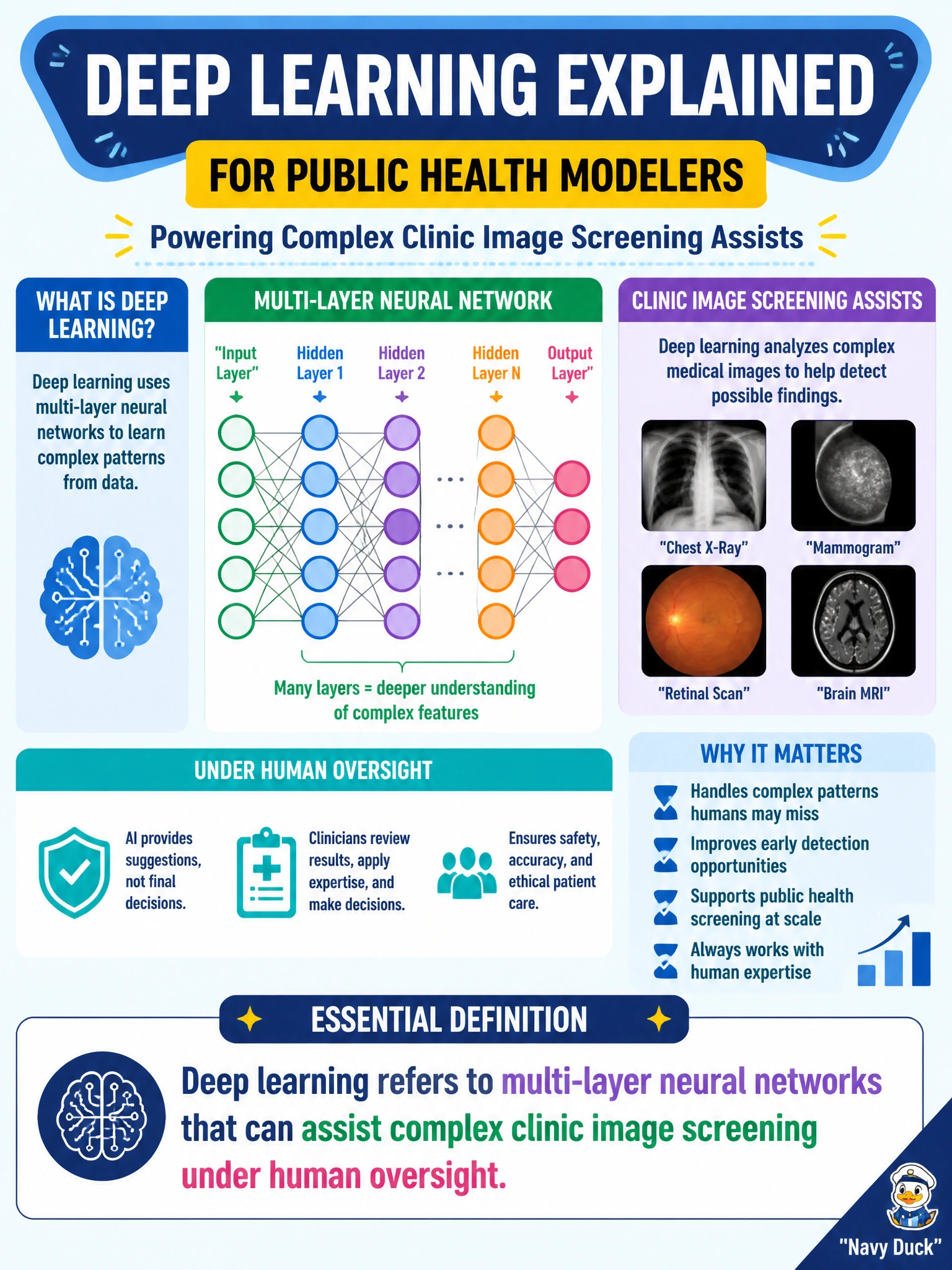
Short Explanation
Deep learning is the stacked-layer neural net that can help spot patterns in complex clinic images—with clinicians still in charge. You'll know manual feature extraction is wrong because you'll see it learns its own features, explicit rule-based logic is wrong because you'll see it learns patterns from data, and structured tabular datasets are wrong because you'll see it's built for complex clinic images. Oversight stays on.
Full Explanation
Public-health modelers describing deep learning as multi-layer neural networks useful for complex clinic image screening assists are giving an essentials-level definition. Deep learning refers to neural architectures with multiple layers that can learn hierarchical representations, often applied to complex perceptual tasks such as assisting clinic image screening under human oversight. The literacy point is conceptual recognition of the term and its typical use pattern, not processing structured tabular datasets when the essentials definition covers multi-layer neural methods for complex clinic image screening rather than structured tabular data. Describing deep learning as multi-layer neural networks that require manual feature extraction for complex clinic image screening misstates the method; deep learning refers to multi-layer neural networks that learn hierarchical representations and their own features, not manual feature extraction. Describing deep learning as multi-layer neural networks that execute explicit rule-based logic during complex clinic image screening misstates the method; the essentials definition here is multi-layer neural networks that learn hierarchical representations from data for complex clinic image screening, not systems that follow pre-written explicit rules. Saying deep learning refers to multi-layer neural networks that process structured tabular datasets for complex clinic image screening misstates the typical use; the essentials definition here is multi-layer neural networks for complex clinic image screening, not specifically processing structured tabular datasets. Exam caveat: deeper models need more data and careful validation; for many municipal tabular problems, simpler models may be preferable even though deep learning is powerful for images. Operational check: if a clinic image assist uses deep learning, document training data provenance, require clinician review before care decisions, monitor error rates by site, and retain a non-AI fallback screening path.
Prefer to study offline? Printable PDF study book + test engine ($7.50, unofficial). These questions stay free here.