
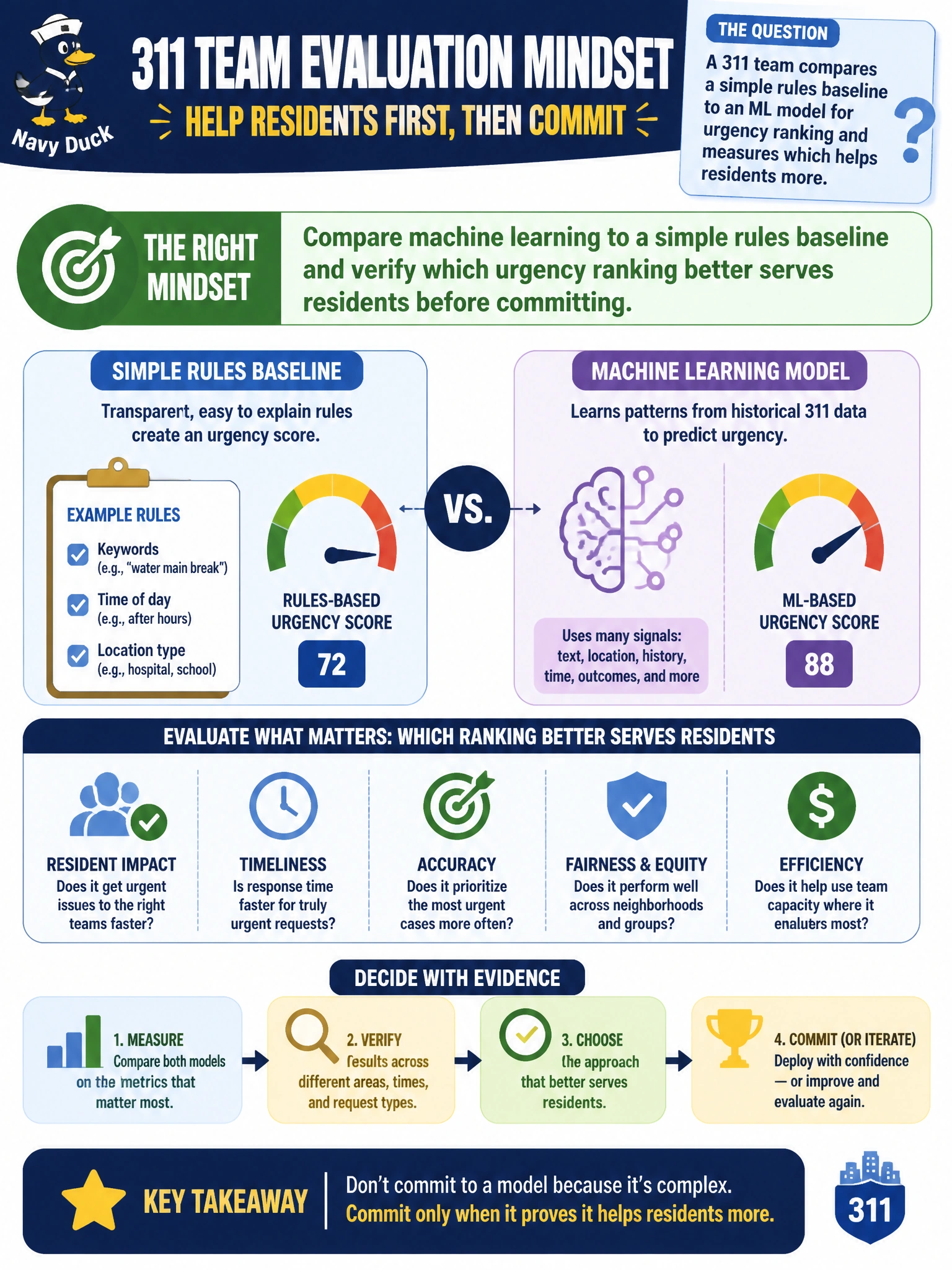
A 311 team compares a simple rules baseline to an ML model for urgency ranking and measures which helps residents more. What evaluation mindset fits?
Select an answer to reveal the explanation.
Short Explanation
Before crowning the fancy model, race it against a plain rules checklist and see who actually helps residents faster. Measurement beats hype. Don't crown it for improving offline resident metrics, aligning with resident annotations, or simulating resident satisfaction; you'll still need proof it's helping residents in live service.
Full Explanation
A 311 team that compares a simple rules baseline to an ML model for urgency ranking and measures which helps residents more is applying a sound evaluation mindset. Municipal teams should not commit to machine learning by hype; they should verify whether ML urgency ranking outperforms a transparent rules baseline on resident-centered outcomes such as time-to-appropriate routing, escalation quality, or complaint resolution. Baselines make gains measurable and keep simpler controls available when ML does not win. Comparing machine learning to a simple rules baseline and verifying which urgency ranking improves offline resident metrics before committing keeps a baseline comparison but judges on offline resident metrics rather than live service and can commit without evidence of better resident outcomes in real use. Comparing machine learning to a simple rules baseline and verifying which urgency ranking aligns with resident annotations before committing keeps a baseline comparison but judges by alignment with resident annotations rather than prospective live impact and can commit without verified improvement in actual service. Comparing machine learning to a simple rules baseline and verifying which urgency ranking simulates resident satisfaction before committing keeps a baseline comparison but judges by simulated resident satisfaction as a proxy rather than observed resident-centered outcomes and can commit without evidence of better service. Exam caveat: choose live resident impact over offline resident metrics gains that can look convincing without proving better service. Operational check: run a time-boxed comparison with the same ticket stream, publish baseline versus ML results on agreed resident metrics, and promote the winner with monitoring—or keep rules if ML does not improve service.
Prefer to study offline? Printable PDF study book + test engine ($7.50, unofficial). These questions stay free here.