
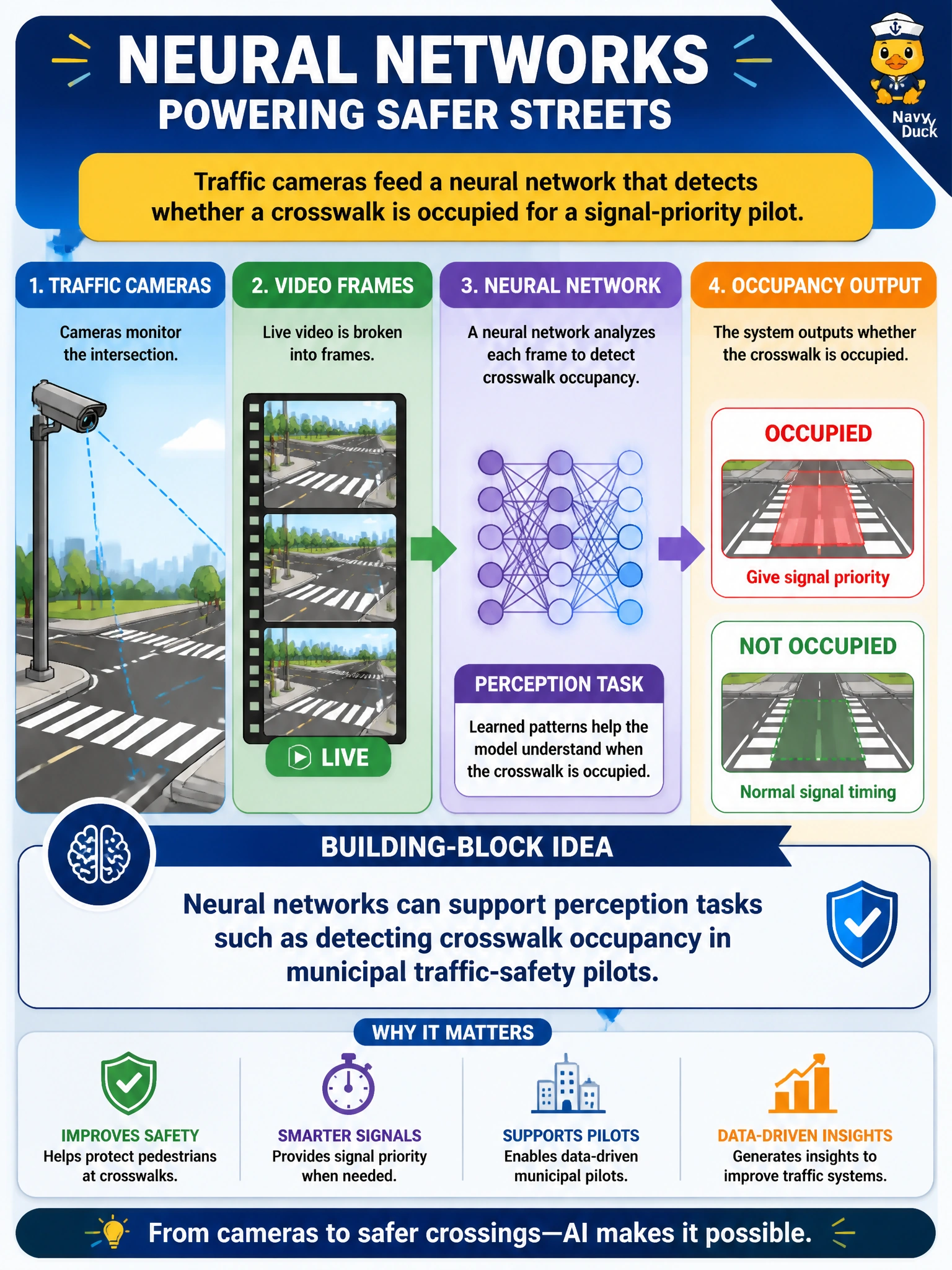
Traffic cameras feed a neural network that detects whether a crosswalk is occupied for a signal-priority pilot. What building-block idea fits?
Select an answer to reveal the explanation.
Short Explanation
A neural net watching the crosswalk is like a very fast pattern-spotter for “someone’s in the stripes”—useful for signal pilots. That is perception AI for traffic safety literacy. You'll spot if someone's in the crosswalk with perception, and adjusting the signals from that spot is a separate control step.
Full Explanation
Traffic-safety pilots may use neural networks for perception tasks such as detecting whether a crosswalk is occupied to inform signal-priority logic. Essentials literacy recognizes neural networks as a building block that can support image or sensor perception in municipal contexts when paired with engineering controls and human oversight of the pilot. The correct idea is capability awareness for civic safety use, not a forecasting task such as predicting pedestrian arrivals, a planning task such as scheduling signal priority, or a control task such as adjusting crosswalk signals. Describing the pilot as a forecasting task such as predicting pedestrian arrivals mislabels the building block, because forecasting concerns future-state prediction, not the camera-based perception task of detecting whether a crosswalk is currently occupied described in the pilot. Describing the pilot as a planning task such as scheduling signal priority mislabels the building block, because scheduling priority is a planning use of a detection, not the camera-based perception task of detecting whether a crosswalk is currently occupied described in the pilot. Describing the pilot as a control task such as adjusting crosswalk signals mislabels the building block, because detecting occupancy from camera feeds is perception, while control would be adjusting crosswalk signals based on that detection, rather than the detection itself. Exam caveat: perception accuracy varies with lighting, occlusion, and camera placement; signal actions based on detections need fail-safe defaults when confidence is low. Operational check: for a crosswalk pilot, measure detection performance across day/night conditions, minimize retained imagery, define fallback signal behavior on model failure, and keep traffic engineers accountable for timing changes.
Prefer to study offline? Printable PDF study book + test engine ($7.50, unofficial). These questions stay free here.