
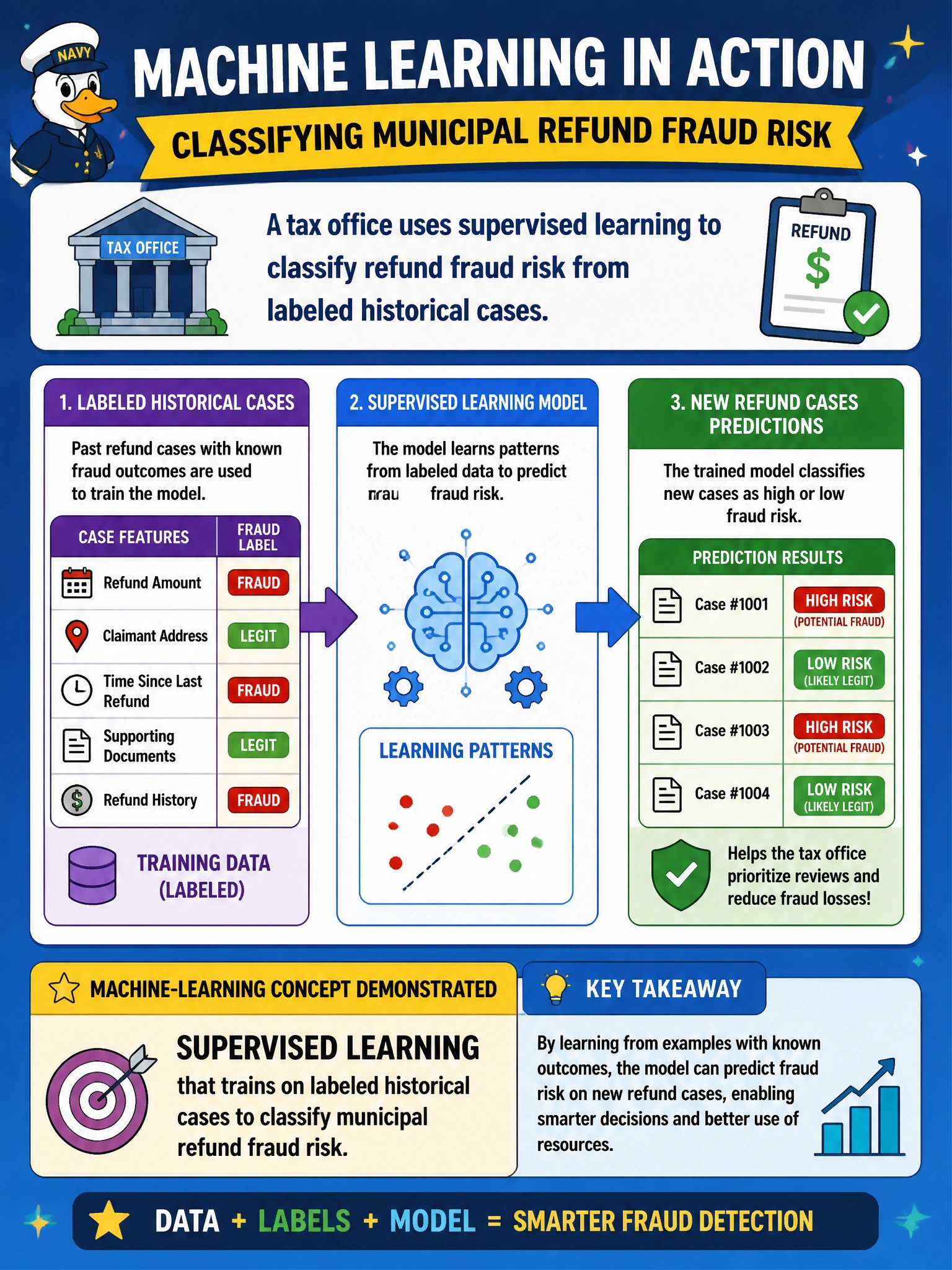
A tax office uses supervised learning to classify refund fraud risk from labeled historical cases. What machine-learning concept is demonstrated?
Select an answer to reveal the explanation.
Short Explanation
Labeled past fraud cases are the answer key; supervised learning studies that key to score new refund risk. You'll use it to predict risk on new claims, so clustering labeled cases to segment groups misses the classification teaching signal, optimizing policies to map actions misses learning from known outcomes, and reducing features to plot cases understates the risk scoring you've got. Humans still oversee enforcement actions.
Full Explanation
A tax office that classifies refund fraud risk from labeled historical cases is demonstrating supervised learning: the algorithm trains on examples where the fraud or risk outcome is known, then applies the learned mapping to new refund claims. That concept fits municipal fraud-risk ranking because past adjudicated cases supply the teaching signal for classification or scoring under analyst review. Supervised learning that clusters labeled historical cases to segment municipal refund fraud risk misstates the mechanism for this item, since clustering segments cases by similarity without learning a labeled outcome mapping, whereas the office is classifying fraud risk from known labels. Supervised learning that optimizes policies on labeled historical cases to map municipal refund fraud risk misstates the mechanism for this item, since optimizing policies learns sequential decision policies from rewards, whereas the office is classifying fraud risk from known labels. Supervised learning that reduces features of labeled historical cases to plot municipal refund fraud risk misstates the mechanism for this item, since reducing features to plot compresses variables for visualization, whereas this item describes training on labeled historical cases to classify fraud risk. Exam caveat: label bias in historical enforcement can encode past disparities; supervised fraud models need sampling and metric review so risk scores do not simply replay biased audit patterns. Operational check: confirm training labels come from reviewed historical cases, hold out a test period of refunds, and keep human adjudication on high-impact denials or escalations rather than fully automating taxpayer outcomes.
Prefer to study offline? Printable PDF study book + test engine ($7.50, unofficial). These questions stay free here.