
An HR analytics team documents hyperparameters only at literacy level: settings that change how training behaves. What essentials idea fits?
Select an answer to reveal the explanation.
Short Explanation
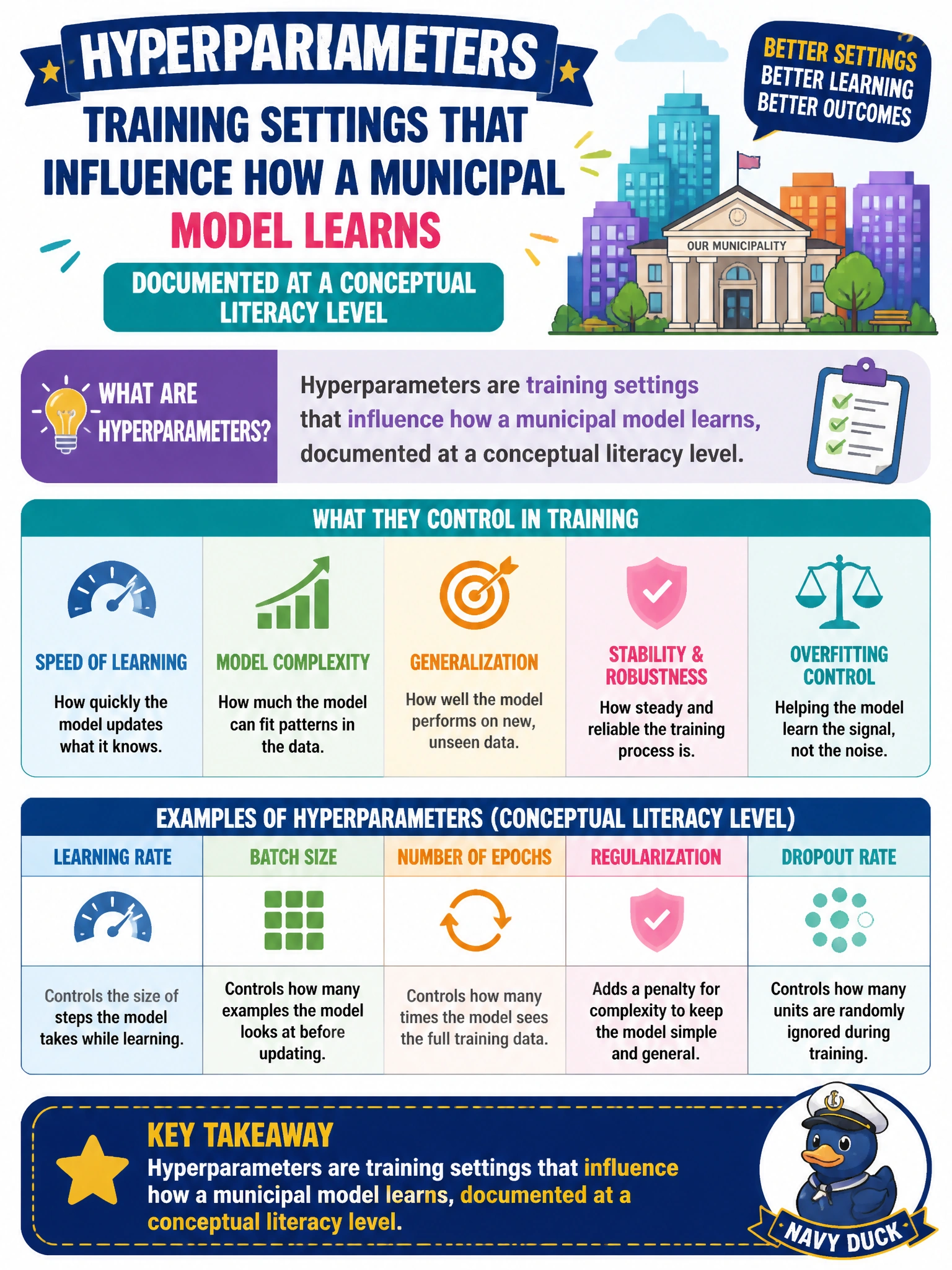
Hyperparameters are the oven dials—temperature and time—for training, not the cake ingredients themselves. HR teams at essentials level just need that dials-change-behavior idea. You're not picking learned model weight settings, curated HR data settings, or accuracy and fairness settings tracked after training.
Full Explanation
At Artificial Intelligence Essentials literacy, an HR analytics team that documents hyperparameters as settings that change how training behaves is capturing the correct conceptual idea. Hyperparameters—such as learning rate, tree depth, or training epochs conceptually—influence how a municipal model learns from labeled examples; they are chosen or tuned as part of training setup rather than learned as the primary model parameters in the simplest teaching framing. Documenting them at a conceptual level supports reproducibility and governance conversations without requiring research-level math. Calling hyperparameters learned model weight settings tuned during municipal model training confuses training settings with the internal parameters the model actually learns, even though documenting at a conceptual literacy level is correct. Saying they are curated HR data settings used for municipal model training confuses training settings with the training data itself—hyperparameters shape how learning happens, they are not the curated data, even though documenting at a conceptual literacy level is correct. Calling them accuracy and fairness settings tracked after municipal model training confuses setup dials with post-training evaluation metrics—hyperparameters influence training behavior, they don't describe deployment performance, even though documenting at a conceptual literacy level is correct. Exam caveat: exact hyperparameter lists vary by algorithm; essentials exams emphasize the role (settings that influence training behavior), not memorizing every knob for every library. Operational check: when HR models are trained, record the hyperparameter choices with the model version, justify changes after retuning, and re-evaluate fairness and accuracy metrics rather than assuming a new dial setting is automatically better.
Prefer to study offline? Printable PDF study book + test engine ($7.50, unofficial). These questions stay free here.