
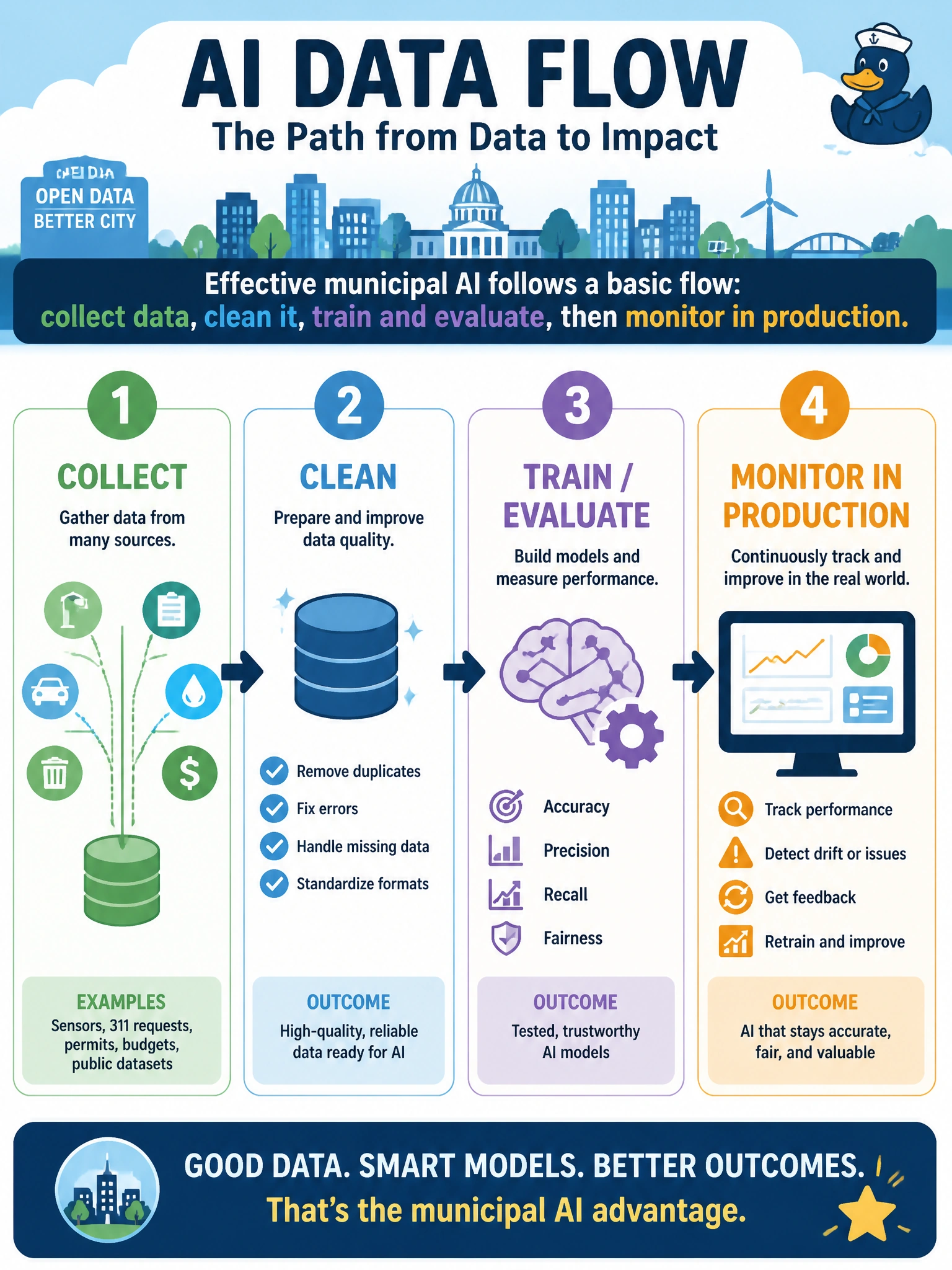
An open-data portal team explains AI data flow as collect → clean → train/evaluate → monitor in production. What literacy point are they teaching?
Select an answer to reveal the explanation.
Short Explanation
Think of civic AI like a kitchen line: gather ingredients, wash them, cook and taste-test, then keep an eye on the plate after it leaves the window. Skip a station and the dish suffers. You've got to wash it clean because labeling alone won't make it safe, you'll cook and taste-test it because tweaking and shipping skips the test, and you're watching it live because it's not filed away.
Full Explanation
Open-data and municipal AI teams teach a basic lifecycle literacy point when they explain AI data flow as collect → clean → train/evaluate → monitor in production. That sequence emphasizes that civic projects need deliberate intake, quality work, model fitting with evaluation, and ongoing production monitoring rather than a single leap from raw files to live decisions. Each stage catches different failure modes, from bad source extracts to silent drift after deployment. Saying effective municipal AI follows a basic flow of collect data, label it, train and evaluate, then monitor in production omits the cleaning step; labeling is only one possible preparation task, while cleaning is the required quality work that must happen before models are fit and evaluated. Saying effective municipal AI follows a basic flow of collect data, clean it, fine-tune and deploy, then monitor in production skips evaluation; train and evaluate is the required fitting-with-testing stage before deployment, while fine-tuning and deploying alone provide no evaluation gate before production monitoring. Saying effective municipal AI follows a basic flow of collect data, clean it, train and evaluate, then archive in production replaces ongoing oversight with storage; production monitoring comes last as active oversight for drift and failures, not archiving. Exam caveat: stages iterate; monitoring findings often drive new collection or cleaning, so the flow is a loop in practice even when taught linearly at essentials level. Operational check: for each municipal AI pilot, name owners for collection, cleaning, train/evaluate, and production monitoring, and refuse go-live if the monitoring stage has no metrics, owners, or rollback path.
Prefer to study offline? Printable PDF study book + test engine ($7.50, unofficial). These questions stay free here.