
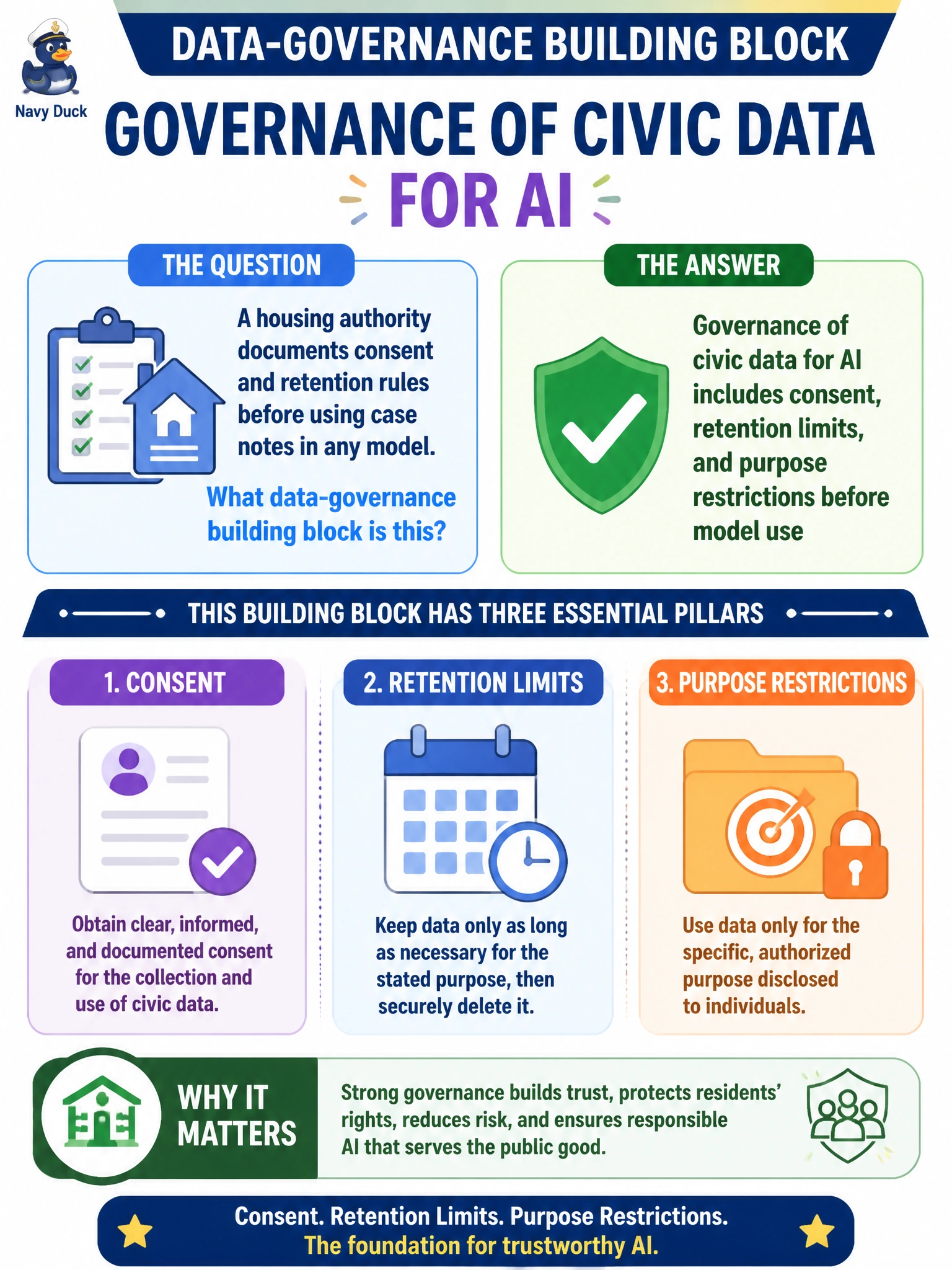
A housing authority documents consent and retention rules before using case notes in any model. What data-governance building block is this?
Select an answer to reveal the explanation.
Short Explanation
Case notes are not free training candy—consent, retention clocks, and purpose limits come before any model snack. That's civic data governance, not just encoding tags, fields, and codes, sharing summaries, notices, and statements, or tracking coverage, expiry, and drift you'll measure in production. You still have to nail that down before training starts.
Full Explanation
A housing authority that documents consent and retention rules before using case notes in any model is establishing a core data-governance building block for civic AI. Governance includes consent where required, retention limits, and purpose restrictions so sensitive resident information is not reused indefinitely or for incompatible aims. Those controls precede model training because technical accuracy does not authorize unlawful or unethical processing of case notes. Governance of civic data for AI includes consent tags, retention fields, and purpose codes before model use fails: encoding governance into tags, fields, and codes is a downstream data-engineering implementation step, not the upstream documentation of consent and retention rules that authorizes whether the notes may be held or reused at all. Governance of civic data for AI includes consent summaries, retention notices, and purpose statements before model use fails because summaries, notices, and statements concern outward reporting of governance for transparency, not the upstream documentation of consent and retention rules that governs whether case notes may be used at all. Governance of civic data for AI includes consent coverage, retention expiry, and purpose drift before model use fails because coverage, expiry, and drift are ongoing monitoring measures enforced after deployment; they are not the upfront documentation of consent and retention rules before any model use. Exam caveat: governance requirements vary by program and jurisdiction; essentials literacy stresses the need for documented consent and retention rules, not a single universal number, and should not be confused with encoding details like consent tags, retention fields, and purpose codes, reporting artifacts like consent summaries, retention notices, and purpose statements, or production measures like consent coverage, retention expiry, and purpose drift. Operational check: before any housing-AI pilot, record the lawful basis or consent approach, map retention periods to note types, restrict vendor access by purpose, and verify deletion or anonymization paths when retention expires.
Prefer to study offline? Printable PDF study book + test engine ($7.50, unofficial). These questions stay free here.