
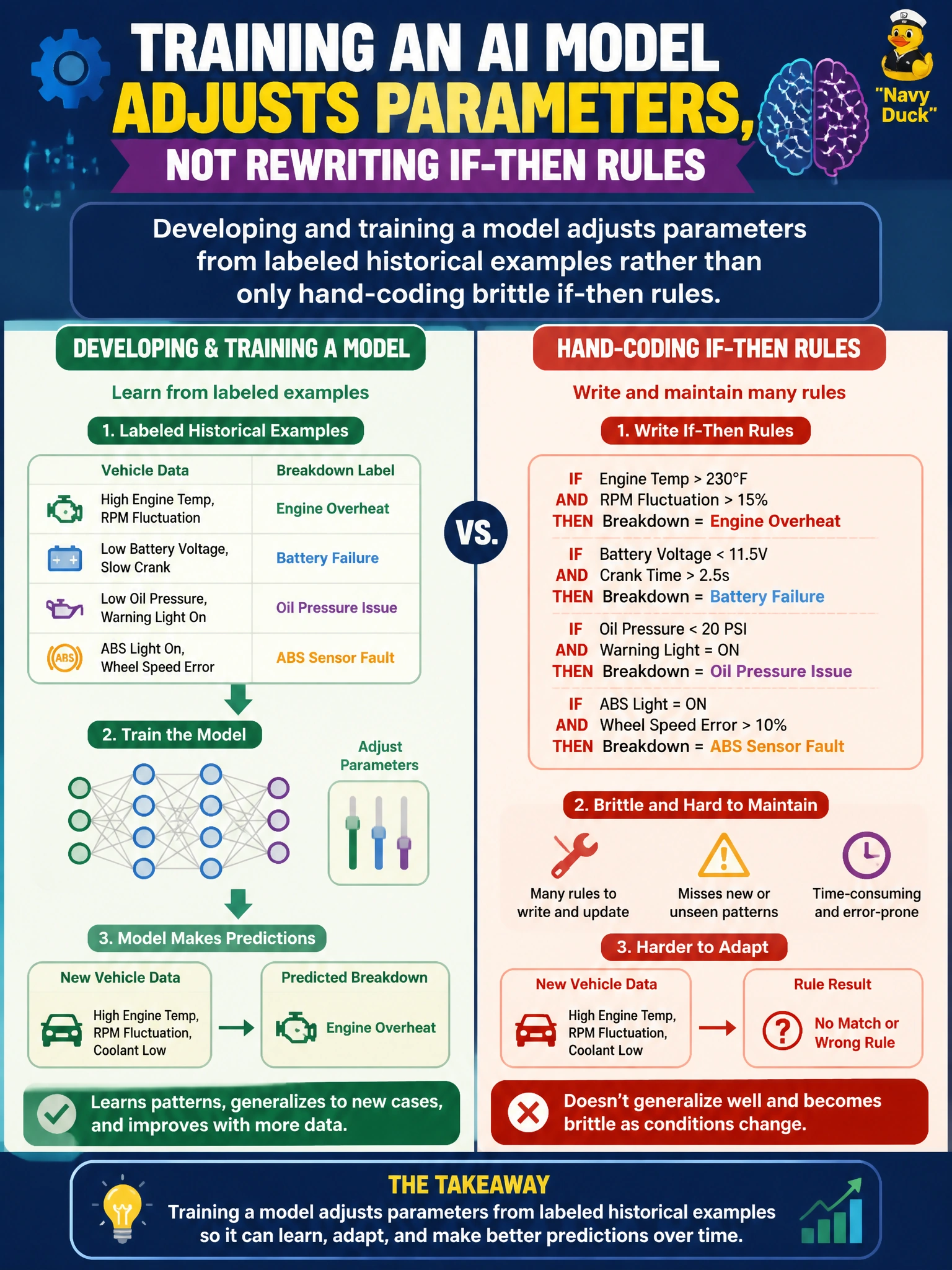
Fleet managers hear that training an AI model means adjusting parameters on historical breakdown labels, not rewriting a long list of if-then rules. What development idea fits?
Select an answer to reveal the explanation.
Short Explanation
Old-school if-then binders are recipes you type by hand; training is more like the model tuning dials from past breakdown labels. Fleet AI literacy starts with that difference. When you validate on held-out routes to estimate recall, you're checking performance, and it's not the parameter tuning itself.
Full Explanation
Fleet managers learning how AI models are developed need the conceptual distinction that training adjusts parameters using labeled historical examples—such as past breakdown outcomes—rather than only hand-coding long brittle if-then rule lists. Parameter learning from data can capture patterns that are hard to enumerate manually across vehicle types, duty cycles, and failure modes, while still remaining a municipal decision-support aid rather than an autonomous mechanic. Validating a breakdown model on held-out historical routes to estimate recall from labeled examples before deployment decisions measures how well already-fitted parameters generalize, but it does not adjust parameters from labeled breakdown history the way training does. Deploying a fitted breakdown model with frozen parameters to score incoming telematics batches for maintenance scheduling workflows describes live inference with fixed parameters, not the training and parameter fitting the question asks about. Curating and cleaning historical work orders and sensor logs to improve label quality for future breakdown parameter fitting work is important data preparation, but it happens before parameter fitting and is not itself the training that adjusts parameters from labels. Exam caveat: learned models still need operational thresholds, human review for safety-critical fleet actions, and clear fallback rules when sensor data are missing. Operational check: when evaluating a fleet AI proposal, ask what labeled breakdown history trains the model, how parameters are validated, and where rule-based overrides remain for out-of-policy maintenance decisions.
Prefer to study offline? Printable PDF study book + test engine ($7.50, unofficial). These questions stay free here.