
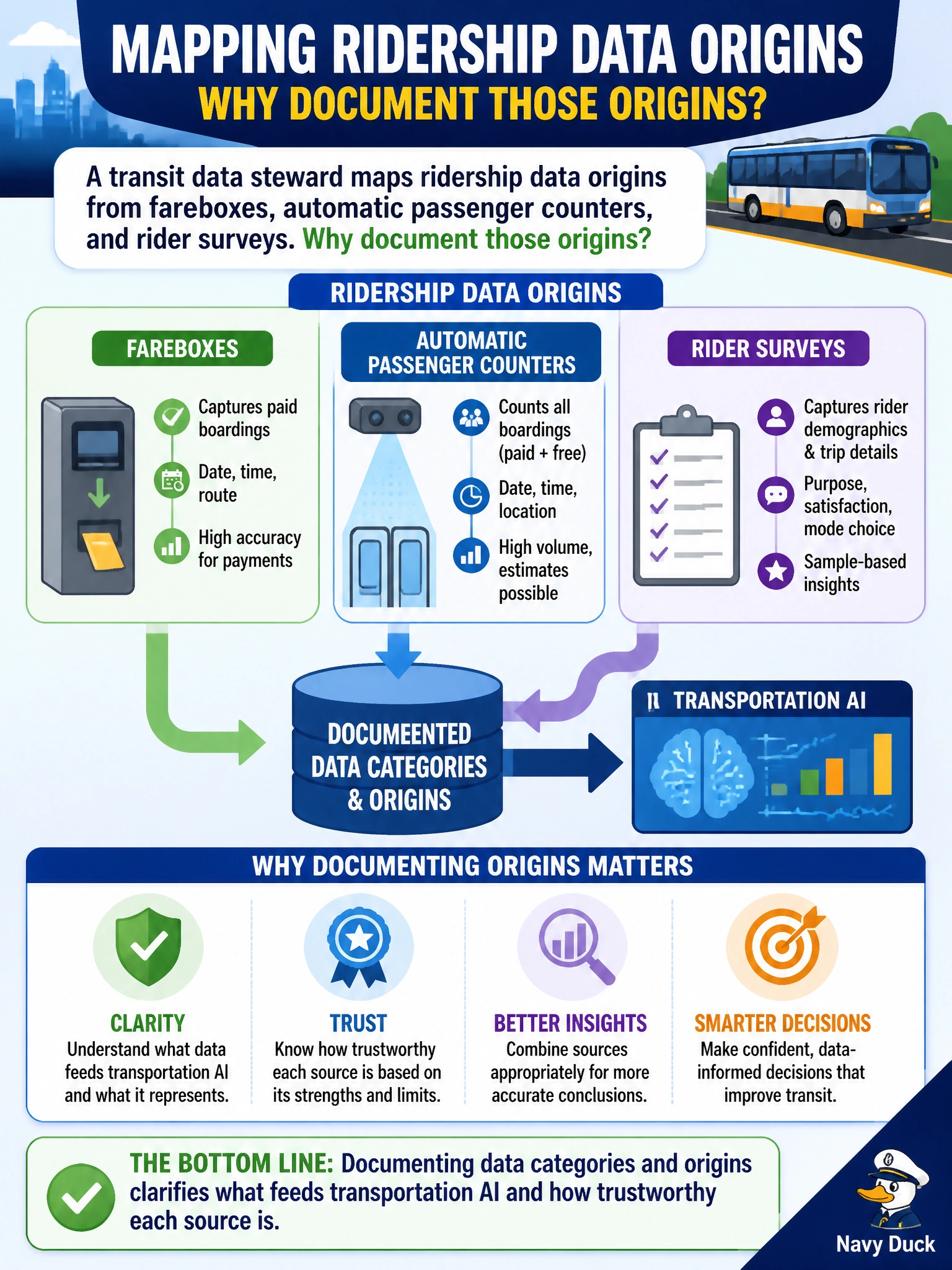
A transit data steward maps ridership data origins from fareboxes, automatic passenger counters, and rider surveys. Why document those origins?
Select an answer to reveal the explanation.
Short Explanation
Ridership numbers come from different taps—fareboxes, counters, surveys—and each tap has quirks. Mapping origins tells you what the transportation AI is actually drinking. You'll still need separate work to structure schemas for route optimization AI, normalize metrics for demand forecasting AI, and anonymize records for dynamic scheduling AI, since listing origins doesn't automatically fix those jobs.
Full Explanation
Transit data stewards who map ridership data origins from fareboxes, automatic passenger counters, and rider surveys are practicing lineage and category documentation. Documenting those origins clarifies what feeds transportation AI and how trustworthy each source is—farebox taps, sensor counts, and survey responses differ in bias, coverage, refresh rate, and error modes. That literacy helps municipal teams choose features, weight sources, and explain limitations to policymakers. Documenting data categories and origins does not clarify what feeds route optimization AI and how structured each schema is; route optimization AI requires route networks, travel-time constraints, and schema structuring, while documentation only clarifies what feeds transportation AI and how trustworthy each source is. Documenting data categories and origins does not clarify what feeds demand forecasting AI and how normalized each metric is; demand forecasting AI requires historical trends, external factors, and metric normalization, while documentation only records the ridership origin and its reliability. Documenting data categories and origins does not clarify what feeds dynamic scheduling AI and how anonymized each record is; dynamic scheduling AI requires real-time capacity signals, operational rules, and anonymization safeguards, while documentation only records what feeds transportation AI and assesses the trustworthiness of each source. Exam caveat: origin documentation should include known biases (for example undercounting non-fare riders) so AI consumers do not treat merged ridership features as ground truth. Operational check: maintain a source catalog for each ridership input, record collection method and refresh cadence, and require model cards or data notes to cite which origins trained or evaluated the transportation model.
Prefer to study offline? Printable PDF study book + test engine ($7.50, unofficial). These questions stay free here.