
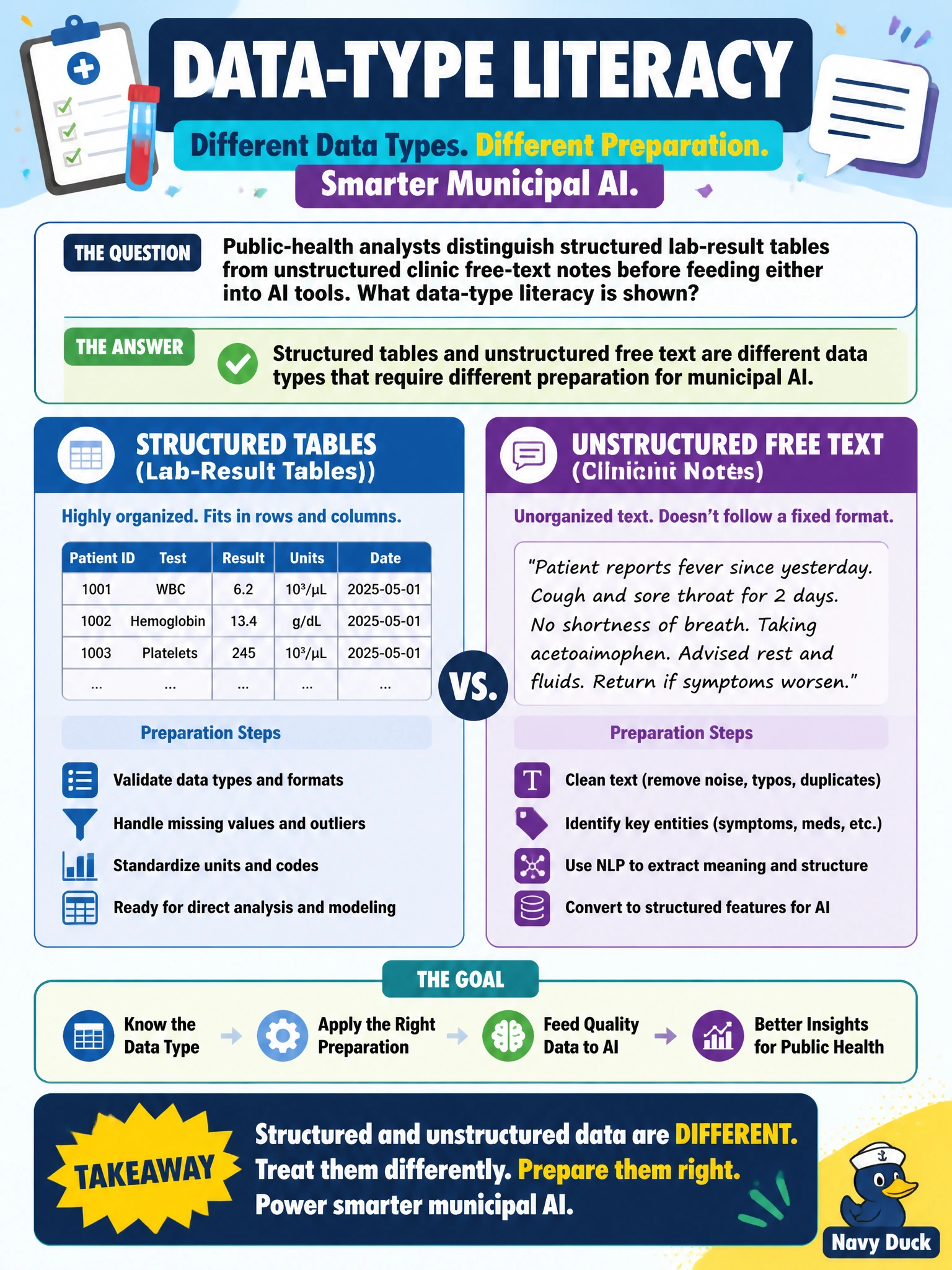
Public-health analysts distinguish structured lab-result tables from unstructured clinic free-text notes before feeding either into AI tools. What data-type literacy is shown?
Select an answer to reveal the explanation.
Short Explanation
Lab tables are neat spreadsheet drawers; clinic notes are messy desk piles—both can feed AI, but you prep them differently. That structured-versus-unstructured literacy keeps public-health projects honest. You don't semantically encode tables, you don't schema-check notes, and you don't feature-scale text—you'll prep each type its own way.
Full Explanation
Public-health analysts preparing AI inputs must distinguish structured lab-result tables from unstructured clinic free-text notes because those are different data types that require different preparation. Structured tables typically have defined fields, types, and validation rules amenable to straightforward feature use, whereas free-text notes need language preprocessing, de-identification care, and often different model families. Literacy about that distinction prevents one-size-fits-all pipelines that mishandle either source. Claiming that structured tables and unstructured free text are different data types that require separate semantic encoding for municipal AI misassigns the preparation — semantic encoding is a preparation step for unstructured clinic notes, while structured tables require schema validation and direct feature use, not semantic encoding. Saying structured tables and unstructured free text are different data types that require distinct schema validation for municipal AI overgeneralizes validation — schema validation applies to structured tables with defined fields, while free-text notes have no fixed schema and require language preprocessing, de-identification care, and embedding-oriented steps before modeling. Saying structured tables and unstructured free text are different data types that require independent feature scaling for municipal AI misapplies a structured-data step — feature scaling applies to numeric fields in structured tables, while free-text notes require language preprocessing and embedding, not numeric scaling. Exam caveat: semi-structured exports (PDF labs, HL7-like blobs stored as text) blur the boundary and still need explicit parsing decisions before modeling. Operational check: classify each public-health source as structured, unstructured, or mixed; document the prep steps and PHI handling for each; and keep human review on any clinic-facing recommendation path.
Prefer to study offline? Printable PDF study book + test engine ($7.50, unofficial). These questions stay free here.