
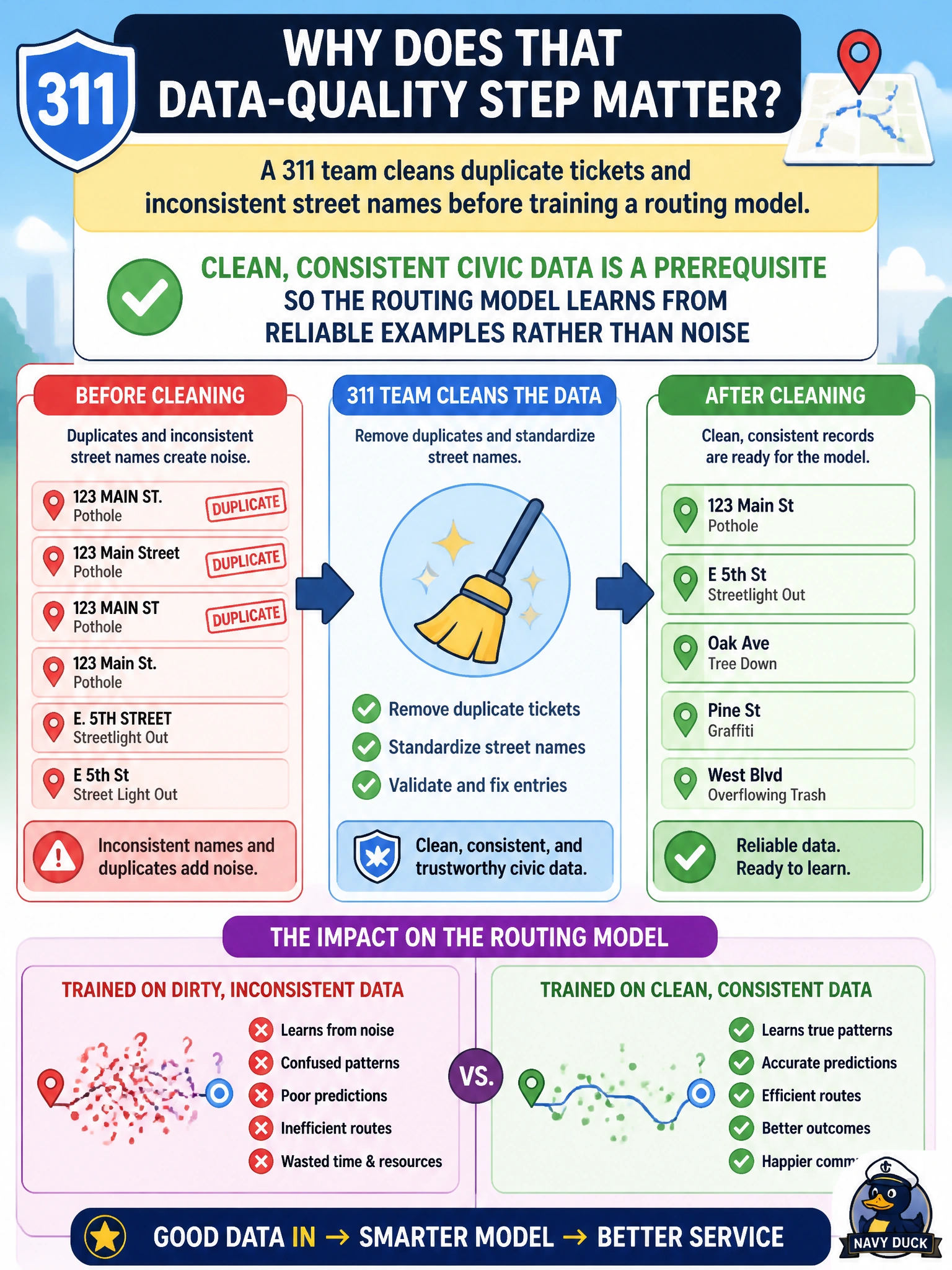
A 311 team cleans duplicate tickets and inconsistent street names before training a routing model. Why does that data-quality step matter?
Select an answer to reveal the explanation.
Short Explanation
Cleaning gives you reliable examples to learn from, but it won't scale your numerical features for faster convergence or balance minority class examples during training. You'll still need separate scaling and sampling steps, and clean data alone won't reduce the spatial dimensionality of your inputs. Clean, deduped tickets give the routing model a fair shot.
Full Explanation
A 311 routing model learns patterns from historical tickets, so duplicate tickets and inconsistent street names inject noise that distorts which issues map to which crews or neighborhoods. Cleaning those problems first is a data-quality prerequisite: the model should learn from reliable civic examples rather than repeated copies of the same request or conflicting address strings that fragment one location into many. Deduplication and standardization improve both training stability and downstream routing fairness for residents. Claiming clean, consistent civic data is a prerequisite so the routing model scales numerical features for faster loss convergence misstates the effect: cleaning provides reliable examples rather than noise to learn from, and it does not scale numeric ranges, which would require separate feature scaling or normalization. Claiming clean, consistent civic data is a prerequisite so the routing model balances minority class examples during the training misattributes the benefit: cleaning provides reliable examples rather than noise to learn from, and it does not rebalance class frequencies, which depends on sampling, weighting, or other imbalance handling. Saying clean, consistent civic data is a prerequisite so the routing model reduces the spatial dimensionality of input vectors misplaces the outcome: cleaning gives the model reliable examples rather than noise to learn from, and it does not by itself compress or reduce dimensions, which depends on feature selection, embeddings, or dimensionality-reduction methods. Exam caveat: over-aggressive deduplication can collapse genuinely distinct requests at one address (for example multiple independent hazards), so cleaning rules need domain review, not only fuzzy string matching. Operational check: publish a street-name standardization map, measure duplicate rates before and after cleanup, and retrain or re-evaluate the routing model only after stewards accept the cleaned 311 extract.
Prefer to study offline? Printable PDF study book + test engine ($7.50, unofficial). These questions stay free here.