
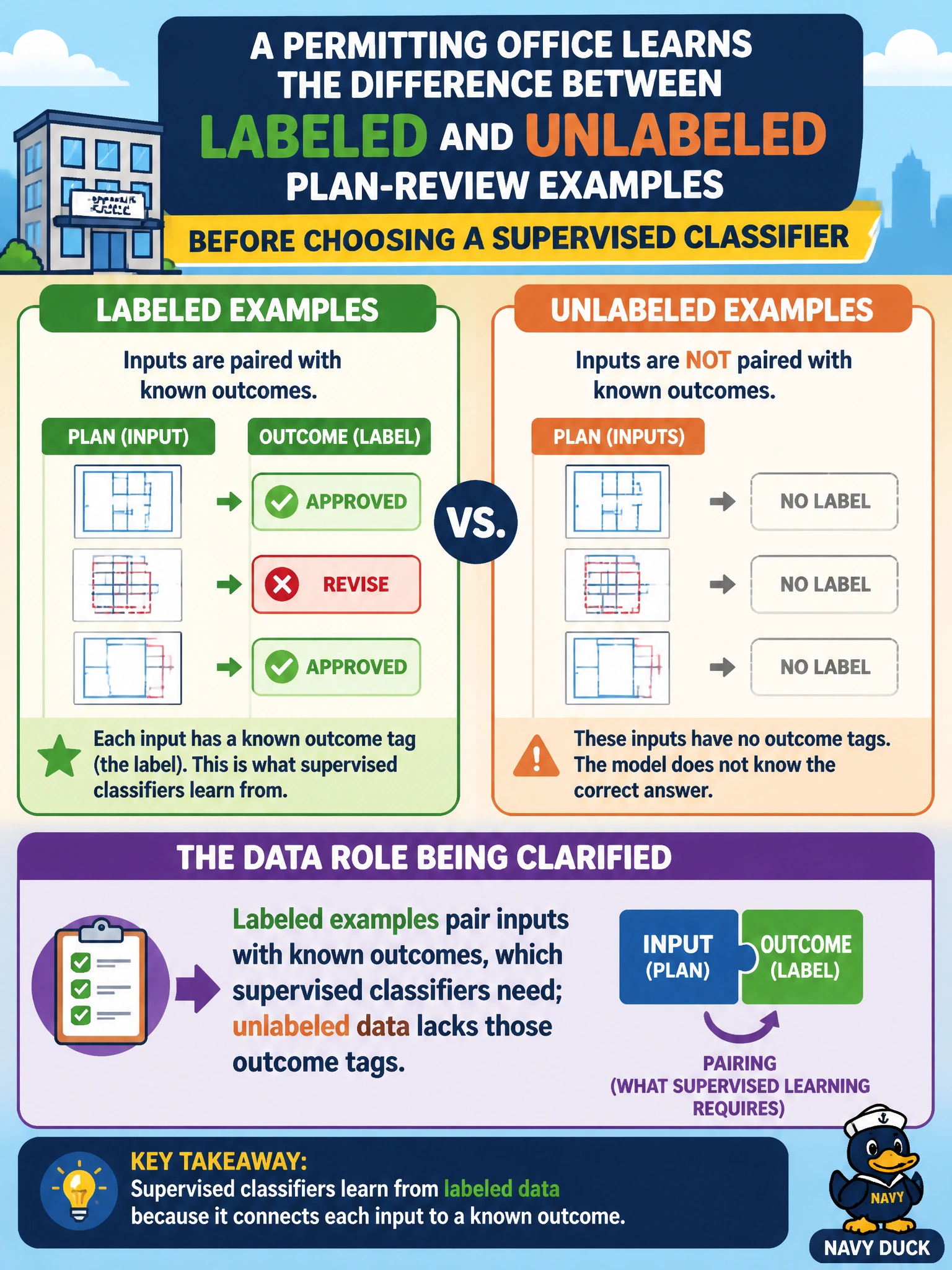
A permitting office learns the difference between labeled and unlabeled plan-review examples before choosing a supervised classifier. What data role is being clarified?
Select an answer to reveal the explanation.
Short Explanation
Labeled plan examples are like answer keys in the margin—supervised classifiers need those known outcomes. Unlabeled piles are just raw stacks without the answer. You'll flip it if you think those answer keys are for unsupervised clusters while supervised trains on unlabeled stacks, you'll mix up validation if you think labels split inputs into folds since they're the tags you'll train on, and you'll slip up if you think unlabeled stacks provide those tags since they're missing the answer by definition.
Full Explanation
Before a permitting office chooses a supervised classifier for plan-review assistance, staff must understand the role of labeled versus unlabeled examples. Labeled examples pair inputs—such as plan attributes or document excerpts—with known outcomes like prior approval decisions or deficiency categories. Supervised classifiers need those outcome tags to learn decision boundaries. Unlabeled data lacks outcome tags and may support other learning approaches, but it does not by itself supply the supervision signal a supervised classifier requires. Claiming labeled examples pair inputs with known outcomes, which unsupervised clusters need; supervised classifiers train on unlabeled groups reverses the learning roles; labeled examples are the inputs paired with known outcomes that the supervised classifier needs to learn plan-review decisions, while unsupervised clusters by definition work without those outcome tags. Saying labeled examples split training inputs into validation folds confuses outcome tags with validation mechanics; labeled examples provide the outcome tags the supervised classifier learns from during training, not the fold partitions used to split data for cross-validation, even though unlabeled data does lack those outcome tags. Saying labeled examples pair inputs with known outcomes, which supervised classifiers need; unlabeled data provides those outcome tags gets the labeled half right but misstates unlabeled data; unlabeled data by definition lacks those outcome tags and cannot provide the supervision signal the supervised classifier needs. Exam caveat: label quality and consistency across reviewers matter as much as label presence; noisy permit outcomes produce brittle classifiers even when every row is tagged. Operational check: before training, inventory whether historical plan-review cases have reliable outcome fields, document the labeling guide, and separate a labeled evaluation set so the office can measure whether the supervised approach is viable.
Prefer to study offline? Printable PDF study book + test engine ($7.50, unofficial). These questions stay free here.