
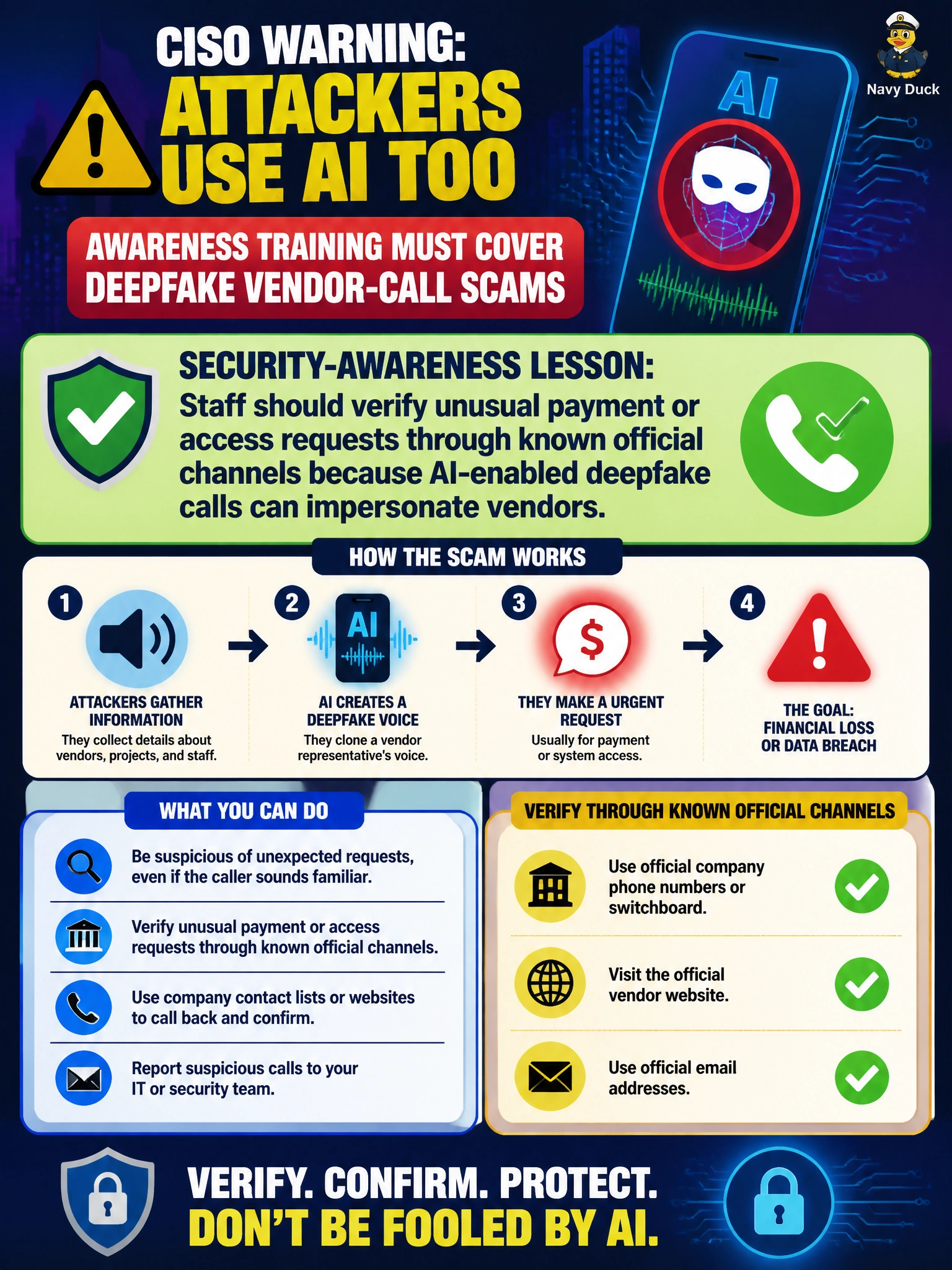
A city CISO warns that attackers also use AI, so awareness training must cover deepfake vendor-call scams. What security-awareness lesson fits?
Select an answer to reveal the explanation.
Short Explanation
A voice that sounds like the HVAC vendor can still be a deepfake costume—verify weird payment asks through known city channels. That is AI-era social-engineering awareness for municipal staff. Trusting caller ID callbacks, voice authentication screening, or invoice quiz answers doesn't prove it's really them since those can be spoofed or stolen—you'll still need to verify through known city channels.
Full Explanation
City security awareness must evolve as attackers use AI to produce deepfake vendor-call scams that mimic familiar voices and urgent payment or access requests. The fitting lesson is that staff should verify unusual payment or access requests through known official channels—callback numbers from the vendor master file, finance approval workflows, or established IT ticketing—because voice familiarity alone is no longer reliable proof of identity. Awareness training that centers verification habits reduces successful social engineering against municipal finance and facilities teams. Verifying unusual payment or access requests through caller ID callback procedures is unsafe because displayed numbers can be spoofed, so calling back the displayed number does not provide independent verification through known official channels. Verifying unusual payment or access requests with automated voice authentication screening is not a reliable control because spectral analysis can miss evolving fakes and produce errors, so synthetic-speech flags do not replace verification through known official channels. Verifying unusual payment or access requests via knowledge-based invoice challenge questions is unsafe because attackers can learn stolen amounts or details from prior emails or breaches, so matching details do not confirm vendor familiarity and out-of-band verification is still required. Exam caveat: deepfake quality improves quickly, and internal callers can also be spoofed; policies should cover both external vendors and unusual requests that appear to come from executives or department heads. Operational check: confirm that finance and facilities SOPs require out-of-band verification for payment-detail changes, that staff know where official contact directories live, and that reporting of suspected deepfake attempts is practiced in tabletop exercises.
Prefer to study offline? Printable PDF study book + test engine ($7.50, unofficial). These questions stay free here.