
An open-data team wants AI to scan published datasets for accidental personally identifiable information before release. What privacy-protection use is appropriate?
Select an answer to reveal the explanation.
Short Explanation
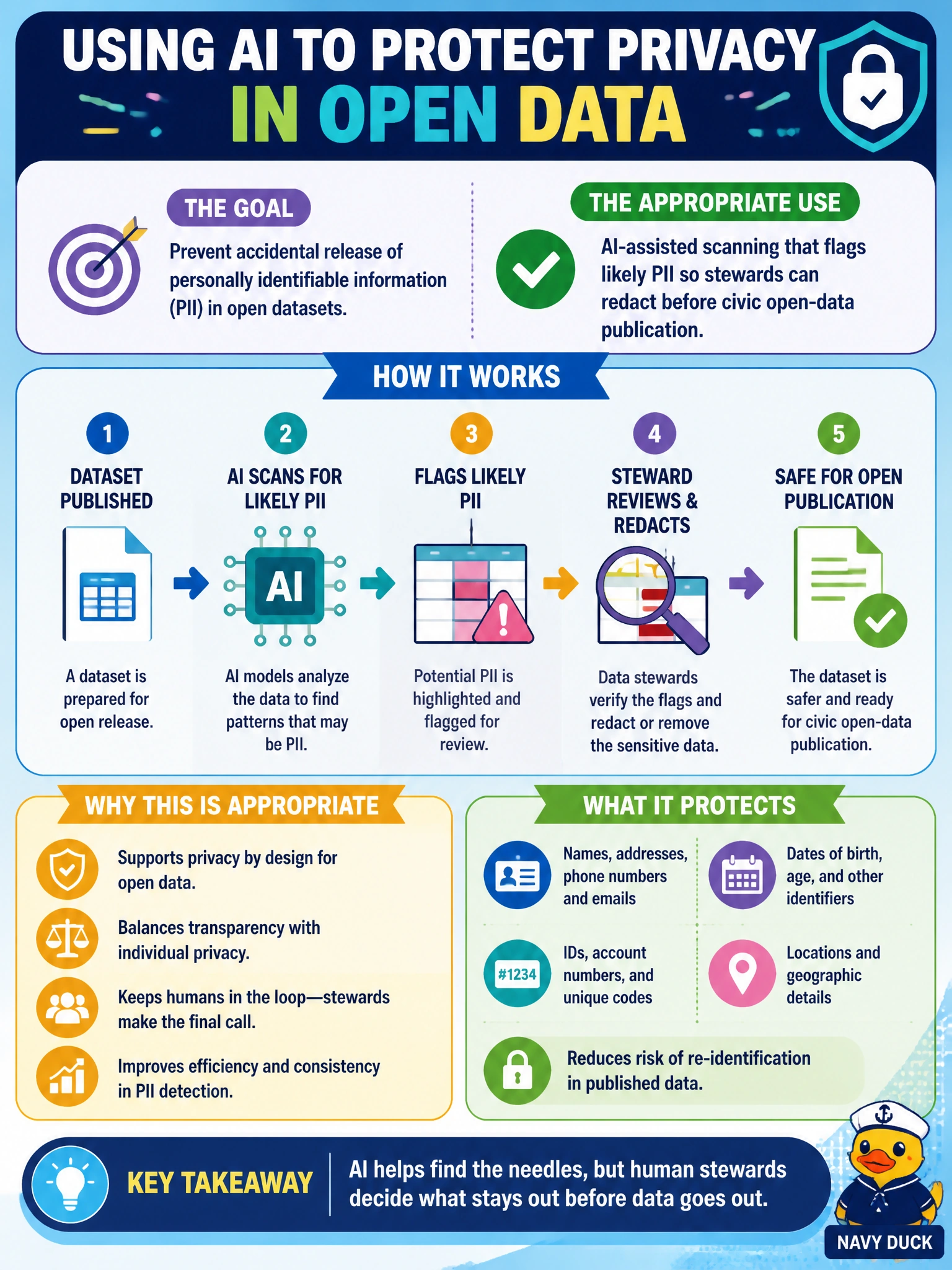
Open data is great until someone’s phone number rides along like a sticky note on a library book. You can use AI to flag likely PII so stewards redact before the drop. But pseudonymizing, encrypting, or tokenizing it keeps it recoverable, so you'll still leave a way to re-identify people in a public release.
Full Explanation
Open-data programs for cities, counties, and utilities routinely publish datasets that may accidentally contain personally identifiable information left in free-text fields, join keys, or legacy exports. AI-assisted scanning that flags likely PII so stewards can redact before civic publication is an appropriate privacy-protection use because it augments human review at scale without replacing stewardship accountability. The model’s role is detection and prioritization of suspect fields; redaction decisions remain with data stewards who understand legal and policy constraints. AI-assisted scanning that flags likely PII so stewards can pseudonymize before civic open-data publication keeps identifiers reversibly linked rather than removing them, so accidental phone numbers, addresses, or other identifiers in free-text fields would remain re-identifiable if the public file or mapping is exposed. AI-assisted scanning that flags likely PII so stewards can tokenize before civic open-data publication replaces identifiers with reversible tokens rather than removing them, so accidental phone numbers, addresses, or other identifiers in free-text fields would remain re-identifiable if the token vault or mapping is exposed. AI-assisted scanning that flags likely PII so stewards can encrypt before civic open-data publication leaves sensitive values in the package in reversible form rather than removing them, so unexpected PII left in join keys or legacy exports would still create disclosure risk instead of being redacted for public release. Exam caveat: PII detectors are probabilistic and domain-sensitive; municipal names, parcel IDs, and case numbers may require custom rules and human escalation beyond generic detectors. Operational check: before each open-data release, run the scanner, route flagged fields to a steward checklist, document redaction or suppression decisions, and re-scan the final package so accidental identifiers do not reach the public portal.
Prefer to study offline? Printable PDF study book + test engine ($7.50, unofficial). These questions stay free here.