
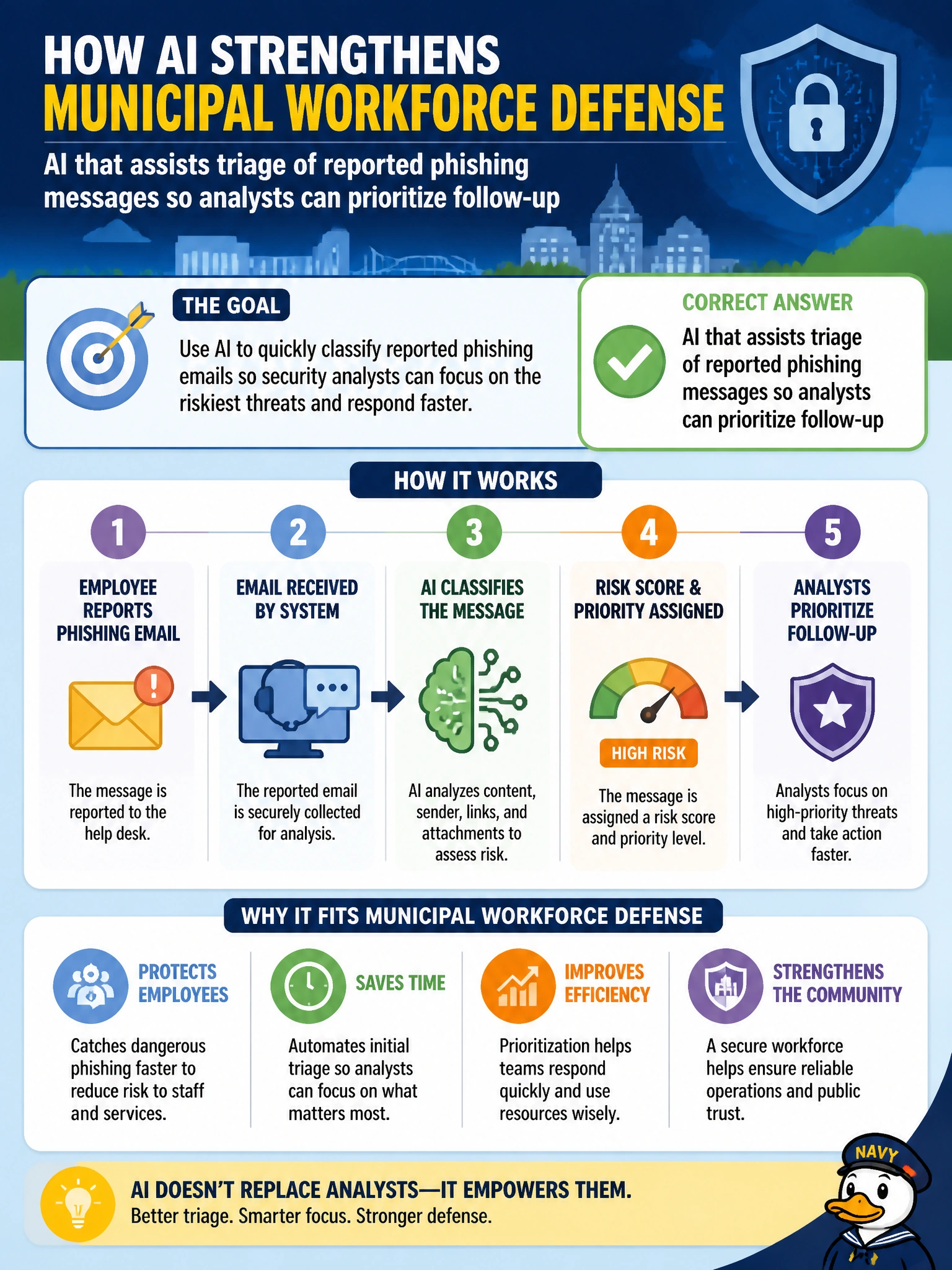
City IT security training shows how AI can help classify phishing emails employees report to the help desk. Which cybersecurity use fits municipal workforce defense?
Select an answer to reveal the explanation.
Short Explanation
Think of the help desk inbox as a sorting belt—AI can tag likely phishing so humans grab the hottest packs first. That's defensive classification you'll use for city staff, not cleaning confirmed emails from mailboxes or decrypting attachments to inspect malware safely. Tying campaigns to actors for intel sharing isn't phishing triage either, and MFA still stays on.
Full Explanation
Municipal security operations commonly receive a high volume of employee-reported phishing messages through the help desk. AI that assists triage of those reports helps analysts prioritize follow-up by classifying likelihood, urgency, and similarity to known campaigns while leaving final disposition to humans. That pattern is a defensive workforce-protection use: the model accelerates review of civic staff reports rather than inventing attack tooling. AI that assists removal of confirmed phishing emails so analysts can clean affected mailboxes is a post-confirmation remediation and cleanup action, not the phishing-report classification this scenario teaches; essentials training for municipal defenders focuses on detection and prioritization of employee-reported messages, not cleaning mailboxes after confirmation. AI that assists decryption of encrypted incident attachments so analysts can inspect malware safely is a cryptographic decoding task for safe malware inspection, not a technique for classifying employee-reported phishing, and would not directly help analysts prioritize follow-up on inbound messages. AI that assists attribution of phishing campaigns so analysts can support intel sharing is an actor-identification and intel-sharing task, not a phishing-report triage aid; it does not classify employee-reported messages by likelihood or campaign similarity or help analysts prioritize follow-up on civic staff reports. Exam caveat: AI triage quality depends on labeled feedback from analysts and can drift as phishing tactics change; treating scores as absolute truth without human review creates both false negatives that miss campaigns and false positives that overwhelm the desk. Operational check: confirm that reported messages stay in a controlled review queue, that AI suggestions are logged with analyst overrides, and that MFA and reporting channels remain mandatory for city staff even after filters improve.
Prefer to study offline? Printable PDF study book + test engine ($7.50, unofficial). These questions stay free here.