
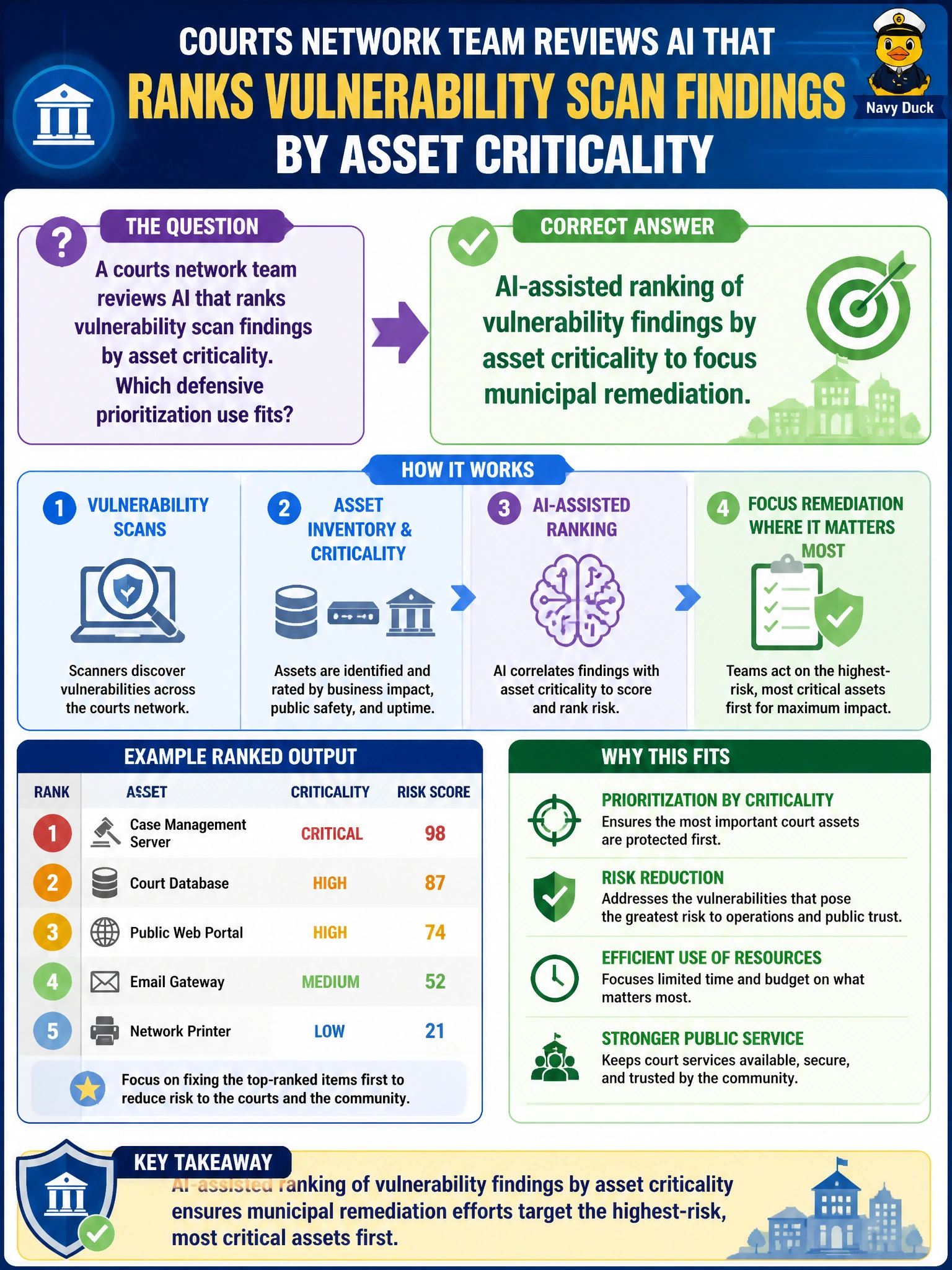
A courts network team reviews AI that ranks vulnerability scan findings by asset criticality. Which defensive prioritization use fits?
Select an answer to reveal the explanation.
Short Explanation
Scans dump a mountain of tickets—AI ranking by how critical the courthouse asset is helps crews climb the right peak first. You'll use it to focus remediation, while prioritizing alert triage just sorts alerts, ordering pen testing just plans tests, and tracking compliance trends just reports status. Criticality still guides the queue.
Full Explanation
Courts and other municipal networks generate large vulnerability-scan inventories that exceed remediation capacity if every finding is treated equally. AI-assisted ranking of findings by asset criticality helps focus remediation on systems whose compromise would most harm court operations, public access, or sensitive case data. The model combines severity signals with civic asset importance so security and infrastructure teams sequence patches and compensating controls where impact is highest. AI-assisted ranking of vulnerability findings by asset criticality to prioritize courthouse alert triage is an alert-triage activity, not defensive remediation prioritization; it directs the ranking toward sorting alerts for investigation rather than focusing municipal remediation where impact is highest. AI-assisted ranking of vulnerability findings by asset criticality to order municipal penetration testing is a testing-planning activity, not defensive remediation prioritization; it directs the ranking toward scheduling offensive tests rather than sequencing remediation by asset criticality and can leave high-impact courthouse systems unremediated while testing is arranged. AI-assisted ranking of vulnerability findings by asset criticality to track municipal compliance trends is a compliance-reporting task, not a defensive prioritization use case; it uses the ranking to observe trends over time rather than to sequence remediation by asset criticality. Exam caveat: criticality labels and CMDB freshness drive ranking quality; stale ownership or misclassified assets can push urgent courthouse findings down the queue even when the AI appears confident. Operational check: verify that ranked queues still require human acceptance of remediation tickets, that critical courthouse and justice systems have explicit criticality tags, and that scanning schedules continue on a defined cadence rather than being paused after the ranking tool is introduced.
Prefer to study offline? Printable PDF study book + test engine ($7.50, unofficial). These questions stay free here.