
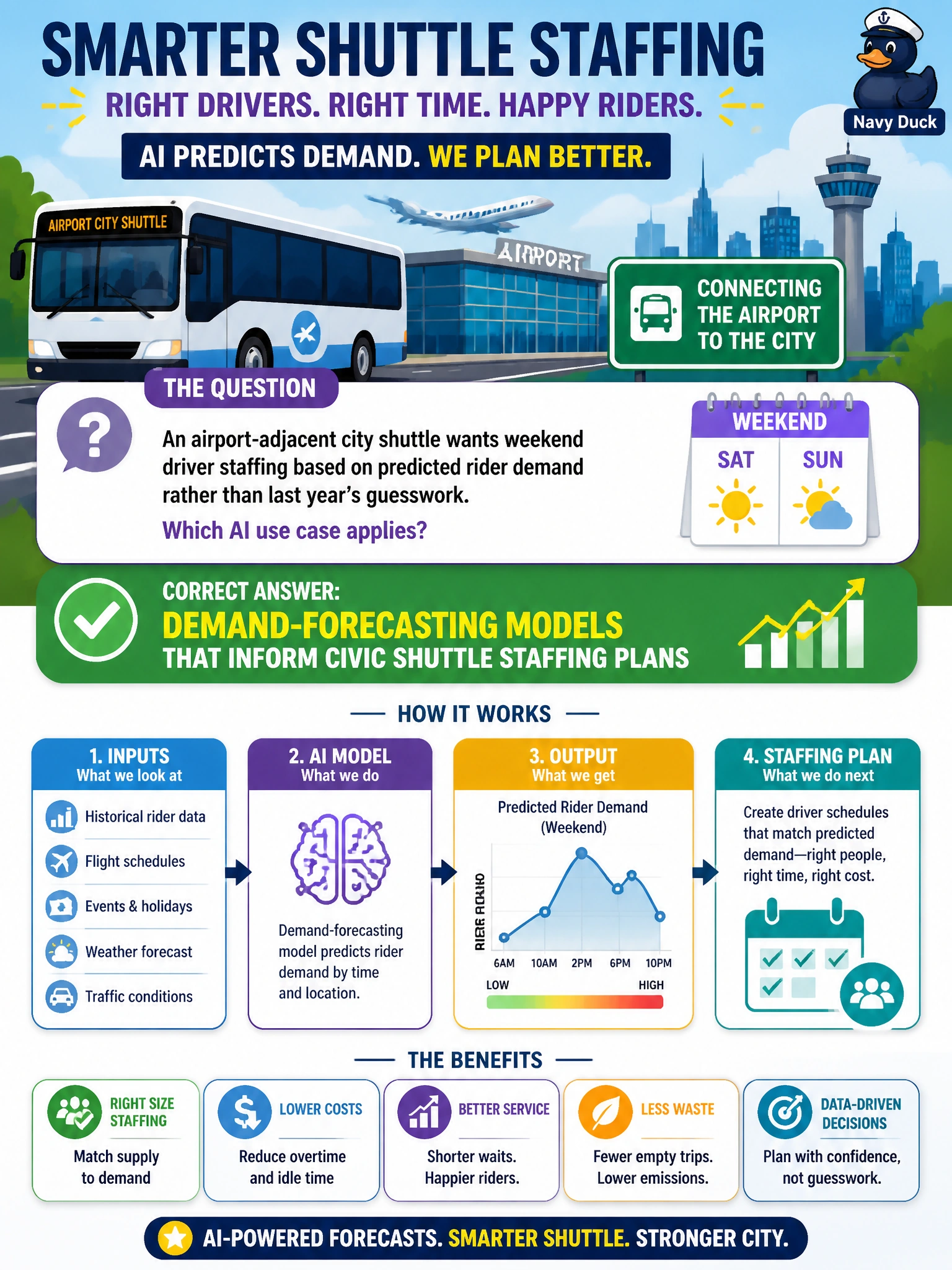
An airport-adjacent city shuttle wants weekend driver staffing based on predicted rider demand rather than last year’s guesswork. Which AI use case applies?
Select an answer to reveal the explanation.
Short Explanation
You'll get weekend staffing right when you predict rider demand — arrival-time prediction just estimates when shuttles arrive, it doesn't tell you how many riders you'll get. That's predictive planning for drivers. Attrition forecasts show who might leave and fare-revenue forecasts show dollars you'll collect — they're not telling you how many riders you'll get.
Full Explanation
An airport-adjacent city shuttle wanting weekend driver staffing based on predicted rider demand rather than last year’s guesswork applies demand-forecasting models that inform civic shuttle staffing plans. Forecasting from historical ridership, event calendars, flight patterns, and seasonality helps managers staff enough operators without chronic over- or under-coverage. Managers still approve schedules within labor rules and budget; the model informs planning rather than issuing unsupervised duty rosters.
Arrival-time prediction models that inform civic shuttle staffing plans are arrival-estimation tools, not demand-forecasting tools; they predict when shuttles will reach stops rather than predicting weekend rider volumes from ridership patterns, event calendars, flight patterns, and seasonality to determine how many drivers are needed. Attrition-forecasting models that inform civic shuttle staffing plans are workforce-turnover tools, not demand-forecasting tools; they predict which drivers may leave rather than predicting rider volumes to determine how many drivers are needed. Fare-revenue forecasting models that inform civic shuttle staffing plans are financial-projection tools, not demand-forecasting tools; they estimate future fare income rather than predicting future ridership for staffing.
Exam caveat: Transportation demand forecasting supports resource planning. Distinguish predictive demand forecasting from arrival-time prediction, attrition forecasting, and fare-revenue forecasting for staffing.
Operational check: Compare forecasts to actual boardings by weekend daypart, include special-event overlays, leave manager approval on published driver schedules, and use fare-revenue forecasts as supplementary financial context rather than a basis for driver headcount.
Prefer to study offline? Printable PDF study book + test engine ($7.50, unofficial). These questions stay free here.