
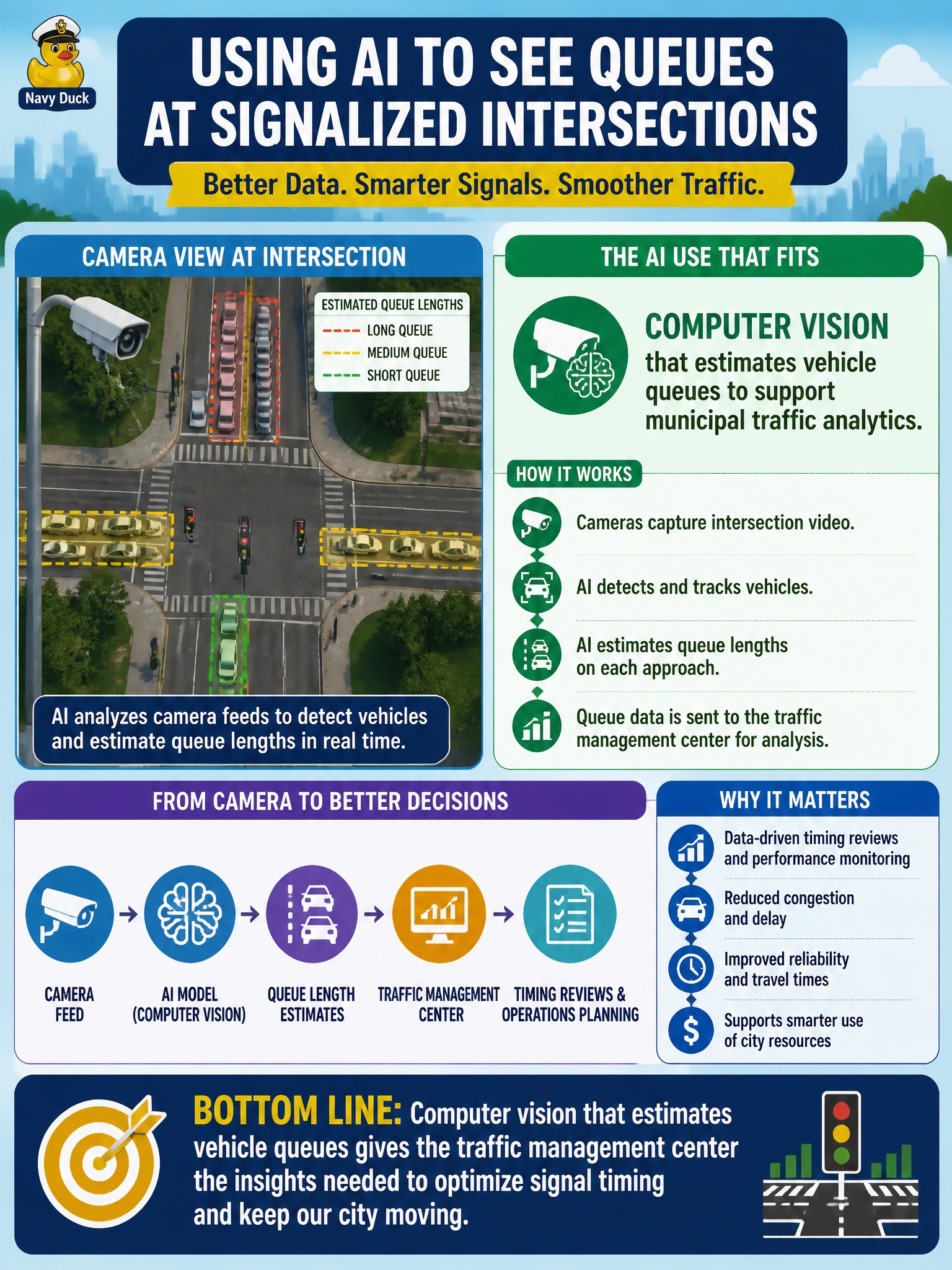
The traffic management center wants camera-based estimates of queue lengths at signalized intersections to inform timing reviews. Which AI use fits?
Select an answer to reveal the explanation.
Short Explanation
Intersection cameras counting the backup are like a smart tape measure for the queue—vision AI estimates length so you get better timing numbers. You'll feed those numbers into your timing review, while turning-count analytics won't help since it's about turn movements, not queue backup. Signal-warrant reviews and travel-time analytics are different jobs, so they won't give you the intersection queues you've asked for.
Full Explanation
A traffic management center wanting camera-based estimates of queue lengths at signalized intersections to inform timing reviews needs computer vision that estimates vehicle queues to support municipal traffic analytics. Queue-length estimates give signal engineers empirical inputs for timing plans and congestion diagnosis without requiring constant manual count crews. Results support engineering review; they do not by themselves rewrite controller timings without agency process and safety checks. Computer vision that estimates vehicle queues to support municipal turning-count analytics focuses on directional turning movements, so it does not fit a request for queue lengths at signalized intersections to inform timing reviews. Computer vision that estimates vehicle queues to support municipal signal-warrant reviews targets analysis of whether a signal is warranted, not queue lengths at already signalized intersections for timing reviews. Computer vision that estimates vehicle queues to support municipal travel-time analytics measures corridor travel times, not vehicle queue lengths at intersections for timing reviews. Exam caveat: Transportation computer vision for queue estimation is an analytics assist for traffic engineering. Distractors often transplant turning-count analytics, signal-warrant reviews, or travel-time analytics into a traffic stem. Operational check: Calibrate vision estimates against periodic manual counts, account for occlusion and weather, feed outputs into engineering workflows rather than unsupervised timing pushes, and document how queue metrics influence corridor timing reviews.
Prefer to study offline? Printable PDF study book + test engine ($7.50, unofficial). These questions stay free here.