
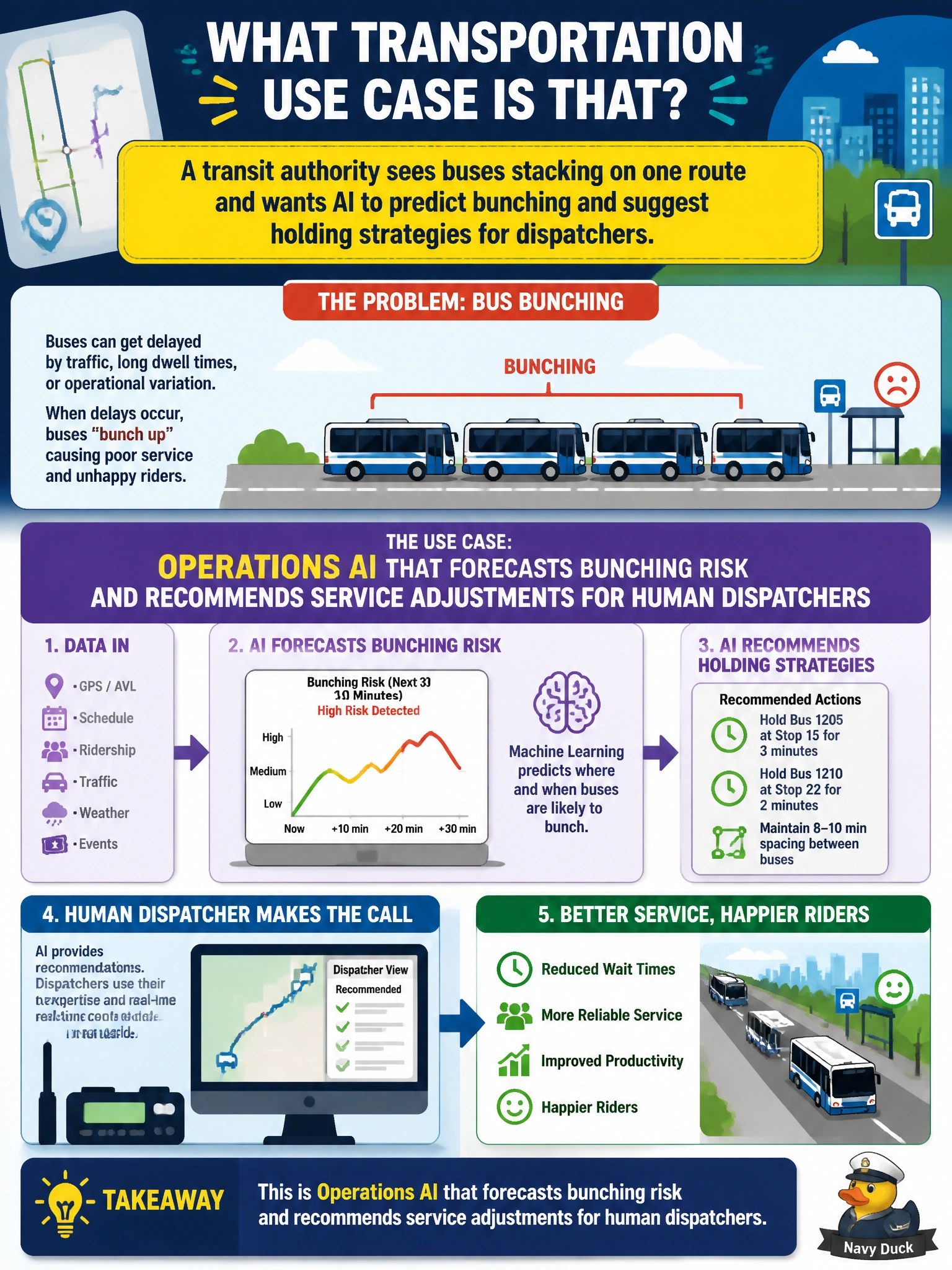
A transit authority sees buses stacking on one route and wants AI to predict bunching and suggest holding strategies for dispatchers. Which transportation use case is that?
Select an answer to reveal the explanation.
Short Explanation
Bunching is the transit version of a traffic jam of buses—AI spots the pile-up coming and suggests holds so dispatchers can spread the gaps. You'll recognize it's reliability ops for headway control, not timetable planning, street routing, or standby deployment, so timetable revisions, street detours, and standby vehicles don't fit. Drivers stay in the loop.
Full Explanation
When a transit authority sees buses stacking on one route and wants AI to predict bunching and suggest holding strategies for dispatchers, the transportation use case is operations AI that forecasts bunching risk and recommends service adjustments for human dispatchers. Models use headway, AVL, and demand signals to anticipate irregular spacing and propose holds, short-turns, or other tactics that dispatchers evaluate against field conditions and policy. Reliability improves when recommendations are timely; control of the service plan remains human. Planning AI that models bunching scenarios and recommends timetable revisions for human dispatchers mislabels the use case, since planning addresses timetable scenario modeling and revision for future schedules, not real-time headway prediction and holding control for dispatchers. Routing AI that detects early bunching indicators and recommends street detours for human dispatchers mislabels the use case, since routing addresses street path selection and detours, not real-time bunching prediction and holding service adjustments. Fleet AI that analyzes bunching events and recommends deploying standby vehicles for human dispatchers mislabels the use case, since that fleet use case addresses post-event analysis and standby capacity deployment, not AVL and headway signals to recommend holds and short-turns. Exam caveat: Transportation ops AI here is predictive decision support for dispatchers. Do not confuse it with planning, routing, or fleet AI for timetable revisions, street detours, and standby vehicle deployment, since those categories describe timetable design, path changes, and capacity deployment rather than operations control. Operational check: Feed recommendations into dispatcher consoles with reason codes, measure recommendation acceptance and on-time impact, allow easy rejection when incidents dominate, and never auto-issue passenger-facing schedule changes without transit control confirmation.
Prefer to study offline? Printable PDF study book + test engine ($7.50, unofficial). These questions stay free here.