
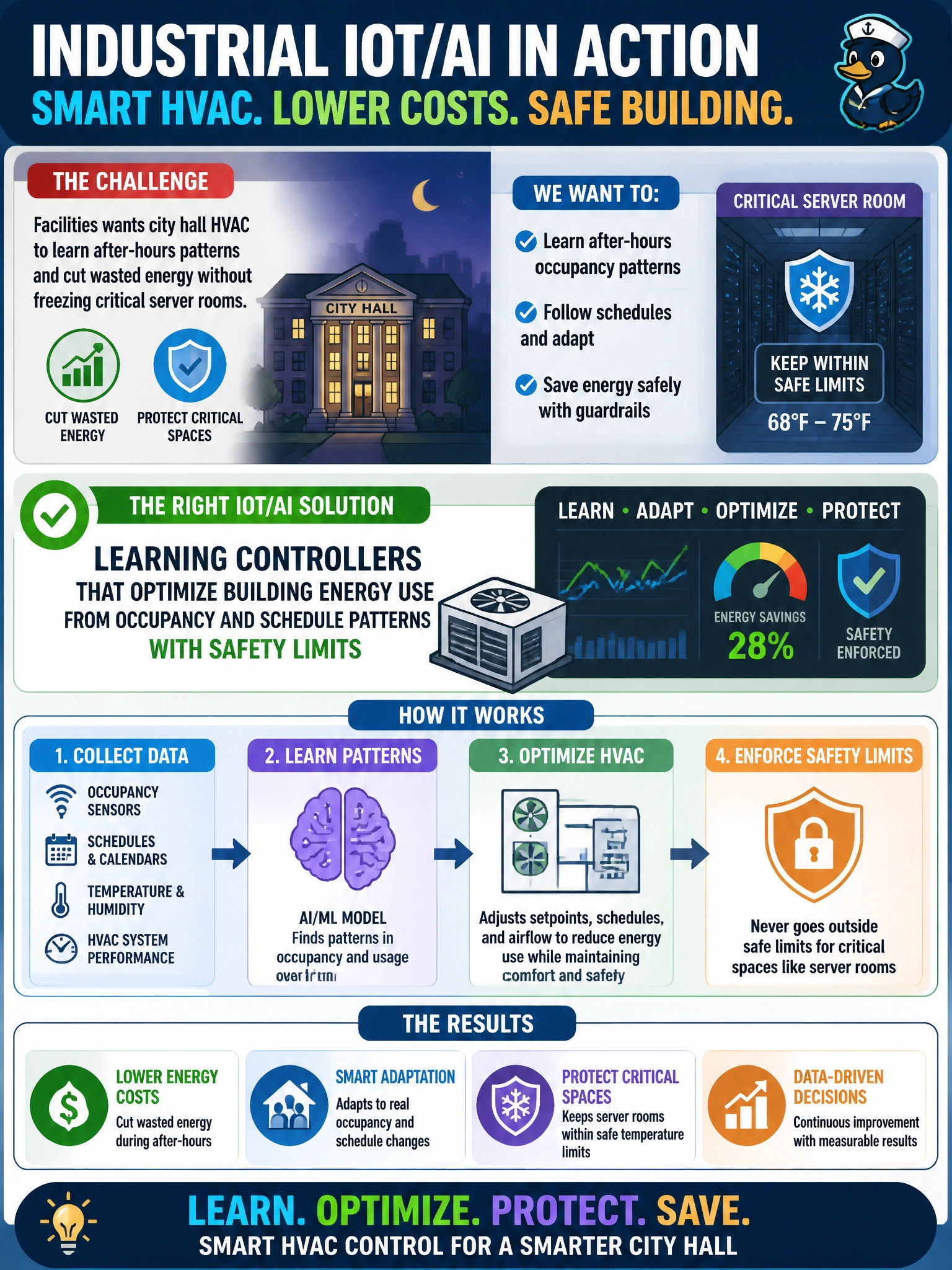
Facilities wants city hall HVAC to learn after-hours patterns and cut wasted energy without freezing critical server rooms. Which industrial IoT/AI use fits?
Select an answer to reveal the explanation.
Short Explanation
City hall after dark should not heat empty floors like a house left with every light on—learning HVAC controllers trim waste while respecting hard limits for critical spaces. That is industrial IoT/AI for municipal buildings. You'll not get occupancy-pattern savings with server-room safety limits from chiller failure predictions, price-driven pre-cooling timing, or overnight stabilization from usage trends.
Full Explanation
Facilities wanting city hall HVAC to learn after-hours patterns and cut wasted energy without freezing critical server rooms needs learning controllers that optimize building energy use from occupancy and schedule patterns with safety limits. AI/IoT optimization adapts setpoints and schedules to reduce empty-space conditioning while hard constraints protect mission-critical rooms, humidity bounds, and occupied-comfort floors. This is an industrial process control use case inside municipal facilities management, not a free-form generative experiment.
Learning maintenance models that predict chiller failure risk from vibration trends with critical safety limits are equipment-health diagnostics, not after-hours HVAC learning controllers. Learning pre-cooling controllers that optimize chill timing from price forecasts and peaks with safety limits optimize for price-driven chill timing rather than occupancy and schedule patterns, so they don't learn after-hours use to cut wasted energy while protecting critical server rooms. Learning setback controllers that stabilize overnight temperatures from historical building usage trends with safety limits stabilize temperatures from historical building usage trends rather than optimizing energy use from occupancy and schedule patterns with differentiated safety limits, so they can't cut after-hours waste while protecting critical server rooms.
Exam caveat: Building energy optimization with explicit safety limits is the industrial IoT framing. "Learning setback" style options test whether you confuse overnight stabilization from historical building usage trends with responsible, occupancy-pattern optimization with differentiated safety limits.
Operational check: Encode non-negotiable temperature and runtime floors for server and critical spaces, require facilities approval for aggressive setpoint changes, retain sensor history for commissioning reviews, and verify after-hours savings against comfort and uptime incidents.
Prefer to study offline? Printable PDF study book + test engine ($7.50, unofficial). These questions stay free here.