
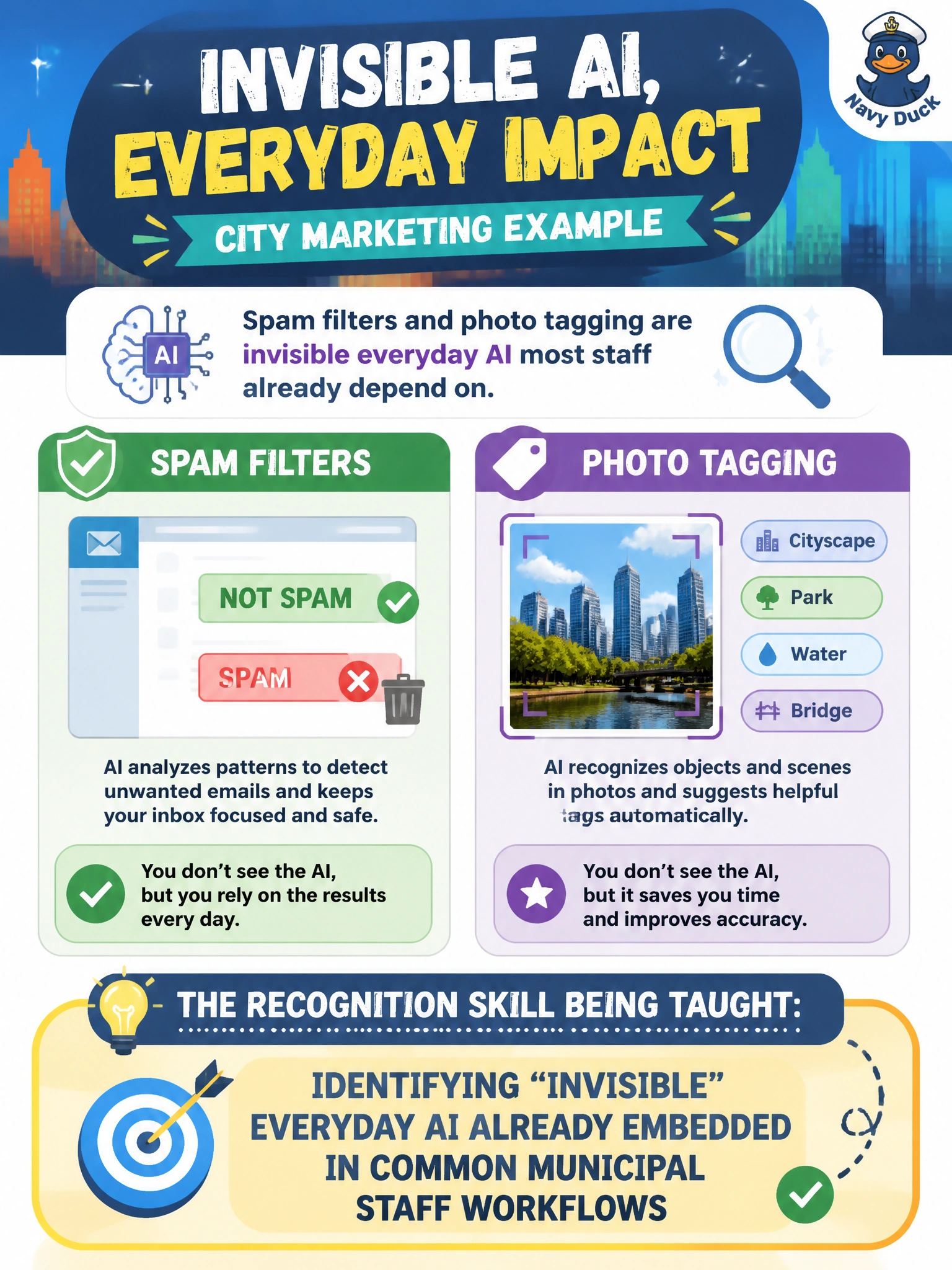
City marketing notes spam filters and photo tagging as invisible everyday AI most staff already depend on. What recognition skill is being taught?
Select an answer to reveal the explanation.
Short Explanation
If your inbox junk folder just works, you’ve already been leaning on everyday AI. Same with photo tagging that labels the picnic shot. Marketing wants staff to notice the invisible helpers they already trust.
Full Explanation
City marketing notes that spam filters and photo tagging are invisible everyday AI most staff already depend on, teaching a recognition skill: identifying ‘invisible’ everyday AI already embedded in common municipal staff workflows. Literacy expands beyond chatbots to mail hygiene, media asset labeling, and similar quiet features that use learned or rule-based intelligence without announcing themselves as ‘AI projects.’ Identifying “invisible” everyday AI needing explicit prompts in common municipal staff workflows misses the mark because spam filters and photo tagging run automatically in the background without explicit prompts rather than waiting for staff to prompt them, and the lesson is spotting invisible embedded helpers staff already depend on, not prompt-driven use. Identifying “invisible” everyday AI using autonomous agents in common municipal staff workflows is wrong because spam filters and photo tagging filter and label existing mail and photos staff already depend on, rather than operating as autonomous agents that plan and act across steps, and the stem teaches mail hygiene and photo-library tagging, not agentic workflows. Identifying “invisible” everyday AI drafting new content in common municipal staff workflows misses the mark because spam filters and photo tagging classify and label existing mail and photos rather than create new content, and the lesson is spotting invisible embedded helpers, not generative drafting. Exam caveat: invisible-everyday-AI items reward identifying embedded filters and tagging already present in municipal workflows—not identifying “invisible” everyday AI needing explicit prompts in common municipal staff workflows. Operational check: inventory where spam filtering, auto-tagging, and similar features are enabled on city mail and digital asset systems; document false-positive impacts on constituent email; include these examples in onboarding so staff recognize AI literacy applies beyond flashy copilots; and assign owners when filter behavior affects public correspondence quality.
Prefer to study offline? Printable PDF study book + test engine ($7.50, unofficial). These questions stay free here.