
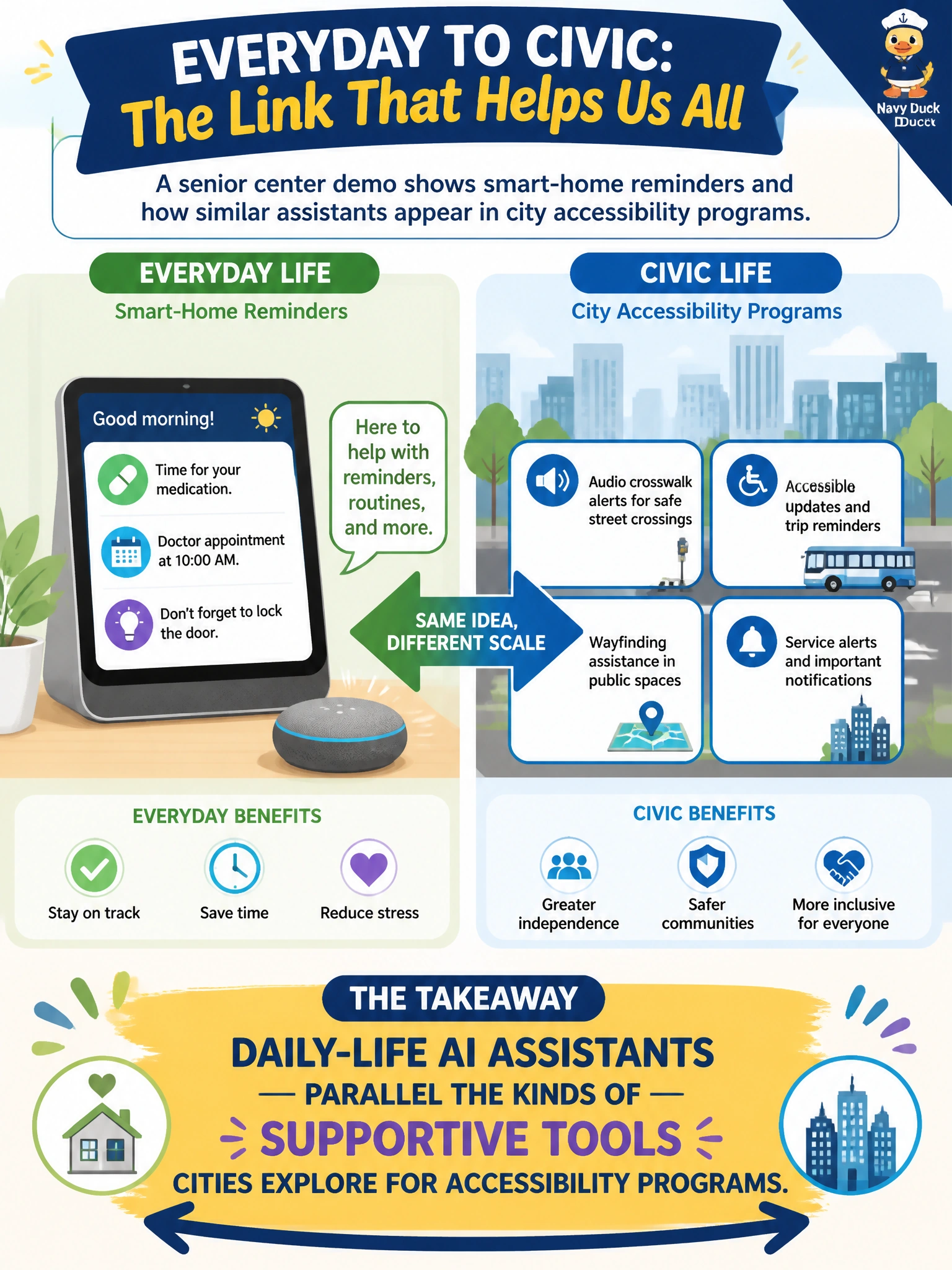
A senior center demo shows smart-home reminders and how similar assistants appear in city accessibility programs. What everyday-to-civic link should attendees take away?
Select an answer to reveal the explanation.
Short Explanation
Mom’s smart speaker nudging “take your meds” feels a lot like the gentle prompts cities test for accessibility. The demo is connecting everyday assistant AI to civic support ideas. Same helpful vibe, public mission.
Full Explanation
A senior center demo showing smart-home reminders and how similar assistants appear in city accessibility programs should leave attendees with the everyday-to-civic link that daily-life AI assistants parallel the kinds of supportive tools cities explore for accessibility—gentle prompts for appointments, medications, or tasks in consumer settings rhyme with civic assistive designs under program governance and consent. The demo bridges familiarity to municipal possibility; it does not mean smart-home reminder systems utilize the identical training datasets cities mandate for accessibility programs, which would imply consumer devices and municipal programs share the same mandated training data rather than simply illustrating a similar supportive idea. Treating the demo as proof that smart-home reminder systems utilize the identical training datasets cities mandate for accessibility programs inverts the bridging purpose of the demo from general analogy to a shared-dataset mandate claim not shown. Treating consumer voice interaction models as establishing the baseline compliance policies cities adopt for accessibility tools mistakes an illustrative analogy for policy authority, implying product interaction designs set municipal requirements rather than cities defining governance and accessibility compliance through their own programs. Saying domestic automation frameworks operate on the exact same localized edge networks cities deploy for accessibility mistakes a functional resemblance for shared infrastructure, implying home systems run on municipal edge networks rather than simply resembling civic tools in supportive purpose. Exam caveat: everyday-to-civic link items affirm parallels between consumer assistants and municipal accessibility tools—not utilizing the identical training datasets cities mandate by smart-home reminder systems, establishing the baseline compliance policies cities adopt by consumer voice interaction models, or operating on the exact same localized edge networks cities deploy by domestic automation frameworks. Operational check: when piloting civic reminder or prompt tools, obtain informed consent; protect health-adjacent data; allow human caregiver override; evaluate whether prompts reduce missed appointments without creating unsafe dependency; and label consumer demos clearly as analogies—not as endorsed medical devices or guaranteed city product commitments.
Prefer to study offline? Printable PDF study book + test engine ($7.50, unofficial). These questions stay free here.