
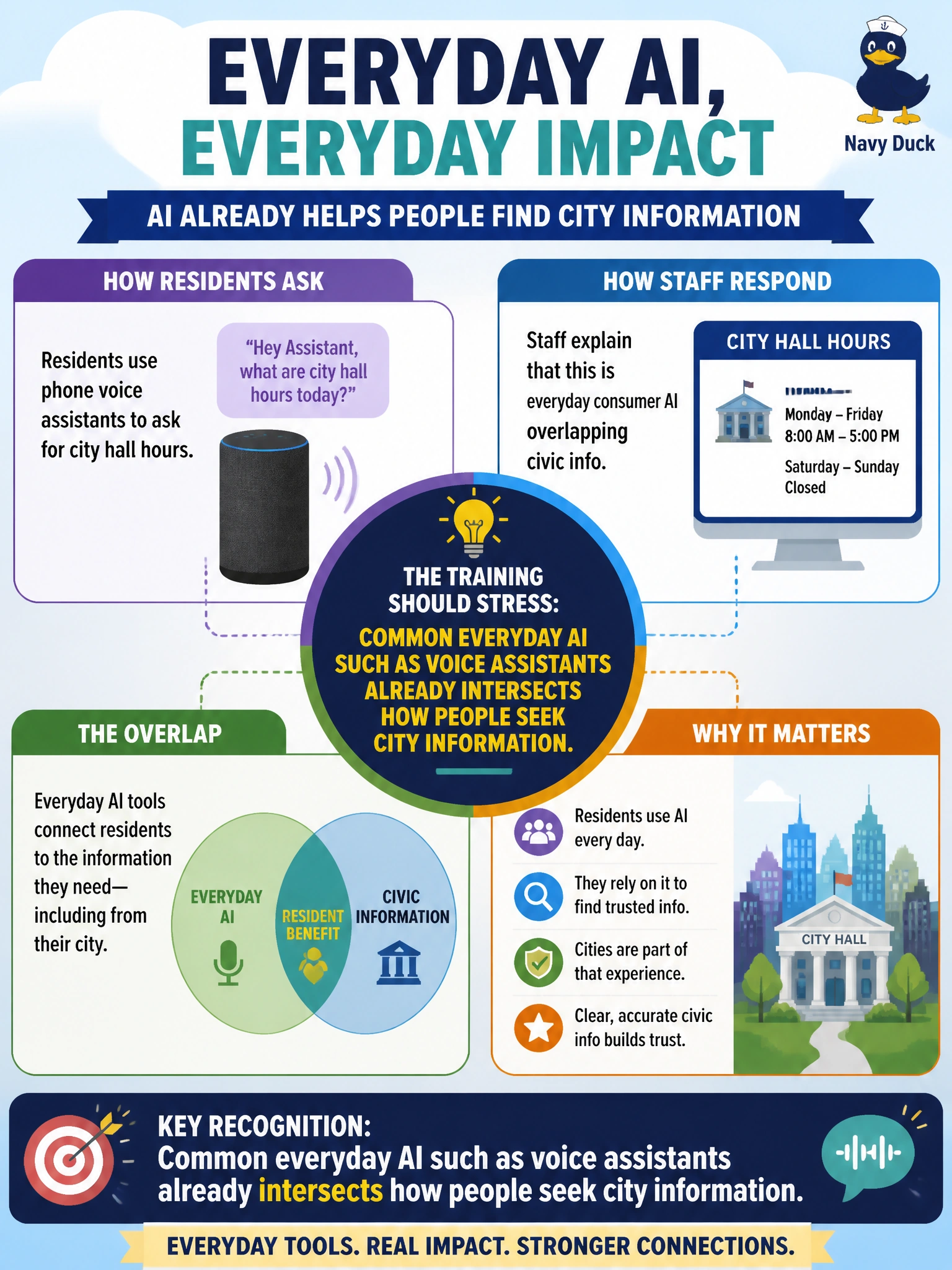
Residents use phone voice assistants to ask for city hall hours, and staff explain that this is everyday consumer AI overlapping civic info. What recognition should the training stress?
Select an answer to reveal the explanation.
Short Explanation
That “Hey assistant, when does city hall open?” moment is everyday AI bumping into civic life. Training should help staff spot those common tools residents already use. Familiar tech, city facts.
Full Explanation
Residents using phone voice assistants to ask for city hall hours, with staff explaining that this is everyday consumer AI overlapping civic information, should leave training recognizing that common everyday AI already intersects how people seek city information. Literacy starts by naming familiar assistants that retrieve municipal facts—hours, locations, holiday closures—rather than treating ‘AI’ as only exotic back-office systems residents never touch. Claiming that common everyday AI such as voice assistants already relies on authenticated municipal open data overstates their reliability; assistants often rely on cached snippets, search indexes, or third-party sources and can quote stale hours rather than authenticated municipal data. Claiming that common everyday AI such as voice assistants already routes resident queries to civic APIs overstates their integration; assistants routinely answer simple civic questions about hours and locations from web results and other public information, not route queries into civic APIs, which is why consumer tools intersect basic information seeking rather than backend system routing. Believing that common everyday AI such as voice assistants already parses public queries into predictive models overstates their function; assistants often give a direct spoken answer from snippets or third-party sources instead of parsing queries into predictive models. Exam caveat: everyday-AI recognition items point to common consumer tools intersecting civic information seeking—not assuming systems already rely on authenticated municipal open data, that they route resident queries to civic APIs, or that they parse public queries into predictive models. Operational check: keep accurate hours and holiday schedules on official sites that assistants and search engines can retrieve; monitor for stale third-party answers; teach front-line staff to correct residents gently when a voice assistant quotes outdated civic information; and treat consumer AI as a distribution channel for facts the city must keep authoritative.
Prefer to study offline? Printable PDF study book + test engine ($7.50, unofficial). These questions stay free here.