
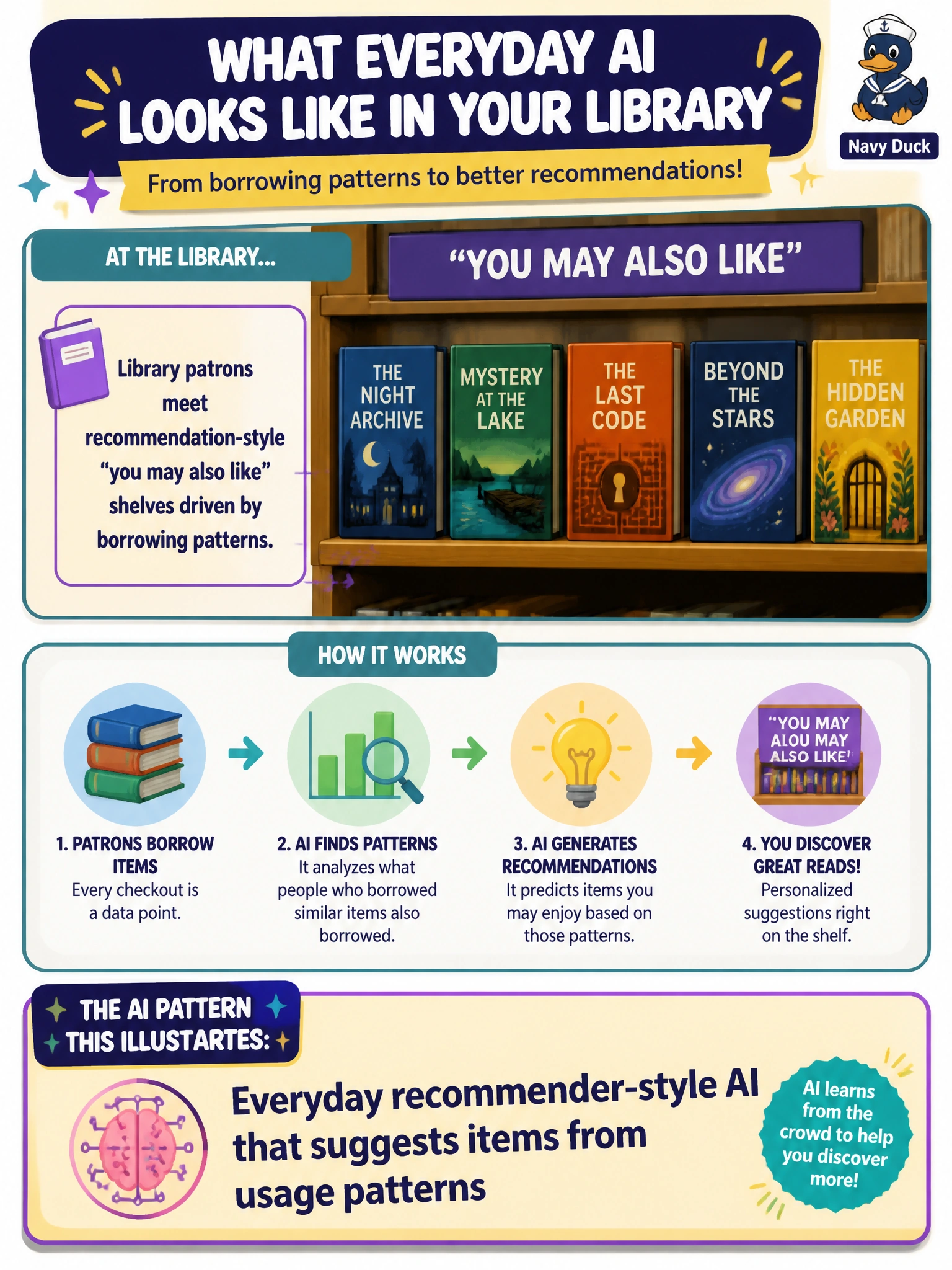
Library patrons meet recommendation-style “you may also like” shelves driven by borrowing patterns. What everyday AI pattern does this illustrate?
Select an answer to reveal the explanation.
Short Explanation
‘You may also like’ isn't generative-style creating lists for you or clustering-style grouping you with similar readers from usage patterns or predictive-style modeling choices you'll make—it's a recommender reading your borrowing patterns. Same everyday AI flavor you see in streaming apps, now on the civic shelf. Patterns in, suggestions out.
Full Explanation
Library patrons meeting recommendation-style ‘you may also like’ shelves driven by borrowing patterns are seeing everyday recommender-style AI that suggests items from usage signals. The same pattern familiar from commercial streaming and retail discovery appears in public library discovery UX: collaborative or content-based signals surface related titles to improve findability. Staff and patrons should recognize that as familiar AI assistance—a specific pattern, not just any AI tool a library might run. Everyday generative-style AI that creates lists from usage patterns fails to match the scenario: generative-style creates new content like lists from patterns, it does not surface ‘you may also like’ shelf suggestions from borrowing patterns the way recommender-style does. Everyday clustering-style AI that groups readers from usage patterns fails because that technology groups readers by shared behavior into clusters; grouping is not the patron-facing suggestion of related titles based on what a patron has borrowed. Everyday predictive-style AI that models choices from usage patterns fails because predictive-style models a future outcome such as choices, not the patron-facing recommendation shelf that suggests related titles from borrowing history. Exam caveat: everyday recommender questions map usage-pattern suggestions to a specific library experience; don't let a different pattern label that creates lists from usage patterns (generative-style), groups readers from usage patterns (clustering-style), or models choices from usage patterns (predictive-style) substitute for the recommender pattern actually described. Operational check: disclose that digital or physical discovery aids may use borrowing or catalog signals; offer privacy-preserving aggregates or opt-outs where policy requires; avoid sensitive inference beyond collection discovery; and periodically audit whether recommendations narrow or diversify reading exposure across the community so equity goals stay visible.
Prefer to study offline? Printable PDF study book + test engine ($7.50, unofficial). These questions stay free here.