
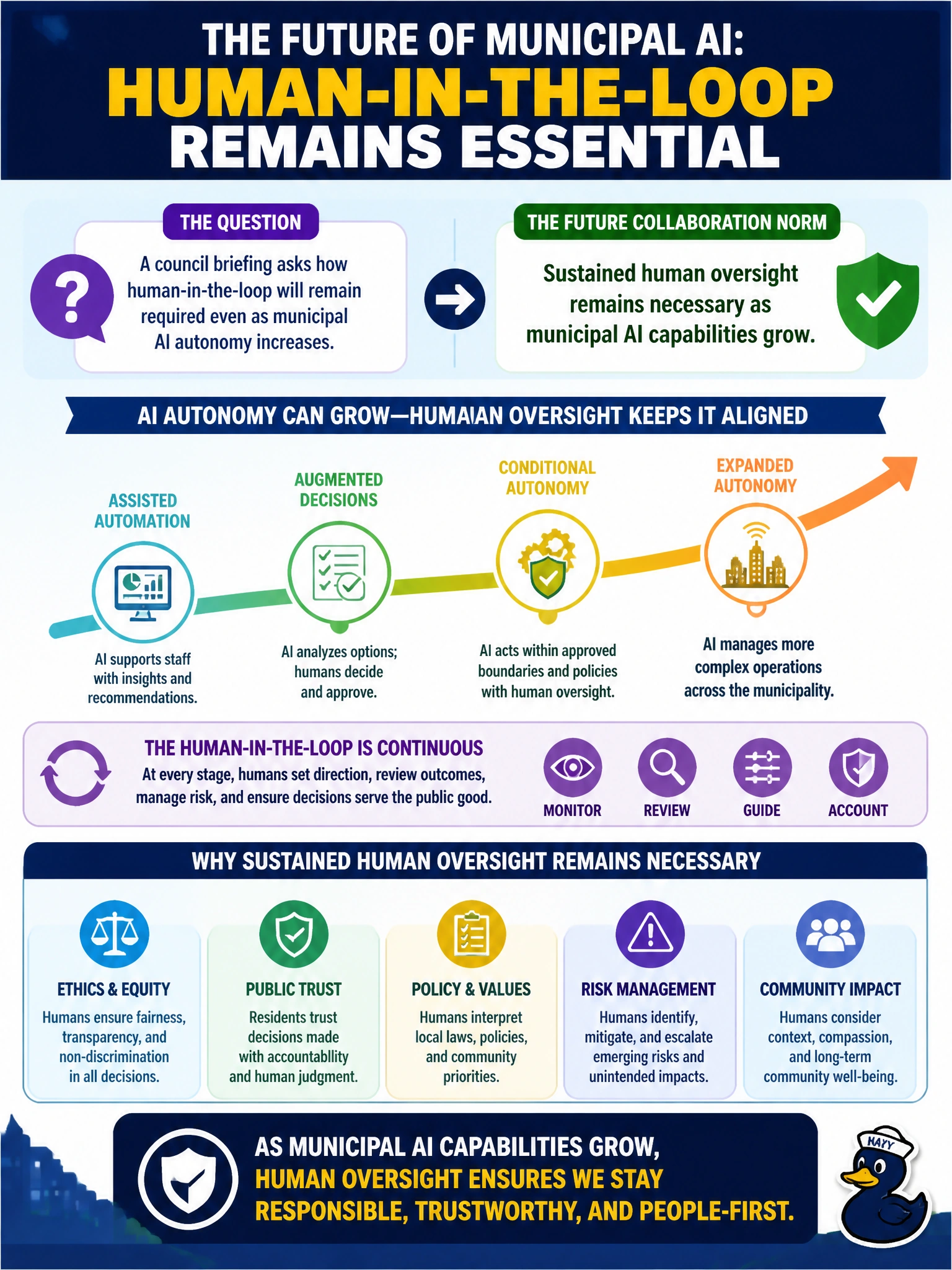
A council briefing asks how human-in-the-loop will remain required even as municipal AI autonomy increases. What future collaboration norm should the briefing affirm?
Select an answer to reveal the explanation.
Short Explanation
Even when the tools get smarter, somebody with a badge still owns the decision. Human-in-the-loop is the future norm council should lock in—you'll keep sustained oversight, it's active approval that goes beyond a periodic peek at system logs. More capability, same accountability.
Full Explanation
A council briefing asking how human-in-the-loop will remain required even as municipal AI autonomy increases should affirm that sustained human oversight remains necessary as capabilities grow. Higher model autonomy can propose more of a workflow—routing, drafting, ranking, or sequencing—but accountability for benefits decisions, enforcement actions, budgeting, and safety still rests with authorized humans. The future collaboration norm is expanding machine proposal power under continuing human approval and exception handling, not reducing sustained engagement to periodic review of system logs. Treating periodic review of system logs as sustained engagement confuses sustained oversight with retrospective paperwork review, which leaves live binding decisions without active human approval and exception handling while missing the real need for risk-based human accountability as capabilities grow. Having human oversight protocols persist via review of continuous retraining metrics narrows oversight to technical model maintenance and sidesteps the sustained human accountability for decisions that the briefing is trying to establish. Limiting sustained human validation to standard pre-deployment test approvals leaves live operations uncovered and actually inverts the risk: the more autonomous a system becomes, the more named human oversight it needs in production, not just before launch. Exam caveat: autonomy-growth items still select continued human oversight for municipal AI—not periodic review of system logs alone, and not treating continuous retraining-metrics review or standard pre-deployment test approvals alone as a substitute for humans in the loop. Operational check: classify decisions as advisory versus binding; require named human sign-off for high-impact actions; publish escalation paths when models conflict with policy; log overrides; and schedule periodic council reviews of autonomy scope so oversight scales with capability instead of quietly disappearing from municipal operations.
Prefer to study offline? Printable PDF study book + test engine ($7.50, unofficial). These questions stay free here.